When Will It Go Hot?
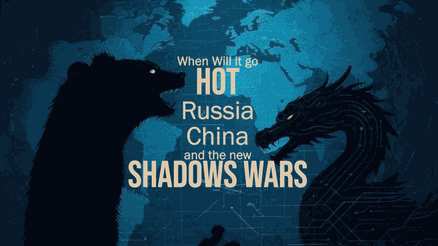
The Cold War never ended. It just changed shape.
Introduction
If you're reading this, you already sense the world is shifting. The old rules---deterrence, red lines, "peace dividends"---feel quaint in a year when Russia sabotages European infrastructure, China tightens its grip on critical minerals, and Iran and North Korea hack, smuggle, and provoke with impunity. The West isn't just at risk of a future war. We're already fighting one, just not in the ways we're used to.
So, the real question is: When will it go hot?
Russia's Shadow War: No Longer Subtle
Europe is under siege---not by tanks, but by cables cut, grids hacked, and infrastructure sabotaged. From railways in Poland to undersea lines near Scandinavia, Russia's "grey zone" warfare is deliberate and escalating. The aim? Undermine confidence, stretch Western resources, and avoid triggering NATO's Article 5.
But as I explored in The Cyber Threat from Russia: Cyberwarfare and Global Stability, what happens when sabotage causes deaths or paralyses a major city? There's a limit to strategic patience---and we're nearing it.
Recent reporting from the Associated Press and the Guardian documents dozens of Russian operations across Europe since 2022, including attacks on energy grids, water supplies, and even assassination attempts on defence executives. The front line is no longer just Ukraine---it's everywhere.
China: The Supply Chain Superpower
China isn't launching cyberattacks on Europe, it doesn't have to. Its strength lies in economic entanglement and technological dominance.
Beijing controls more than 85% of global rare earth processing, the metals that power everything from fighter jets to semiconductors. As detailed in RISC-V and China: Road to Technology Independence, China is racing toward self-reliance while the West remains dangerously dependent.
In a crisis over Taiwan or the South China Sea, China could cripple Western military production simply by closing its ports or restricting exports. This isn't theoretical: in 2024, China imposed export controls on key rare earths, and in 2025, it discovered the world's largest deposit of heavy rare earths, cementing its leverage for years to come (Reuters).
Trump's Trade Tariffs: Protectionism or Strategic Pivot?
Criticised at first as economic nationalism, Trump's tariffs now appear to some as a prescient recalibration. In his current campaign, he's pivoted even more sharply toward China, framing it as the primary existential threat to U.S. power. The underlying strategy? Russia disrupts. China could dismantle.
According to the Wall Street Journal, Trump's second-term China trade strategy would be even harsher and more focused. CNBC notes that the world is finally listening to the warning behind his tariffs.
As the U.S. pivots to counter China, Europe must assume a more significant share of the burden elsewhere.
Europe's Moment: Why the Continent Must Step Up
If America's attention shifts to the Indo-Pacific, Europe must become the frontline responder to Russian aggression. Not because it wants to, because it must.
-
Sabotage is happening on European soil.
-
Energy systems, telecoms, and transportation are under direct threat.
-
As covered in China's Cyber espionage: Undermining Western Capabilities, Russia and China exploit Western dependencies.
Europe must develop strategic autonomy, enhance infrastructure defense, and unify intelligence operations before it is forced to do so in a crisis.
The Wild Cards: Iran and North Korea
Beyond the superpowers lie two volatile regimes with global reach and nothing to lose.
North Korea: Cybercrime, arms smuggling, and missile tests. Pyongyang's threat isn't just regional, it's digital and global. In North Korea and Iran: Accomplices in Cybercrime, I explored how North Korea's hacking groups, like Lazarus, increasingly target Western finance and infrastructure. They're shipping artillery shells to Russia (MIT Technology Review).
Iran: Iran excels in hybrid warfare: drones, disinformation, and asymmetric attacks. It supplies drones to Russia, supports militias from Iraq to Lebanon, and conducts cyber operations against water systems and financial infrastructure (The Guardian; Reuters). These regimes won't hesitate to act as accelerants in a more significant conflict.
What Must the West Do, Before It's Too Late?
This isn't just about weapons. It's about readiness across the board.
1. Secure Supply Chains Rare earths, chips, and refined metals are now weapons. The West must mine, refine, and recycle domestically or through trusted allies.
2. Establish a Grey-Zone Doctrine Hybrid warfare must meet hybrid deterrence. Sabotage and cyberattacks should provoke real diplomatic, economic, or covert consequences.
3. Stockpile Critical Resources Strategic reserves of key inputs, not just oil, but lithium, cobalt, and titanium, must become part of national security doctrine.
4. Fortify Infrastructure Our adversaries view pipelines, satellites, and ports as targets. We will need to protect them accordingly.
5. Align Trade and Defence Strategy Globalisation without safeguards is a liability. Trade must now serve resilience as much as growth.
Conclusion
The Clock Is Ticking: Russia is already attacking, China is already decoupling, and Iran and North Korea are already coordinating. The next phase---the hot phase---won't arrive with ceremony. It will arrive with a flashpoint we didn't anticipate.
If the West wants to win tomorrow, it must act today---industrially, digitally, and strategically. Because when it does go hot, it'll be too late to build what we should've built in the cold.
Further Reading
What do you think? Is the West prepared for the subsequent escalation---or are we already behind? Hit reply or share your thoughts in the comments.
Tags: geopolitics, cybersecurity, national security, rare earths, hybrid warfare, Russia, China, Iran, North Korea, resilience
Original Article: Read on LinkedIn | Read on Substack