Sovereign Vision: Mastering Taste in the Synthetic AI Era
Introduction
Systemic Shifts in Digital Curation: The digital landscape is currently saturated with baseline competence. As generative models drive the marginal cost of execution to near zero, the mechanical aspects of digital product creation have become fully commoditised.
This macro-transition shifts our operational focus away from blank canvas creation toward an era defined by strict editorial curation:
- Scattershot Implementations: Organisations deploying AI generators without constraints produce a flood of coherent but structurally soulless interfaces.
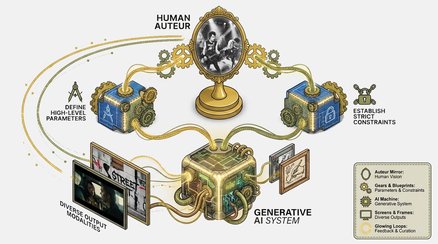
- Sovereign Vision: Competitive advantage relies entirely on the human faculty of discernment, which provides a unifying aesthetic and functional compass.
- Transcending Noise: By orchestrating specialised models through a high-fidelity feedback loop, we transcend the stochastic output of the machine, achieving a vision that matches the Auteur's intent.
- Systemic Risk: Failing to build a disciplined framework for human judgment guarantees uninspired digital ecosystems that fail to empower users.
The Human Advantage
Taste Over Mechanical Skill: Historically, professional value was intrinsically linked to the physical ability to render complex logic or visual components. Today, that mechanical skill is merely the functional baseline.
As the industry moves value from content creation to human curation, maintaining a competitive edge requires purposeful differentiation:
- Taste as a Differentiator: The visceral "Why"—driven by emotion, lived experience, and strategic intent—stands as the ultimate creative discriminator.
- Managing Abundance: The machine provides infinite output, but abundance without a Sovereign Vision inherently generates an incoherent mess.
- The Sovereign Director: Human operators must utilise deep editorial judgment to unify fragmented generative outputs into a cohesive product with a definitive point of view.
Algorithmic Homogenization
The AI "Average": From a systems-design perspective, generative models are statistically engineered to favour high-probability outputs, inevitably regressing toward the mean of their vast training data. This mathematical reality introduces severe constraints to automated workflows.
We classify this phenomenon as algorithmic homogenization, which manifests through several degenerative processes:
- The Trap of the Preset: While modern technology can amplify outliers, the cultural default is a reliance on standard presets, resulting in a "High-Quality Average" that is toxic to brands.
- Erasing Edge Cases: Vibrant stylistic nuances and innovative patterns are systematically smoothed out into generic usability.
- Model Collapse: Models trained recursively on synthetic data progressively forget minority distributions.
- The Curse of Recursion: This curse of recursion aggressively strips away architectural diversity across outputs.
Technical Sovereignty and Stylistic Fidelity
To actively resist this convergence, the Auteur must establish Technical Sovereignty—the ability to enforce a specific vision through technical protocols and architectural constraints.
We achieve this structural alignment through advanced alignment techniques:
- Direct Preference Optimisation: Techniques like DPO are used to align model behavior with the Auteur's vision.
- Enforcing Intent: Utilising Reinforcement Learning from Human Feedback (RLHF) incentivises alignment with curated constraints.
- Reference-Based Authorship: For true legal security and stylistic fidelity, the Auteur should prioritize using owned reference assets (via ControlNet or IP-Adapters) as structural guides.
- The "Frozen" Requirement: For brands and films, style must remain static. Achieving this requires rigorous Versioning of the technical stack.
Synthetic Orchestration for Sovereign Vision
When evaluating generative output pipelines, undisciplined and monolithic generation leads directly to a disjointed user experience. Overcoming this requires Synthetic Orchestration, where the Auteur acts as the director of a team of specialised AI agents.
Conclusion & Strategic Advice
The convergence of Taste and Standards indicates our competitive future relies entirely on upstream curation. By establishing Technical Sovereignty and orchestrating specialised agents, we actively prevent algorithmic homogenization.
- Exploratory Ideation: Use generalised models as a sandbox, then follow with rigorous human curation (HITL).
- Stylistic Fidelity: Prioritise owned reference assets and structural guides to ensure your output matches your vision and is legally protected.
- State Freezing: Implement strict Versioning for all models and parameters to maintain a consistent brand identity.
- Production Orchestration: Deploy multi-agent systems bound by strict JSON schema constraints and aligned to your sovereign vision.
Further Reading
- Direct Preference Optimization (DPO) Implementation
- Nature: AI models collapse when trained on recursively generated data
More From Me
Original Article: Read on LinkedIn | Read on Substack