Access as Accessibility: The Problem of Digital Exclusion
Part 1 of 4
Introduction
The technology sector puts inclusive design in specific tactical deployments: championing semantic HTML , enforcing high-contrast aesthetics, and integrating robust screen reader support. Underlying these surface-level optimisations is a foundational requirement often overlooked in modern deployment pipelines: ensuring structural accessibility.
In 2025, the digital exclusion metric extends past the physical fibre-optic cable deficits. The access divide stems directly from the misalignment between AI -heavy, compute-intensive web paradigms and the physical constraints of legacy user hardware.
Before users interact with perfectly compliant digital workflows, they require three operational baselines:
- Stable Connectivity : Reliable network access to fetch and execute core payloads.
- Capable Hardware : Devices with sufficient compute headroom to process modern client-side architectures.
- Digital Literacy : The functional knowledge required to navigate complex interface patterns.
Focusing only on interface compliance while ignoring structural network barriers renders meticulously crafted platforms inaccessible to marginalised demographics. This guide outlines the socio-economic data that define digital exclusion and provides a framework for building resilient, multi-channel service delivery.
Architecting infrastructure to scale down gracefully requires addressing the invisible barriers embedded in digital-only funnels. This technical approach guarantees equitable participation across highly volatile user environments.
Current Landscape and Statistics (as of 2025)
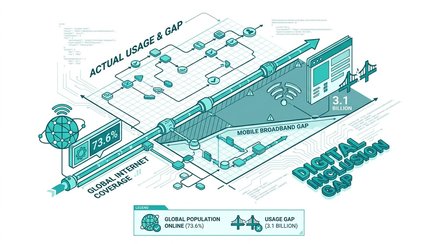
Global internet connectivity has expanded, yet two primary divides in connectivity persist. According to the ITU Facts and Figures 2024, approximately 73.6% of the global population is online, leaving 2.2 billion people entirely disconnected.
This baseline connectivity deficit correlates strictly with economic development metrics. The GSMA State of Mobile Internet Connectivity Report 2024 further identifies a secondary "usage gap" comprising 3.1 billion people:
- Coverage Proximity : Populations living within active mobile broadband coverage zones.
- Secondary Barriers : Populations remaining offline due to strict hardware affordability and digital literacy deficits.
The baseline mechanics of the infrastructure deficit are actively shifting. The rapid deployment of two core routing technologies actively transitions connectivity from a geographic limitation to a strict affordability problem:
- Satellite Infrastructure : Low-Earth Orbit (LEO) arrays, specifically Starlink and Project Kuiper.
- Distributed Routing : Modern Edge Caching deployments that push payloads closer to end-users.
Furthermore, broadband connectivity statistics rely on carrier self-reporting. This data pipeline frequently over-represents rural access speeds and geographic coverage in official databases compared to measured real-world telemetry.
Barriers for Specific Marginalised Groups
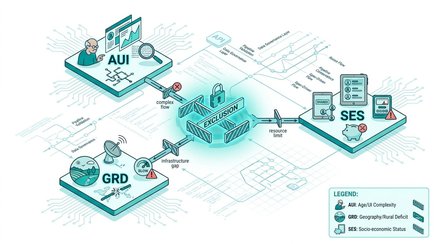
Digital exclusion is an intersectional challenge compounded by demographic factors, including age, geography, and socioeconomic status. Low-income populations rely predominantly on shared family computers, public library terminals, or legacy mobile hardware.
This reliance on shared physical infrastructure fundamentally dictates the required security posture:
- Privacy as Inclusion : Device sharing enforces privacy as a foundational metric for digital access.
- Structural Defence : Protecting shared-session state necessitates strict zero-trust architectures .
Deploying heavy JavaScript frameworks or unoptimised assets imposes a direct financial tax on users restricted to pay-as-you-go data plans. The Pew Research Centre Internet & Technology Fact Sheet quantifies this deficit in the United States, noting that only 57% of adults earning under $30,000 annually maintain home broadband access.
Rural populations confront persistent physical infrastructure deficits. A lack of high-speed connections actively degrades "digital-first" deployments into single points of failure during routine network outages.
Simultaneously, two development antipatterns create severe cognitive friction that alienates elderly demographics:
- Release Velocity : Rapid software iterations that constantly alter functional layouts.
- Interface Complexity : Over-engineered UI patterns that disrupt established user workflows.
Relying strictly on digital metrics creates closed feedback loops. This data isolation permanently masks the operational needs of offline and disconnected demographics.
Benefits of Broadening Accessibility
Moving from narrow UI compliance to structural inclusion delivers measurable operational benefits. As documented in Beyond Accessibility Compliance: Inclusive Design for Overlooked Disabilities , holistic inclusive architecture drives two primary system upgrades:
- Market Expansion : Unlocking previously unreachable global user bases.
- System Stability : Enforcing the creation of simplified, highly fault-tolerant technical systems.
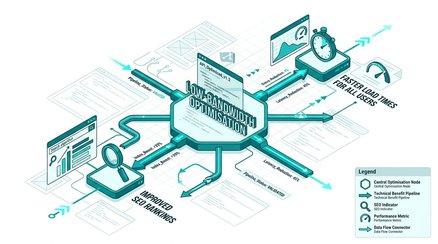
The architectural "curb-cut effect" becomes mathematically evident during performance audits. Lightweight, text-heavy fallback components engineered for low-bandwidth environments systematically load faster and index more efficiently on search engines .
Integrating across channels helps technical platforms stay ahead of evolving international regulatory frameworks. These operational advantages directly address the EU Accessibility Act: Turn Compliance into Competitive Advantage .
Best Practices and Solutions
Building a resilient strategy means using strict, multi-channel delivery models. This architectural redundancy prevents digital-first initiatives from degrading into hard digital-only roadblocks.
Securing the application tier relies on two explicit frontend methodologies:
- Execution Guarantees : Enforcing tight performance budgets and progressive enhancement to process core functionalities during script failures.
- State Management : Implementing offline-first storage patterns via Service Workers to preserve data integrity during network dropouts.
To safeguard vulnerable populations on shared hardware, we must make privacy UX a non-negotiable structural pillar. Architects must mandate two specific security protocols for public access terminals:
- State Termination : Explicit exit-and-clear interface patterns to manually flush local data.
- Authentication Lifecycles : Aggressive, short-lived session token configurations to force automatic logouts.
This strict zero-trust design actively neutralises severe session-hijacking vulnerabilities. It structurally mitigates the data privacy risks inherent in legacy public infrastructure.
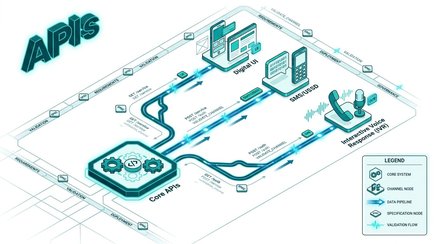
Bypassing browser-based dependencies requires integrating three low-friction communication nodes into the core system:
- Cellular Data Bypass : SMS and USSD interfaces, exemplified by Kenya's M-Pesa network, to process transactions without mobile broadband.
- Audio Fallbacks : Interactive Voice Response (IVR) integrations to establish structured, reliable fallback routing.
- Assisted Hardware : Hybrid physical deployments, modelled on India's BharatNet Project community kiosks, to provide direct access points for demographics lacking private hardware.
Transitioning to multi-channel service delivery increases operating overhead for organisations previously optimised for low-touch, digital-only interactions. This calculated architectural redundancy permanently eliminates the socio-economic tax of systemic digital exclusion.
Taking on this controlled technical debt directly finances three core business advantages:
- Cost Reductions : Aggressive minimisation of legacy manual processing and support overhead.
- Risk Mitigation : The systematic elimination of high-attrition legal and regulatory compliance risks.
- Market Capture : Direct integration with a vastly expanded Total Addressable Market (TAM) .
Conclusion & Strategic Advice
Engineering true accessibility fails when developed within an isolated vacuum of high-speed connections and flagship processing hardware. Achieving definitive inclusion requires merging performant codebases with diverse, offline-capable delivery mechanics.
Auditing system delivery against varied demographic constraints dictates design choices that mathematically expand user agency. Architects must deploy specific protocol layers to match target user scenarios:
Scenario Recommended Approach Key Technology Low-Compute/Legacy Hardware Payload compression , local compute offloading WebAssembly (WASM) , Edge Caching Low-Bandwidth Regions Offline-first, progressive enhancement Service Workers, IndexedDB Zero-Data Access Cellular text routing SMS / USSD APIs Low Digital Literacy Hybrid physical-digital delivery Interactive Kiosks, IVR.
This concludes Part 1 of the 4-part series "Access as Accessibility". To explore the functional mechanics of resilient frontends, proceed to Part 2: Designing for Low-Bandwidth Environments: Technical UX Patterns.
💬 How is your engineering team architecting for the offline and underserved? Drop your thoughts below and ♻️ share this to push the industry toward true digital inclusion!
Further Reading
- W3C Web Accessibility Initiative (WAI): Accessibility Fundamentals
- Nielsen Norman Group: Digital Divide - The 3 Stages
- World Bank: Digital Development Overview
More From Me
Original Article: Read on LinkedIn | Read on Substack