Access as Accessibility: Technical UX Patterns for Low-Bandwidth Environments
Part 2 of 4
Introduction
Building on the foundational concepts in Access as Accessibility: Part 1 , the gap between premium development environments and global network realities calls for a shift in how we engineer web interfaces. When state-of-the-art hardware and high-speed fibre govern architectural decisions, the result is a fragile ecosystem that isolates billions of potential users. Addressing this systemic flaw requires executing three distinct architectural methodologies:
- Strict Limits : Enforcing rigid page weight budgets through modern paradigms like resumability .
- Progressive Execution : Orchestrating progressive enhancement pipelines delivered via edge computing .
- Caching Protocols : Establishing robust, offline-first data storage layers.
Low bandwidth imposes hard limits on both payload size and the physical distance data must travel. Deploying Edge Workers for HTML delivery bridges the critical gap between client constraints and server capabilities.
Breaking down the frameworks needed for low-bandwidth environments gives a clear path to turn digital inclusion into measurable system resilience. We guarantee operational integrity across all environments, from office fibre networks to intermittent legacy mobile connections, by intelligently delivering JavaScript through bleeding-edge infrastructure.
1. The Default-Premium Blind Spot
Web development routinely optimises for ideal conditions, establishing a default-premium blind spot that divorces engineering from physical network realities. Addressing this barrier requires acknowledging three core socio-technical constraints:
- Global Disconnection : Over 2.2 billion people globally remain completely offline, establishing a baseline of exclusion documented in Measuring digital development: Facts and Figures .
- The Usage Gap : An estimated 3.1 billion people live within broadband coverage but cannot utilise modern internet services due to prohibitive device costs or poor connectivity, per The State of Mobile Internet Connectivity .
- Financial Penalties : High data consumption behaves as a direct financial tax for users relying on pay-as-you-go mobile plans.
Recognising network latency , physical edge-node distance, and legacy hardware as hard accessibility limits forms the non-negotiable baseline for equitable system design.
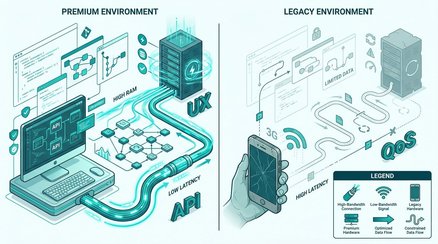
Visual Suggestion: A side-by-side comparison diagram illustrating the hardware and network latency gap between a modern developer environment (fibre, high RAM, proximity to origin server) and a legacy mobile user (3G, pay-as-you-go data, high distance from edge nodes).
2. Strict Page Weight Budgets
To survive intermittent sub-megabit connections and obsolete operating systems, engineering teams must enforce performance limits on the infrastructure. Establishing these boundaries requires executing three strict operational controls:
- Payload Budgets : Imposing a rigid 150KB initial load budget ensures core documents render cleanly on 2G and 3G networks without draining the financial quotas of vulnerable users through heavy scripts or uncompressed media.
- Pipeline Automation : Integrating automation checks, such as size limits, directly into CI/CD pipelines systematically prevents dependency bloat from reaching production environments.
- Structural Resilience : Following these strict aesthetic constraints takes priority over high-bandwidth marketing demands, ensuring maximum operational uptime.
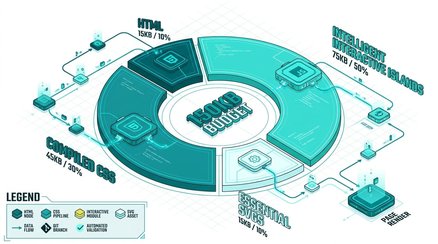
Visual Suggestion: A breakdown chart showing an optimised 150KB budget allocation across HTML, compiled CSS, intelligent interactive islands, and essential SVGs.
3. HTML-First Progressive Enhancement & Resumability
Reliance on JavaScript-heavy single-page applications introduces severe architectural fragility during network dropouts or hydration failures. Progressive enhancement provides an operational guarantee through three distinct architectural layers:
- Semantic Foundations : Prioritising semantic HTML ensures instant text rendering and native compatibility with screen readers , an approach detailed in Beyond Accessibility Compliance: Inclusive Design for Overlooked Disabilities .
- Zero-Runtime Styling : Enforcing strict byte limits dictates a presentation baseline built on compiled, zero-runtime utility CSS (such as Tailwind , UnoCSS , or Lightning CSS ).
- Targeted Interactivity : Modern infrastructures achieve payload limits through Islands Architecture (e.g., Astro ) and Resumability (e.g., Qwik ), delivering minimal interactive components exclusively on demand.
These frameworks eliminate full-page hydration. Users access critical information rapidly without abandoning modern ecosystem capabilities.
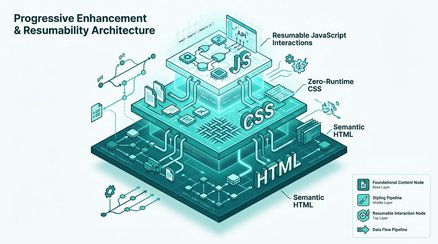
Visual Suggestion: A tiered pyramid diagram depicting Semantic HTML at the foundational base, followed by Zero-Runtime CSS, with Resumable JavaScript interactions integrated at the peak.
4. Offline-First Caching (Service Workers, IndexedDB & OPFS)
Applications operating in intermittently connected environments must natively survive spontaneous network dropouts. Establishing this offline-first data flow requires implementing two primary caching tiers:
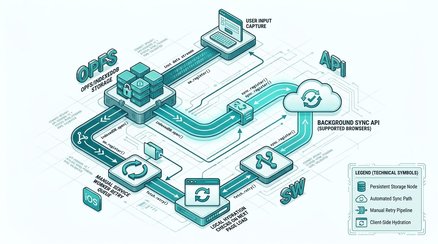
- Asset Caching : Implementing Service Workers allows the application to intercept network requests and cache essential stylesheets and core templates locally, thereby sustaining basic navigation.
- State Preservation : Safeguarding user input during connectivity failures requires local data storage using the Origin Private File System (OPFS) . This standard significantly outperforms traditional IndexedDB by delivering higher read/write speeds on legacy hardware without freezing the main thread .
Architecting this data flow requires navigating cross-browser realities, especially for the global iOS user base. Assuming browsers universally queue saved submissions via the Background Sync API introduces a fatal architectural flaw due to two specific WebKit constraints:
- Background Restrictions : Apple aggressively limits background processes to preserve battery, preventing uniform support for true Background Sync.
- Cache Eviction : WebKit automatically purges Service Worker caches after exactly 7 days of user inactivity.
Securing the data flow across these restrictive environments requires implementing a manual Service Worker retry queue. Engineers must build local application-state hydration checks that fire automatically upon the user's next-initiated page load.
5. The Digital Curb-Cut Effect
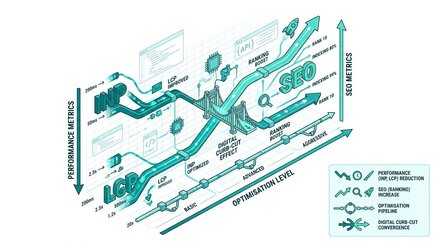
Engineering for low-bandwidth limitations triggers the "digital curb-cut effect," demonstrating that hardware constraints universally benefit premium users. Aggressive optimisation accelerates measurable Core Web Vitals through three core execution vectors:
- Asset Minimisation : Stripping non-essential bloat and designing text-first fallbacks reduces initial processing overhead.
- Edge Delivery : Caching static assets via Edge networks natively optimises Interaction to Next Paint (INP) and Largest Contentful Paint (LCP) .
- Algorithmic Dominance : Deploying a 150KB optimised page achieves an LCP in fractions of a second for fibre-optic users, elevating search engine optimisation (SEO) rankings.
This structural approach aligns directly with the strategic frameworks detailed in the EU Accessibility Act: Turn Compliance into Competitive Advantage . Minimising architectural bloat and cognitive load guarantees superior usability across all internet demographics.
Conclusion & Strategic Advice
Combining strict data budgets, resumable progressive enhancement, and robust offline-first caching creates a strong web foundation. Project requirements prioritising rapid time-to-market often default to heavy frameworks, but global scalability requires non-negotiable lightweight architectures.
Deploying these architectures requires following a strict execution matrix based on project scope:
- High-Media Marketing Sites : Implement aggressive edge-caching, lazy-loading , and enforce a strict 300KB initial budget ceiling using zero-runtime CSS.
- Critical Service Applications : Mandate a 150KB initial budget, resumable architecture, and offline-first Service Workers utilising OPFS with cross-platform fallback retry queues.
These technical UX patterns guarantee robust interfaces that serve the widest possible demographic. To ensure long-term architectural resilience, technical teams must enforce three procedural standards:
- Metric Standardisation : Standardise performance baselines across all development environments.
- Pipeline Audits : Audit all CI/CD pipelines to block unoptimised dependency injections.
- Constraint-Driven Design : Treat network capacity and physical edge-node distance as fundamental architectural constraints.
To explore the mechanics of extending application inclusion beyond traditional web interfaces, review the next instalment: Access as Accessibility: Part 3 - Beyond the Smartphone: The Power of SMS and Interactive Kiosks.
💬 Are your engineering teams optimising for the global reality, or just the ideal developer environment? Share your insights below and ♻️ share this post to champion digital inclusion!
Further Reading
- Using IndexedDB (MDN Web Docs)
- Learn Progressive Web Apps: Service Workers (Web.dev)
- Progressive Enhancement in the Modern Web (Smashing Magazine)
More From Me
Original Article: Read on LinkedIn | Read on Substack