Generative Engine Optimisation: The Death of the Click-Through Estate
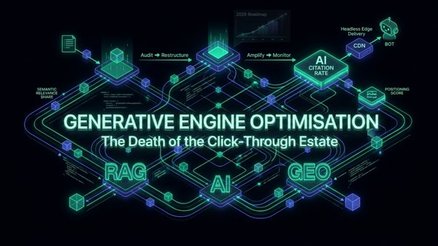
Part 1 of 3 - The Death of the Click-Through Estate
Introduction: The Death of the Click-Through Estate
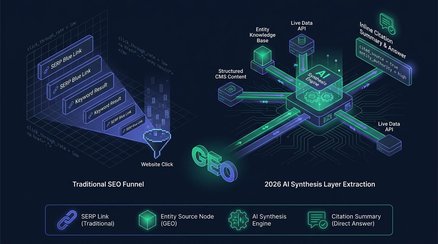
The digital discovery ecosystem has been structurally fractured. Legacy search indexes are rapidly losing ground to conversational synthesis layers such as ChatGPT , Perplexity , Gemini , and Claude .
This "zero-click" approach intercepts regular search queries and provides answers directly within chat interfaces, effectively replacing the usual organic click-through process. The traditional goal of guiding users through a series of blue links becomes unnecessary when authoritative data is compiled and displayed before any user clicks.
This shift demands an immediate pivot toward Generative Engine Optimisation (GEO) . This framework weaponises foundational technical SEO for AI retrieval layers, executing strictly via three technical pillars that survive the transition to LLM Retrieval-Augmented Generation (RAG) pipelines:
- Server-Side Architecture : server-side rendering (SSR) pushes fully compiled markup to the agent, eliminating execution delays.
- Data Structuring : Rigorous schema markup provides deterministic mappings of entities and properties.
- Code Purity : semantic HTML removes visual bloat and defines explicit document hierarchies for parsing algorithms.
The primary success metric shifts from organic ranking positions to the AI Citation Rate - a direct measurement of a digital asset's verified inclusion within an LLMs generative summary. Organisations evaluating enterprise frameworks, such as the Optimizely DXP, must adapt their content delivery models to operate within this citation economy.
1. Decoding the GEO Paradigm Shift
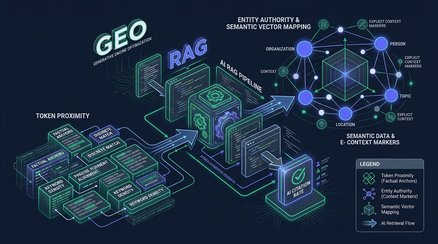
Modern AI retrieval processes operate through hybrid search methodologies. Achieving a high AI Citation Rate requires optimising two specific retrieval mechanisms:
- Token Proximity : Retaining legacy keyword targeting anchors discrete factual blocks.
- Entity Relationships : Applying vector-based semantic mapping defines explicit context markers (who, what, where).
This combined architecture forces RAG pipelines to pull the most factually dense and structurally verifiable nodes directly into context ( Structural Feature Engineering for Generative Engine Optimization: How Content Structure Shapes Citation Behavior) . Maintaining robust entity hierarchies across structured external directories establishes factual authority and provides LLMs with the necessary cross-referencing nodes.
2. The Architectural Mandate for Modern CMS
This paradigm shift forces enterprise content management systems (CMS) to migrate from layout-centric models to strict, data-first architectures. Legacy platforms generate heavily nested Document Object Model (DOM) trees coupled with visually bloated markup, causing severe parsing friction for AI web crawlers.
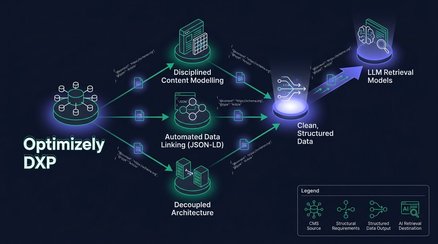
Modern solutions, such as the Optimizely DXP, resolve these bottlenecks through three structural requirements:
- Disciplined Content Modelling : Enforcing strict schema hierarchies replaces unstructured page building.
- Automated Data Linking : Outputting JSON-LD ensures programmatic entity validation.
- Decoupled Architecture : Separating the presentation layer from the data payload removes visual processing overhead.
Stripping this visual bloat and explicitly decoupling data from design establishes a reliable knowledge engine. This structure feeds external language models instantly, bypassing standard processing delays.
3. Benchmarking Enterprise Ingestion & Real-Time Indexing
The behaviour of modern LLM ingestion pipelines dictates strict technical requirements. AI user-agents frequently throttle or entirely bypass heavy, client-side JavaScript applications to conserve compute resources.
Benchmarking shows that scaled enterprise headless deployments demonstrate remarkably higher AI retrieval efficiency. A decoupled Optimizely DXP can use static site generation (SSG) via a modern frontend framework, ensuring immediate programmatic access for web-scale agents without client-side latency.
Structural SSR architecture only solves the initial parsing phase. Resolving dynamic ingestion relies on temporal freshness, which is achieved through two core implementation standards:
- Protocol Push Mechanisms : Integrating standards such as IndexNow forces rapid updates across participating search indices.
- Direct API Ingestion : Utilising the ingestion endpoints provided by major LLMs pushes updated semantic nodes directly into their active datasets.
Combining static rendering with real-time API pinging establishes the strict baseline for dynamic citation trust.
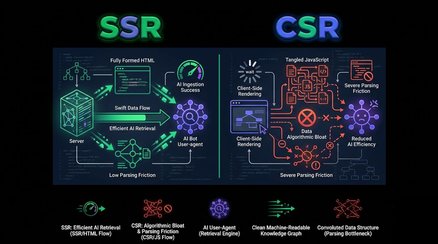
Switching to GEO is a key step in building a strong foundation. To ensure long-term clarity, we need to standardise data delivery so external synthesis engines can easily extract, evaluate, and cite knowledge smoothly and accurately.
Choosing the correct implementation path involves evaluating two primary rendering methodologies:
- Headless SSR Pipelines : Mandating full server-side rendering and precise JSON-LD configurations coupled with real-time indexing APIs establishes permanent architectural stability.
- Dynamic Rendering Fallbacks : Platforms running heavy client-rendered frameworks can implement dynamic rendering to serve pre-rendered static HTML exclusively to AI bot user-agents as a temporary patch.
Technical Architects must evaluate the severe technical debt inherent in dual rendering pipelines (CSR for users, SSR for bots). If these dual states lack perfect parity, organisations risk catastrophic algorithmic penalties, triggering cloaking false-positives that strip domains from both traditional and generative indices.
Executing this strategy requires operational awareness of two critical caveats:
- Metrics Fragmentation : Real-time tracking of the AI Citation Rate remains immature and isolated within closed AI loops.
- Crawler Volatility : AI ingestion protocols and user-agent standards evolve continually, requiring adaptable infrastructure.
Prioritising semantically pure, server-side architectures with direct indexing APIs builds the strongest foundation for the AI-mediated web.
The next phase, GEO for Optimizely Part 2, details practical implementation across structured schemas, code-level delivery, and static architectures.
💬 How is your organization addressing the decline in organic click-through rates? Are you updating your CMS content models for better machine readability, or are you still focusing on traditional keywords? Share your insights below and ♻️ share this post with your network to drive the conversation on true accessibility!
Further Reading
- GEO: Generative Engine Optimization (arXiv: Princeton University et al.)
- Dynamic Rendering on the Web (Google Search Central)
- What is Retrieval-Augmented Generation (RAG)? (IBM Research)
More From Me
Original Article: Read on LinkedIn | Read on Substack