Upgrading Optimizely: CMS 11 to 13 Stepwise Guide
Introduction
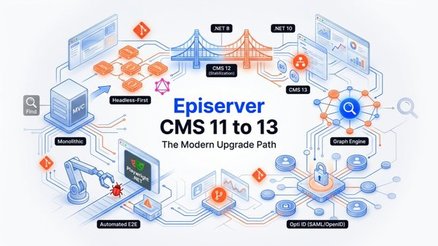
The legacy EPiServer 11 environment compiles today, but it operates on borrowed time. However, transitioning from the legacy .NET Framework 4.7.2+ to .NET 8+ and Optimizely CMS 13 requires a fundamental architectural re-platforming. This article outlines a strategy to modernise ageing systems without compromising core stability.
Navigating this upgrade path requires executing four distinct architectural shifts:
- Design Paradigm : Adopting the new headless-first architecture.
- Search Infrastructure : Shifting from legacy Find to the edge-cached Optimizely Graph .
- Access Management : Centralising system administration via Opti ID .
- Deployment Validation : Guaranteeing rendering parity through automated Playwright regression testing .
Separating the .NET runtime migration risk from content feature modernisation turns legacy constraints into a highly scalable architecture with minimal operational friction.
Prerequisites & Caveats
Direct migrations from version 11 to 13 pose a significant risk to highly customised enterprise implementations due to cumulative API deprecations. Mitigating this risk requires strict adherence to three prerequisite conditions:
- Environment Tooling : Establishing Visual Studio 2022 and the .NET 8 SDK as non-negotiable baseline requirements.
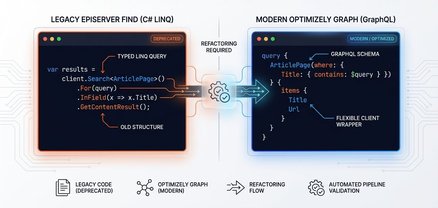
- Query Refactoring : Converting legacy C# LINQ operations into exact GraphQL parameters for Optimizely Graph .
- Schema Validation : Mapping and verifying data schemas before deployment to eliminate frontend rendering failures.
1. Architectural Reality: Headless-First by Default
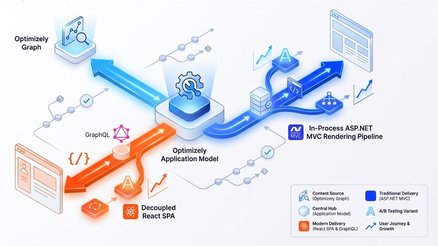
Optimizely CMS 13 enforces a headless-first posture by mandating that core interface features, including the Visual Builder and Content Manager, utilise Optimizely Graph for content discovery and routing. The platform preserves architectural flexibility by replacing the legacy SiteDefinition with an adaptable Application Model.
This Application Model handles content routing across two distinct delivery mechanisms:
- Decoupled Architecture : Executing strict headless delivery to frontends like Next.js and React via GraphQL .
- In-Process Rendering : Maintaining native support for ASP.NET MVC rendering pipelines.
- Legacy Preservation : Utilising native Visual Builder tag helpers (epi-grid, epi-column) to retain complex server-side builds natively within .NET 8 without forcing an immediate frontend rewrite.
2. The Stepwise Migration Path (11 → 12 → 13)
Attempting to merge runtime changes with CMS API deprecation handling in a single jump dramatically increases deployment failure rates. Isolating these breaking changes requires a strict stepwise sequence:
- Configuration Modernisation : Utilising the .NET Upgrade Assistant Overview and the Optimizely Upgrade Assistant Guide to map outdated web.config variables to modern appsettings.json files.
- Dependency Alignment : Managing manual NuGet package updates for the 12-to-13 transition, bypassing automated tooling limitations.
- Namespace Sanitisation : Eliminating hyphens and non- ASCII characters from content type names and shifting removed namespaces (e.g., DAM moving from EPiServer to Optimizely) at the CMS 12 baseline.
- Database Checkpointing : Establishing mandatory gated database backups governed by the System Requirements for Optimizely before targeting the application to .NET 8 and CMS 13.
<img width="438" height="225" src="https://potnoddle.github.io/images/upgrading-optimizely-cms-11-to-13-stepwise-guide-3.jpg" alt="A phased timeline diagram illustrating the "11 → 12 → 13" stepwise migration, highlighting the gated database checkpoint and automated tooling injections at each phase." style="display: block; margin: 20px auto; max-width: 100%; border-radius: 8px; height: auto;" />
3. Decommissioning Legacy Search: Migrating Find to Optimizely Graph
The legacy Search & Navigation (Find) engine is permanently deprecated and replaced by an edge-cached GraphQL service. Executing this migration demands a backend-first operational sequence focusing on three core integration components:
- Index Replication : Operating the new Optimizely.Graph.Cms.Query fluent C# SDK to replicate database indexes and adjust algorithms to cursor-based pagination .
- Payload Extraction : Invoking the .ToGraphQL() helper method to extract C# fluent queries into raw GraphQL strings for decoupled architectures.
- Frontend Integration : Passing extracted payload strings directly into React components to eliminate manual query parameter reconstruction.
Comprehensive indexing synchronisation schemas are mapped in the Introduction to Optimizely Graph .
4. Identity Modernisation: Centralising with Opti ID
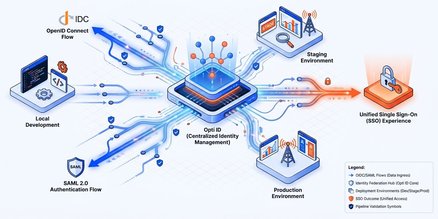
Fragmented ASP.NET Identity providers are obsolete, and has been superseded by the unified Opti ID standard. This federated authentication layer enforces enterprise governance by mandating Multi-Factor Authentication (MFA) and SCIM provisioning.
Configuring this layer requires two procedural modifications:
- Package Integration : Installing the EPiServer.Identity.OptiId NuGet package and registering its middleware within the application pipeline.
- SSO Implementation : Establishing a Single Sign-On (SSO) fabric connecting local environments and DXP deployment slots via OpenID Connect and SAML 2.0 standards.
Implementation specifics are documented in the Get started with Opti ID guide.
5. Automated Verification: Playwright for Post-Upgrade Regression
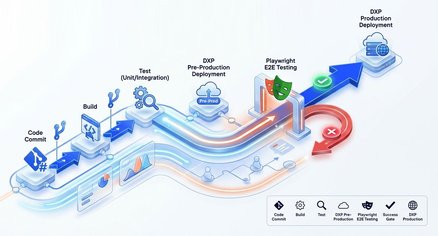
Fundamental database schema and framework upgrades dramatically amplify the risk of silent visual failures. Integrating Playwright .NET mitigates this exposure by executing automated end-to-end (E2E) browser verifications, as outlined in the Playwright .NET Intro .
Securing the continuous delivery pipeline relies on three testing paradigms:
- Pre-Production Validation : Executing test scripts against DXP slots to validate federated Opti ID logins, Visual Builder layout interactions, and Graph response data.
- Network Interception : Mandating the interception and mocking of GraphQL responses from Optimizely Graph within Playwright to combat E2E brittleness.
- Layer Isolation : Separating the headless data layer to guarantee UI rendering failures remain distinctly isolated from network latency or edge-caching delays.
Embedding these regression checks directly inside the pipeline reduces manual QA cycles to near zero.
Conclusion & Strategic Advice
Transitioning to Optimizely CMS 13 bridges the high-performance edge delivery of Optimizely Graph with the strict administrative security of Opti ID .
Executing this shift dictates choosing between two primary strategic paths:
- In-Place Stepwise Sequence (11→12→13) : Operating this path preserves sprawling legacy monoliths where rebuilding heavy business logic introduces unmanageable capital costs.
- Greenfield Pivot : Executing a direct shift to decoupled, headless SPA frontends on CMS 13 to fully shed technical debt .
Isolating runtime stabilisation from frontend feature enhancement prevents critical downtime. Capitalising on the headless-first composability of the modernised platform demands two immediate actions:
- Implementation Research : Consulting the next implementation guide: Architecting the Visual Builder: Blueprints in Optimizely CMS 13 .
- Migration Initialisation : Auditing prerequisite .NET 8 SDK dependencies and initialising a gated database checkpoint to execute the transition safely.
💬 Will you preserve your monolith via a stepwise migration, or make the greenfield pivot to a headless SPA? Share your strategy in the comments below and ♻️ share this blueprint with your architecture team!
Further Reading
- .NET Upgrade Assistant Overview (Microsoft Learn)
- System Requirements for Optimizely CMS
- Playwright .NET Documentation
More From Me
- Mastering Optimizely's Headless CMS: Unlocking Optimizely with Frontend Frameworks
- Beyond Technical Debt: Overcoming The Burden of Legacy Systems
- Website Overhaul: When a Rebuild Is Better Than a Refresh
- Future-Proofing Optimizely: Unlocking Optimizely with Frontend Frameworks
Original Article: Read on LinkedIn | Read on Substack