Introduction
Visual composition platforms accelerate digital delivery but frequently generate nested
and
tags—an anti-pattern known as "div-soup." This lack of structural integrity hurts technical SEO signals and impedes effective navigation for assistive technology .</p>
Implementing strict markup standards natively within the Optimizely Visual Builder requires enforcing semantically correct HTML structure across three distinct environments:
Monolithic Systems : Direct configuration within ASP.NET Core / Razor rendering layers. Decoupled Architectures : Programmatic integration with Headless SaaS and GraphQL endpoints. Frontend Frameworks : Mapping resolution for single-page applications leveraging Next.js or Nuxt .
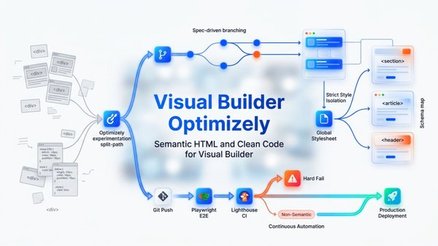
This technical blueprint outlines three core methodologies to intercept non-semantic code before production deployment:
Programmatic Data Mapping : Forcing semantic HTML wrappers at the rendering layer. Inline Style Isolation : Restricting dynamic styling inputs to preserve hierarchical intent. CI/CD Deployment Gates : Embedding accessibility audits natively into the build pipeline.
Executing these technical configurations guarantees the Document Object Model (DOM) systematically meets WCAG 2.2 criteria without sacrificing standard editorial velocity.
1. The Semantic Code Challenge in Visual Builders
Visual builders default to generic container outputs, which prevents search engine crawlers from correctly indexing the page architecture. This flat output breaks screen reader navigation by not natively exposing primary content regions to assistive technologies .
To resolve this structural limitation, developers must force layout parameters to map sequentially against the Optimizely five-tier content hierarchy:
Root Container : Correlates to the global Experience object. Structural Division : Defines the specific or Section.</li>
Grid Wrapper : Outputs the inner Row layout structure. Layout Block : Enforces standard Column distribution constraints. Component Level : Renders the individual UI Element.Applying landmark tags precisely at the Section tier ensures that visual design bands are correctly rendered as parsed structural data points.
2. Four Core Strategies for Semantically Clean Layouts
Achieving a clean DOM hierarchy requires developers to offload accessibility compliance from content editors onto programmatic pipeline constraints. Engineers must implement four exact configuration strategies to secure system formatting:
Semantic Element Mapping : Enforce HTML wrappers directly at the rendering layer. Monolithic systems embed these in SectionData display templates, while SaaS environments utilise the ICompositionMapper pipeline to restructure visual builder JSON payloads before they hydrate the frontend. Style and Script Isolation : Prohibit inline styles and scripts within dynamic block schemas. Implement native DisplaySettings and the </em> tag helper to force layouts to rely entirely on a controlled utility-class palette.</li>
Strict Native HTML5 Over ARIA : Enforce the First Rule of ARIA by defaulting entirely to native HTML elements. Restrict the application of explicit ARIA roles to highly interactive blueprints, preventing the anti-pattern of using ARIA to overwrite generic layouts. Web Component Shadow DOM Resolution : Encapsulated shadow DOM structures in custom Web Components disrupt global assistive tech navigation. Resolve cross-root ARIA traversal by programmatically wiring the ElementInternals API to the Light DOM accessibility tree.
3. The Migration Dilemma: When to Convert Legacy Models
Mandating a wholesale conversion of legacy PageData or BlockData components into generalised Visual Builder models during a platform upgrade will inevitably lead to unchecked DOM bloat. Engineering teams must isolate structural risk by executing a phased component migration protocol:
Safe Harbour Isolation : Maintain highly structured utility models, such as transactional forms or directories, strictly in their legacy states. The retirement of On-Page Edit (OPE) in CMS 13 defaults these legacy inputs to standard form-based editing, automatically protecting their specific markup from canvas-induced contamination. Modular Band Migration : Prioritise highly modular layout components for immediate translation to the visual canvas parameters. Class Refactoring : Refactor the underlying C# classes to inherit from the standard SectionData wrappers securely. This secures the new semantic mapping configurations while deliberately clearing out legacy inline scripts.
4. DevOps Integration: Continuous Accessibility Testing
Programmatic verification gates are the final line of defence against layout regressions in continuous DevOps workflows . Technical operations must deploy three specific validation tiers to lock down the code base:
Static Program Analysis (Pre-Render Gates) : Deploy early AST (Abstract Syntax Tree) parsers and specialised ESLint linting rules (using eslint-plugin-jsx-a11y or Razor static tools) to block structural semantic violations at the commit source categorically. Lighthouse Integration (Post-Render Benchmarks) : Execute Google's Lighthouse engine programmatically as a native Node module to benchmark baseline document health across all layouts, targeting strict 95+ scores. Deque axe CI/CD Gates (E2E Integration) : Embed the axe accessibility engine via axe-playwright into deployment cycles to flag and reject hierarchy violations before they hit staging servers.
Automated testing with axe-core successfully flags an average of 57% of WCAG criteria failures. Continuous integration pipelines will intercept malformed node hierarchies, but manual screen reader verification remains the sole mechanism for fully validating interactive compliance.
Conclusion & Strategic Advice
When you combine structural integrity with flexible content composition, a standard visual builder becomes a reliable operational asset. Engineers must lock in this technical foundation by enforcing three critical standardisation rules:
Pipeline Constraint Mapping : Execute absolute structural wrappers through integration hooks such as ICompositionMapper . Styling Centralisation : Standardise cross-system layouts by centralising inline configuration tokens. CI/CD Enforcements : Deny non-compliant markup at the pipeline tier through robust AST and deployment gates.
When planning phased migration rollouts, prioritise standard layout components for conversion and maintain strict isolation protocols for highly rigid legacy utility models.
Advancing these patterns requires deep engineering to achieve fully keyboard-navigable interaction states. Engineers can refine custom widget parameters in the follow-up guide, ARIA Best Practices for Custom Optimizely Components. Teams, please run static analyses across all current generic templates immediately to block cascading structural regressions across current environments.
When you combine structural integrity with flexible content composition, a standard visual builder becomes a reliable operational asset. 💬 How does your engineering team handle accessibility compliance in visual builders? Share your insights below and ♻️ share this post with your network!
Further Reading
More From Me
</div>
Original Article: Read on LinkedIn | Read on Substack
#Optimizely #SemanticHTML #TechnicalSEO #WebAccessibility #CleanCode