Sovereign Wall: Navigating the Global Era of Localised AI

Introduction
Regional regulations fracture global data networks, making centralised public cloud APIs a structural compliance liability. Routing sensitive workloads across borders introduces compounding legal risks, massive auditing overhead, and severe penalties as residency laws tighten.
This document evaluates the economic costs of international data transit and outlines three architectural paths for mitigating these risks:
- Infrastructure Replacement : Replace global network dependencies with enterprise on-premise clusters and private cloud orchestration to build compliance-first AI environments.
- Risk Mitigation : Bypass network friction entirely by assessing data residency exposure and transitioning workloads to hardware-enforced regulatory shields.
- Architectural Trade-off : Localised compute guarantees compliance and protects intellectual property, shifting the CapEx burden entirely to the enterprise while eliminating elastic scalability.
1. The Compliance Wall: Regulatory Friction in the Cloud
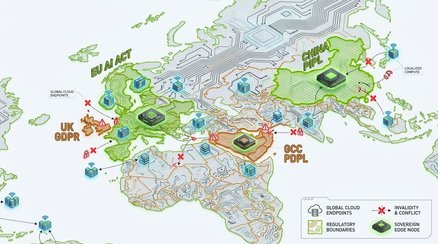
The international regulatory landscape enforces physical borders on digital infrastructure. Relying on centralised cloud endpoints across these jurisdictions renders global APIs legally invalid.
Global compliance mandates impose distinct operational constraints across four major regions:
- European Union Penalties : The EU AI Act enforces exacting transparency and classification standards, carrying penalties of up to 7% of global turnover Regulation (EU) 2024/1689 (Artificial Intelligence Act) .
- UK Data Safeguards : The UK GDPR applies strict personal data controls on cross-border transfers: Model Driven Engineering for Data Protection and Privacy: Application and Experience with GDPR .
- Chinese Storage Mandates : China's Data Security Law (DSL) and Personal Information Protection Law (PIPL) compel local storage for critical operators, demanding exhaustive export assessments.
- Emerging Market Autonomy : India's DPDPA and GCC frameworks dictate local processing to guarantee absolute data autonomy: Sovereign AI: Rethinking Autonomy in the Age of Global Interdependence .
2. The Economics of Data Residency Mandates
Data residency laws fundamentally alter the economics of infrastructure. Accelerated data localisation mandates across more than 40 countries compound the burden of compliance auditing: The Impact of the Russia-Ukraine Conflict on the Cloud Computing Risk Landscape .
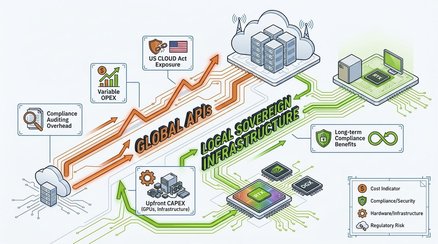
Validating data flows for global API providers functions as a recurring legal tax. Physical residency does not guarantee legal sovereignty.
Transitioning workloads requires evaluating three competing financial and operational models:
- Jurisdictional Conflicts : The US CLOUD Act forces US-based hyperscalers to surrender data globally, instantly violating European and UK protections.
- Compute Throttling : Restricting deployments to narrow regional zones throttles GPU access and introduces dynamic capacity pricing premiums.
- Financial Reallocation : Enterprises must contrast the variable OPEX of offshore API endpoints against the multi-million dollar upfront CAPEX required to procure local GPUs and establish private sovereign infrastructure.
3. Enterprise On-Premise and Sovereign Edge Architecture
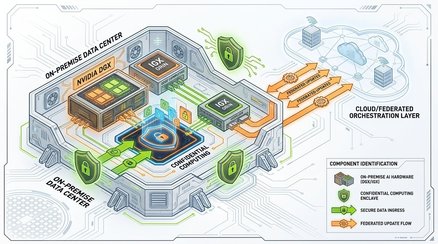
From a systems-design perspective, enterprises bypass network compliance friction by shifting to localised on-premise data centres and hybrid racks. Treating data privacy as a strict architectural parameter satisfies core data privacy frameworks: Sovereign-by-Design A Reference Architecture for AI and Blockchain-Enabled Systems .
This physical isolation strategy operates across three deployment tiers:
- Private Orchestration : Deploying AWS Outposts or Google Distributed Cloud provides a primary regulatory shield for enterprise workflows.
- Production Clusters : Running NVIDIA DGX systems guarantees high-throughput inference while preventing sensitive data from transiting external networks.
- Industrial Edge Compute : Utilising IGX Orin ensures model weights and prompts stay on physically controlled hardware, converting complex cloud audits into direct on-premise log checks.
Physical isolation drastically bottlenecks concurrency and inference throughput. Managing a decentralised fleet of disconnected nodes creates severe Total Cost of Ownership (TCO) logistics.
When data remains locked on-device, operations teams face three specific maintenance barriers:
- Performance Degradation : Disconnected environments prevent teams from monitoring model drift against live production metrics.
- Vulnerability Management : Hardware isolation blocks the automated deployment of critical security patches.
- Lifecycle Bottlenecks : Engineering teams cannot orchestrate continuous, automated weight updates across the fleet.
Federated Orchestration resolves these operational limits. Enterprises protect data in use to maintain absolute compliance while operating the telemetry pipelines required for fleet management.
This federated model relies on three exact technical integrations:
- Distributed Training : Implementing federated learning distributes model updates without exposing raw local datasets.
- Cryptographic Validation : Applying secure multi-party computation (SMPC) enables secure, cross-node analytic functions.
- Hardware-Level Isolation : Activating NVIDIA H100 Confidential Computing features processes encrypted payloads directly inside secure enclaves.
4. The Rise of Regional Sovereign Clouds
Where local compute lacks scale, regional sovereign clouds provide isolated hosting for compliant workloads. These federated infrastructures protect against foreign jurisdiction and provide the backbone for scaling operations.
Three primary geographic initiatives define the current sovereign cloud market:
- European Federation : GAIA-X operates as the technical blueprint for secure, interoperable regional clouds across the continent.
- Indian Infrastructure Scaling : The IndiaAI Mission funds the deployment of 10,000+ GPUs to process and host models safely within domestic borders.
- Middle Eastern Localisation : Saudi Arabia and the UAE fund dedicated sovereign data hubs to force secure processing under local administrative control
Sovereign AI: Rethinking Autonomy in the Age of Global Interdependence .
Conclusion & Strategic Advice
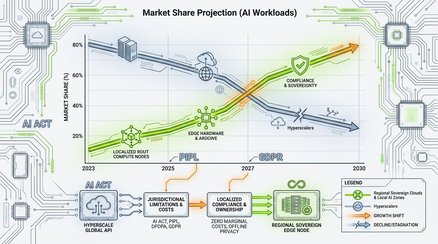
Combining private enterprise orchestration with regional sovereign clouds outputs a robust, compliance-first architecture.
Engineering teams determine deployment environments using three primary architectural matrices:
- High Data Sensitivity / Low Latency : Deploy isolated industrial edge hardware (e.g., IGX Orin) to insulate workloads and terminate network audit requirements.
- High Compute Scale / Strict Jurisdiction : Use regional sovereign clouds to scale training operations, ensure local data autonomy, and avoid hyperscaler jurisdictional risks.
- High Compute Scale / Extreme Data Sensitivity : Deploy on-premise enterprise clusters (e.g., DGX SuperPODs ) executing Confidential Computing to maintain physical data control while driving production-level throughput and federated model updates.
Conflicts & Caveats: Localised compute resolves data transfer compliance by eliminating the elasticity of the public cloud. This infrastructure shift forces the operational security burden, the fleet management of decentralised nodes, and massive upfront capital investments entirely onto internal engineering teams.
As regulatory pressures intensify, engineering for sovereignty functions as a strict survival mechanism. In the next part of this series, we detail distributed compliance mechanics in The GAIA-X and UK Sovereign Compute Standard.
💬 How is your organisation managing the compliance risks of using third-party global APIs? Are you actively shifting sensitive workloads to enterprise on-premise clusters or regional clouds? Share your strategies below and ♻️ share this post with your network!
Further Reading
- Towards Assuring EU AI Act Compliance and Adversarial Robustness of LLMs
- Operationalising AI Regulatory Sandboxes under the EU AI Act
- Complying with the EU AI Act
More From Me
Original Article: Read on LinkedIn | Read on Substack