Edge vs Origin: Maintenance Responses and 304 Caching
Introduction
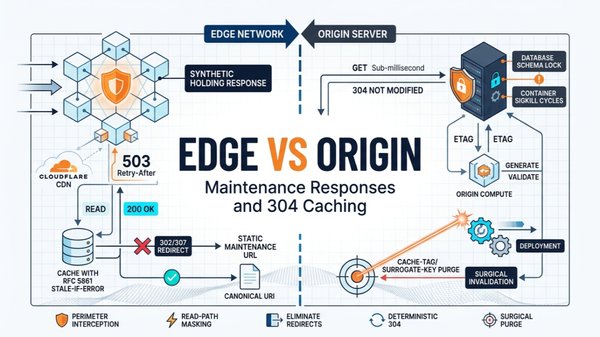
Executing zero-downtime releases reveals an architectural fault line between edge routing logic and origin computation. When deployment runbooks conflate routing control with application middleware, maintenance outages cascade into catastrophic failure loops.
Conflating these boundaries triggers two cascading failure modes:
- Socket Termination Failures : Origin servers terminate socket listeners during reboots, dropping inbound connections with connection resets (ECONNRESET) while web crawlers de-index redirected holding pages.
- Stale Validation Loops : Delegating validation solely to edge caching without deployment-triggered invalidation locks returning clients into stale 304 Not Modified confirmation cycles.
Decoupling availability from state computation resolves this operational friction through strict boundary enforcement.
Maintaining operational coherence requires three architectural pillars:
- Edge Interception : Edge runtimes intercept traffic and serve RFC-compliant maintenance states governed by dynamic configuration.
- Origin Authority : Upstream origin servers retain absolute authority over entity tags (ETag) and dynamic state computation.
- Automated Invalidation : Continuous deployment pipelines orchestrate surgical cache purges post-release.
By dissecting protocol semantics and edge interception, this guide establishes an implementation blueprint to preserve crawl equity during infrastructure updates, guarantee deterministic conditional revalidation, and automate cache coherence across globally distributed points of presence.
The Architectural Dilemma: Edge Routing vs Origin Computation
Hosting maintenance pages inside application middleware binds holding availability to origin process survival. Inbound traffic terminates with connection resets or gateway timeouts whenever application processes recycle.
Upstream process terminations trigger transport failures across three routine operational events:
- Database Schema Migrations : Long-running table migrations lock records and saturate database connection pools, causing worker thread exhaustion.
- Framework Upgrades : Runtime engine restarts drop existing listener bindings before replacement processes bind to target ports.
- Container Restarts : SIGTERM and SIGKILL termination sequences terminate active TCP socket listeners mid-flight.
Isolating availability at the network perimeter via the Cloudflare Workers Documentation intercepts requests before upstream connections initiate. Configured through cloudflare-worker/wrangler.toml and executed via cloudflare-worker/worker.js, distributed edge runtimes evaluate request headers across global points of presence.
Edge architectures decouple outage containment from deployment pipelines via two runtime mechanisms:
- Dynamic State Evaluation : Edge runtimes asynchronously read dynamic maintenance flags from globally distributed Key-Value ( Edge KV ) or Edge Config stores rather than relying on static worker script redeployments.
- Synthetic Holding Responses : Edge nodes return instant synthetic holding responses regardless of origin socket availability, isolating outage containment from CI/CD deployment delays.
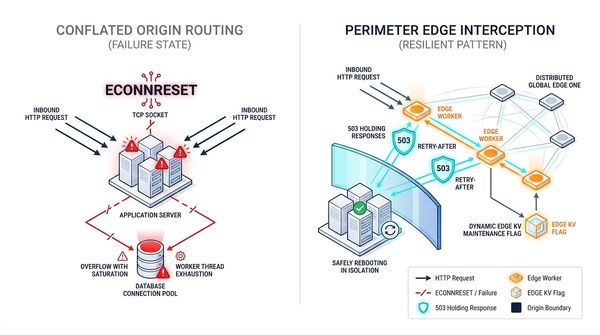
Visual Suggestion : Architecture block diagram contrasting dynamically configured edge-intercepted routing against origin middleware failure.
Maintenance Protocols & Resilience: RFC 5861, 503 Service Unavailable, and Redirect Anti-Patterns
Planned maintenance demands semantic protocol precision. Under RFC 9110 §15.6.4 , a 503 Service Unavailable status code signals temporary downtime without altering resource URI mapping.
Search engine crawlers evaluate temporary downtime using two primary header semantics:
- Crawler Traversal Throttling : Paired with a decimal-second or IMF-fixdate Retry-After header field ( RFC 9110 §10.2.3 ), automated crawlers pause indexing traversal and schedule non-destructive retries, as documented by Google Search Central Documentation .
- URI Canonical Preservation : Retaining the requested URI prevents indexing engines from dropping canonical endpoints from the search index during planned origin maintenance.
Returning a 503 status code remains a last resort within a resilient edge network topology. Modern caching semantics governed by RFC 5861 dictate that the edge evaluate cached assets before rejecting traffic.
Edge proxies mitigate origin maintenance by enforcing two RFC 5861 caching mechanisms:
- Read-Path Masking via stale-if-error: During an origin maintenance window, edge nodes serve stale 200 OK responses for cached, read-heavy assets, masking origin downtime from end-users.
- Targeted Synthetic 503 Interception : Synthetic 503 responses are surgically reserved for state mutations (POST, PUT, DELETE) and expired or uncached GET requests.
Redirecting maintenance traffic to /maintenance.html via 302 Found ( RFC 9110 §15.4.3 ) or 307 Temporary Redirect ( RFC 9110 §15.4.8 ) misrepresents resource canonicalisation and risks search equity degradation.
Redirect topologies introduce two major protocol anti-patterns:
- Method Distortion via 303 See Other: Misusing 303 See Other ( RFC 9110 §15.4.4 ) violates protocol semantics by forcing clients to issue GET requests following POST submissions.
- Browser Polling Divergence : Standard consumer web browsers ignore Retry-After intervals; client-side polling or <meta http-equiv="refresh"> tags must accompany the holding markup for uncached requests receiving a 503 to guide interactive users.
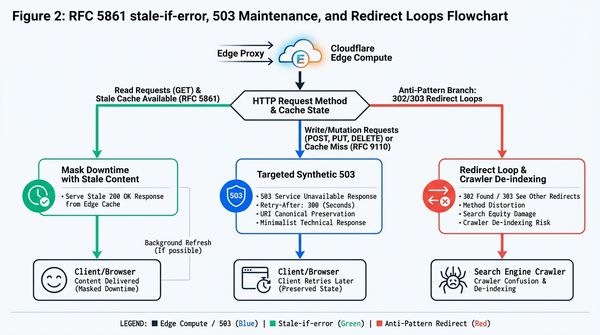
Visual Suggestion : Flowchart comparing RFC 5861 stale-if-error serving, 503 maintenance response handling with Retry-After syntax, and 302/303 redirect loops.
Cache Freshness and Validation: Origin ETag Generation and Edge 304 Responses
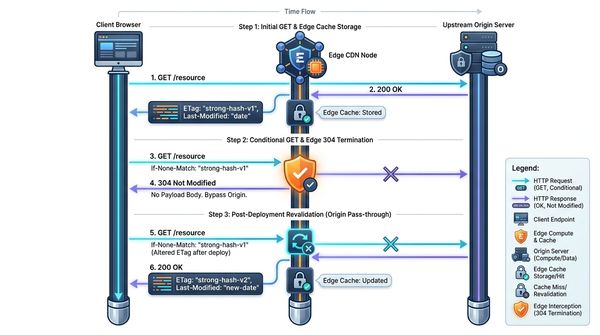
Under RFC 9110 §15.4.5 , 304 Not Modified terminates conditional requests (If-None-Match or If-Modified-Since) without transferring a message body. Upstream origins alone possess build manifests, commit digests, and data changes, making them the exclusive authority for computing deterministic ETag and Last-Modified validators.
Deterministic conditional revalidation operates across two sequential phases:
- Payload Ingestion : Once an origin returns an initial 200 OK, edge nodes store the payload alongside its validator headers.
- Edge Validation Termination : Subsequent conditional GET requests terminate directly at the edge, yielding low-latency 304 confirmations without hitting origin compute.
CDNs automatically rewrite strong origin ETags into weak validators (W/) during dynamic Brotli or Gzip compression. To preserve strong byte-for-byte validators, configure edge rules to respect strong ETags or terminate asset compression at the origin.
Automated Invalidation: Cloudflare Cache Purge in Deployment Pipelines
When code promotions bypass edge cache invalidation, edge caches evaluate incoming conditional headers against obsolete cached metadata, locking clients into stale 304 verification loops. Continuous integration runners must enforce edge cache invalidation as an automated post-deployment hook.
Automated cache coherence relies on two pipeline execution points:
- API Invalidation Targets : As detailed in the Cloudflare Cache Documentation , the Purge API supports single-URL, tag, prefix, and zone-level invalidations.
- Pipeline Script Hooks : Automated CI/CD runners trigger evictions by integrating ci-cd/ purge-cloudflare-cache.sh or ci-cd/ purge-cloudflare-cache.ps 1 directly into post-deployment steps.
Avoid URL prefix purging for high-frequency continuous deployment workflows. Prefix purging operates as an uncalibrated instrument that causes excessive cache misses and exposes the origin to thundering herd spikes.
Targeted cache invalidation requires two architectural mechanisms:
- Granular Header Tagging : Mandate the application of Surrogate-Key or Cache-Tag headers to group dependent entities at generation time.
- Dependency-Aware Eviction : Execute surgical purge calls through the deployment pipeline to evict only the specific entity graphs modified during the release.
End-to-End Operational Workflow and Visual Verification
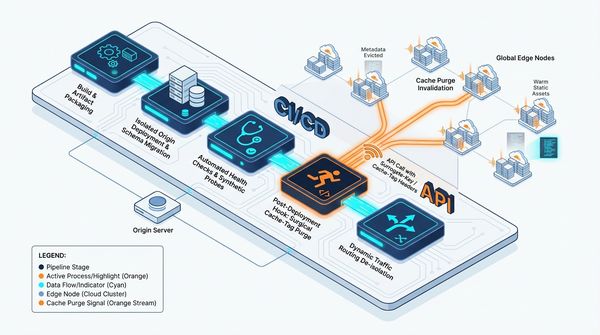
Operationalise this boundary separation across four defined deployment stages:
- Pre-flight Intercept (Dynamic State) : The edge Worker asynchronously reads a dynamic maintenance flag from a globally distributed Key-Value ( Edge KV ) store. Instantly, state mutations (POST/PUT/DELETE) and uncached requests are intercepted with a 503 Service Unavailable and Retry-After: 300. Cached GET requests are seamlessly served stale (stale-if-error), masking the outage. Allow-listed administration IPs bypass this logic entirely for testing.
- Origin Deployment : Execute database migrations, container updates, and origin health checks in total isolation.
- Automated Invalidation : Execute the API cache purge script utilizing Cache-Tag headers to flush strictly the stale edge metadata associated with the deployment.
- Traffic Restoration & Verification : Deactivate maintenance routing by instantly toggling the Edge KV flag off. Verify origin conditional pass-through headers using terminal probes:
curl -I -H "If-None-Match: \"<origin-etag>\"" https://example.com/api/v1/resource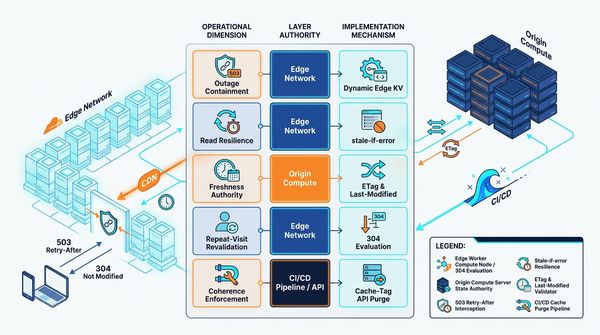
Conclusion & Strategic Advice
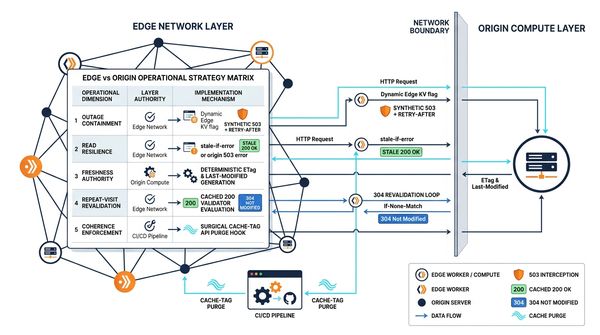
Resilient distributed architectures require explicit separation of concerns between perimeter caching and origin compute.
Enforcing architectural boundaries divides operational duties across two infrastructure layers:
- Edge Gatekeeper : Intercepts outages dynamically via Edge KV, serves stale reads under RFC 5861, issues RFC-compliant 503 responses for mutations, and terminates cached 304 revalidations.
- Origin Authority : Computes state changes and issues deterministic validators exclusively.
Audit release runbooks immediately by executing three procedural remediations:
- Edge Intercept Migration : Replace origin-hosted redirects with dynamically toggled edge-intercept logic via Edge KV.
- Validator Transformation : Normalise downstream CDN validator transformation rules to prevent accidental ETag weakening.
- Automated Tag Purging : Codify automated, tag-based edge cache purging as an immutable pipeline stage.
How does your team isolate origin deployments to protect edge cache consistency and crawl equity? Drop your architectural approach below💬 and share this with your engineering network! ♻️
Further Reading
- RFC 9110: HTTP Semantics (Conditional Requests and Status Codes)
- RFC 9111: HTTP Caching Standards
- RFC 5861: HTTP Cache-Control Extensions for Stale Content
- Cloudflare Documentation: Using ETag Headers with Cloudflare
- Cloudflare Documentation: Cache Statuses and Revalidation Mechanics
More From Me
Original Article: Read on LinkedIn | Read on Substack