Building Custom AI Products with Odysseus on NVIDIA RTX and DGX Spark
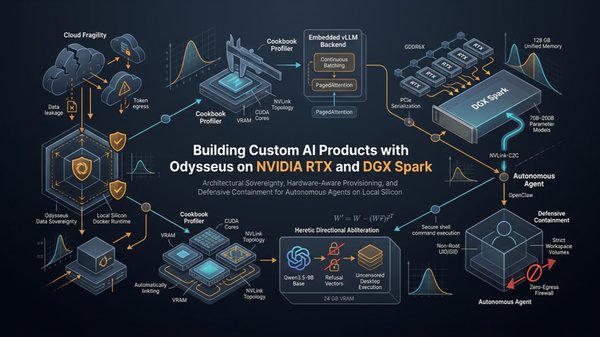
Rented cloud APIs introduce severe platform risks, escalating costs, and opaque telemetry. Deploying the open-source Odysseus workspace on local NVIDIA RTX or DGX Spark hardware solves this by enabling a seamless transition from prototyping to secure, air-gapped production.
Introduction
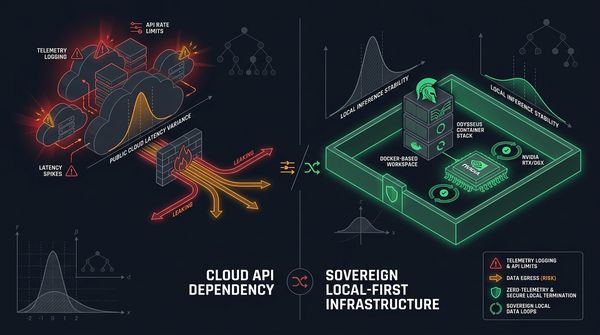
Cloud API dependencies introduce severe operational fragilities, including escalating token costs, opaque telemetry logging, and arbitrary upstream platform bans. Building on the foundational weight-space surgery explored in Automated Model Abliteration with Heretic on NVIDIA RTX and DGX Spark , commercial AI product creation demands an uncompromised, local-first computing fabric.
Odysseus addresses these production constraints as a self-hosted, open-source AI workspace reference implementation. The platform delivers three distinct operational capabilities:
- Hardware-Aware Serving : Combines multi-turn execution, autonomous tool orchestration, and local runtime backends into a unified containerised deployment.
- Zero External Telemetry : Enforces absolute data sovereignty by terminating model invocations directly on local silicon.
- Deterministic Latency : Eliminates network transport overhead and unpredictable remote API queuing delays.
Pairing Odysseus with local silicon—whether workstation-class Ada Lovelace GPUs or Grace Blackwell superchips—bridges the gap between experimental prototyping and air-gapped production. This guide outlines the hardware topologies, container configurations, and model pipelines required to deploy Odysseus on NVIDIA RTX and DGX Spark systems to ship robust, local-first AI software products.
Hardware Foundations: High-VRAM RTX vs. DGX Spark
Selecting compute for local AI workspaces requires evaluating memory bandwidth and coherent address spaces across two hardware architectures:
NVIDIA RTX Arrays
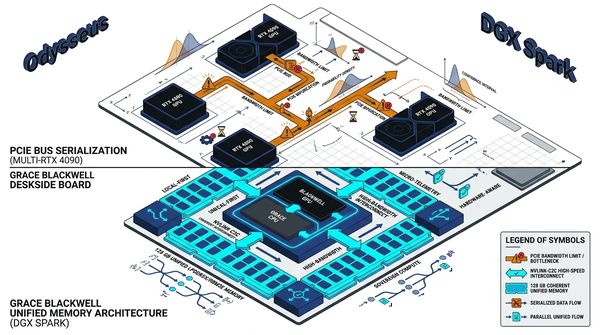
Workstation-class and consumer GPUs deliver FP16 and INT4 throughput via fourth-generation Tensor Cores . However, physical memory subsystem properties impose two explicit constraints:
- GDDR6X Bandwidth Ceilings : Fixed memory bandwidth limits create distinct throughput bottlenecks during vLLM continuous batching cycles.
- PCIe Bus Serialization : Multi-GPU scaling across standalone cards (such as the RTX 4090 with 24 GB VRAM) demands strict PCIe lane bifurcation, specialised riser cards, and targeted driver tuning to avoid inter-GPU bus contention.
NVIDIA DGX Spark (Projected Edge Tier)
Representing an entry-level Grace Blackwell deskside architecture, this platform transitions local serving to an NVLink-C2C coherent memory layout. The hardware specifications address standard consumer GPU limitations through two primary capabilities:
- Unified Memory Subsystem : Features 128 GB of coherent unified LPDDR5x memory paired with high-bandwidth memory (HBM3e), providing up to 1 PFLOP of FP4 compute.
- Continuous Ingestion Throughput : Eliminates PCIe serialization boundaries and saturates continuous batching engines, allowing always-on background agents to host 70B–200B parameter models without model sharding across isolated PCIe slots.
Setting Up Odysseus with the NVIDIA Container Runtime
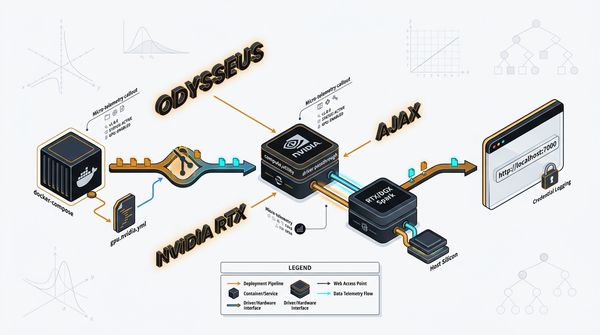
Odysseus isolates application services via Docker Compose. Enabling hardware acceleration requires the host system to run the NVIDIA Container Toolkit (nvidia-docker2).
Clone the repository and target the active development branch:
git clone -b dev https://github.com/open-odysseus/odysseus.git
cd odysseus
cp .env.example .env
To bind local GPUs directly into the execution container, launch the stack using the dedicated NVIDIA overlay:
docker compose -f docker-compose.yml -f docker/gpu.nvidia.yml up -d --buildThe container configuration initialises hardware passthrough and local access via three automated actions:
- Capability Injection : The gpu.nvidia.yml overlay exports NVIDIA_VISIBLE_DEVICES=all and requests NVIDIA GPU driver capabilities (compute,utility).
- Interface Binding : The local workspace exposes its management endpoint at http://localhost:7000.
- Credential Generation : The bootstrap process writes initial administrative credentials directly to the container stdout logs.
Hardware-Aware Provisioning via the Cookbook
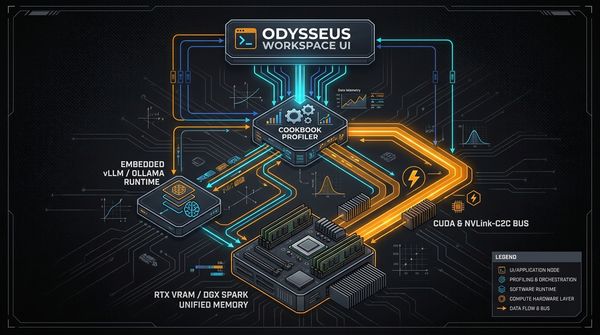
The foundation of Odysseus's internal orchestration is the Cookbook engine. Cookbook automates model selection by profiling physical hardware upon container initialisation across three sequential phases:
- Hardware Scanning : Cookbook inspects available VRAM, CUDA core counts, and NVLink topology.
- Compatibility Scoring : It queries open registries (such as Hugging Face) and evaluates target models based on parameter size, context window memory overhead, and quantisation profile ( GGUF , AWQ , or EXL2 ).
- Automated Serving : The engine executes weight downloads and configures an OpenAI-compatible serving backend using embedded vLLM (for continuous batching and PagedAttention ) or Ollama runtimes.
Powering Odysseus with Ajax: The 9B Uncensored Brain
Desktop workflow execution inside the workspace relies on Ajax , an in-house model engineered for autonomous task processing. The implementation incorporates three core design choices:
- Qwen3.5-9B Base : Ajax bypasses bloated 70B parameter footprints, using Alibaba's dense 9B architecture. It executes daily functional operations—including schedule coordination, research synthesis, shell script generation, and file-system parsing—with low latency within standard 24 GB VRAM allocations.
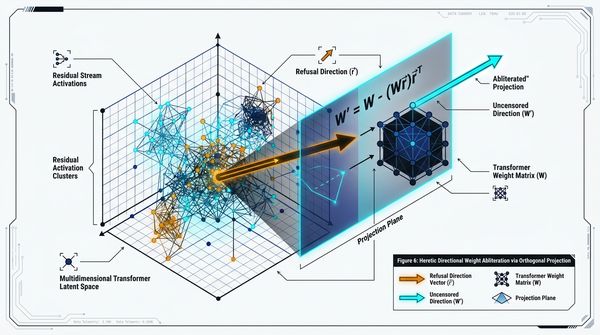
- Heretic Directional Abliteration : Off-the-shelf base weights introduce corporate refusal reflexes during administrative automation tasks. To remove these limitations, the open-source Heretic tool calculates the refusal activation direction across residual stream activations and orthogonalises projection weights (W' = W - (W\vec{r})\vec{r}^T), stripping refusal inertia while preserving structural coherence.
- Sovereign Distillation Pipeline : Constructing custom models like Ajax highlights critical supply-chain risks. Upstream enforcement actions—such as OpenAI suspending ByteDance's developer account for extracting GPT-generated reasoning traces to train proprietary models—demonstrate that external API dependencies compromise platform independence, requiring local synthetic data generation pipelines on sovereign compute.
Agentic Orchestration and System Hardening
Odysseus includes autonomous sub-agents capable of executing shell scripts, managing local repositories, and compiling detailed research briefs. These agents dynamically save validated scripts into a persistent "Skills" library.
To orchestrate proactive triggers beyond the browser, integrate OpenClaw alongside Odysseus. OpenClaw provides multi-channel webhooks (Discord, Telegram, internal message buses) that route user commands directly to Odysseus's local vLLM endpoints.
Defensive Hardening Rules
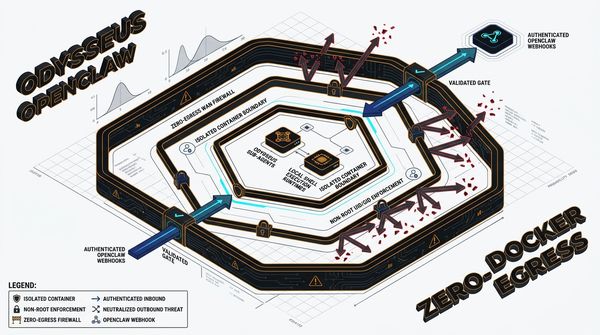
Securing an autonomous agent runtime with local shell execution requires three mandatory containment policies:
- Container Isolation : Scrutinise Odysseus's internal THREAT_MODEL.md. Mount strictly isolated workspace directories into agent containers rather than exposing host root file systems.
- Non-Root Execution : Restrict Docker processes to non-root UID/GID allocations to prevent privilege escalation via LLM shell execution tools.
- Zero-Egress Firewalls : Enforce local network policies preventing model serving containers from issuing unapproved outbound WAN requests.
Conclusion & Strategic Advice
Deploying Odysseus across local NVIDIA silicon replaces unpredictable cloud subscriptions with sovereign, low-latency execution. Combining hardware-aware model serving via Cookbook with abliterated compact copilots like Ajax provides an unconstrained foundation for custom AI products.
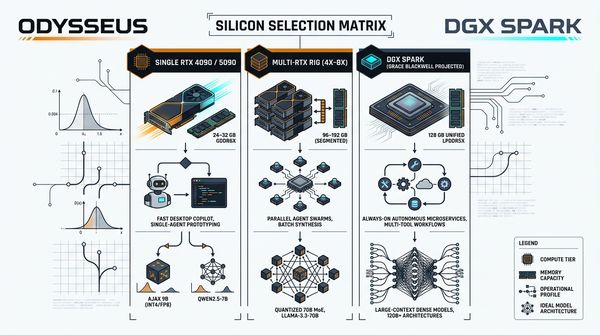
Silicon Selection Matrix
The following matrix outlines three deployment tiers based on available silicon and workload profiles:
Transition your core infrastructure today: isolate an RTX workstation or DGX Spark node, clone the Odysseus repository on the dev branch, and build your custom product stack upon verifiable, sovereign silicon.
Is your engineering team actively provisioning local-first silicon for production workloads, or are you still tethered to commercial model APIs? Share your thoughts below 💬 and share with your network♻️
Further Reading
- Refusal in Language Models Is Mediated by a Single Direction (Arditi et al.) - Foundational research on representation engineering and directional ablation in transformer models.
- Uncensor Any LLM with Abliteration (Maxime Labonne) - Practical methodology for calculating refusal vectors and modifying weight matrices.
- Heretic: Fully Automatic Censorship Removal (Philipp Emanuel Weidmann) - Automated implementation utilising directional ablation and Optuna optimisation.
- NVIDIA Grace Blackwell Architecture Technical Overview - Detailed analysis of coherent memory systems, NVLink-C2C, and deskside supercomputing silicon.
- vLLM Serving Engine Documentation - High-throughput inference server with PagedAttention and continuous batching.
More From Me
Original Article: Read on LinkedIn | Read on Substack