Moore's Law and what it means now, and the challenges the industry faces.
Introduction
For this post, I will discuss Moore's law. Initially, I planned to include a section about what we can expect in the future. However, I've decided to separate this post into another post, Beyond Moore's Law and Future Processing.
Moore's law is the observation that, over the history of computing hardware, the number of transistors in a dense integrated circuit has doubled approximately every two years.
Gordon Moore coined the phrase in 1965 in the thirty-fifth-anniversary issue of Electronics magazine. This observation has dominated the IT industry ever since.
Smaller and Smaller
The root of this phenomenal growth can be seen in the 1959 lecture by physicist Richard Feynman, Plenty of Room at the Bottom. In it, Feynman discusses the difference between us and the atom and the potential for building to this scale.
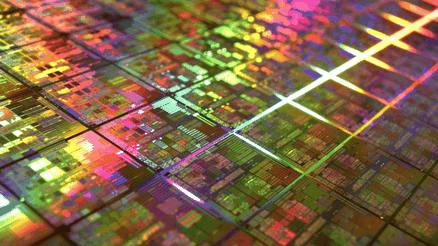
For instance, human hair is roughly 100,000nm wide. Meanwhile, the current generation of transistors is only 14nm, or about 70 atoms wide. A modern Intel Skylake processor contains 1.75 billion transistors, which has allowed for a 4,000,000-fold increase in processing power over Intel's 4004, produced in 1971.
Reaching the Limit
By 2021, it's predicted that transistors will reach 5nm. At this stage, we will have reached the limits of Moores Law. Going smaller, and nature starts to play by different rules. Here, Quantum Mechanics is King and Queen.
However, we have already reached another limit of processor design. The Clock Speed, or the metronome of processors, increased steadily until it peaked at 3.7 GHz in 2004. Since then, it has dropped back to around 3 GHz. This was caused by the difficulty of radiating away the heat generated, which has forced the industry to use alternative approaches.
Parallel Processing
Intel's first (x86) multi-core processor was introduced in 2006, and Hyper-Threading was introduced in 2002. Allowing more programmes to run at the same time. However, software needs to be explicitly designed to exploit parallelism.
Languages like Erlang or F# work well with parallel processing, and their features incorporate mainstream languages like C# and Java. However, writing parallel software is still more challenging and unsuitable for all tasks.
Commoditizing Compute
Processors spend most of their time idle or even off, forming the basis for cloud services. By utilising resources more efficiently, it's possible to save money. However, the most important benefit is scaling. Allowing a service to scale makes it possible to cope better with peak demand.
Multiple vendors offer CAAP or Compute as a Service. Google has its Compute Engine, and Microsoft has Azure Batch. Software that exploits these services must be explicitly written, but the workload can be spread across 100 to 1000 processors and servers.
Custom Processors
I've only written about general-purpose processors above. However, specialized microprocessors can be used to offload specific tasks. One of these, the GPU (Graphical Processing Units) found in PCs and Mobile phones, does this.
One feature of GPUs is their ability to perform massive parallelization of simple mathematic transformations. This parallelization can also be exposed via Compute APIs like Direct Compute or Open CL. Benefiting applications from financial analysis, climate modelling, and machine learning give them a significant boost.
Field Programmable Gate Arrays (FPGA)
Like specialized processors, FPGAs are designed to perform one task very well. However, like General-Purpose Processors, they can be reprogrammed. The difference is that this reprogramming happens at the transistor level.
FPGAs are reprogrammable, offer speed improvements, and have low latency. This means they're used in diverse fields, from the real-time filtering of massive datasets at CERN to High-frequency trading in the world's financial Hubs. Open CL is the leading standard for FPGA, with the original standard set around C++ and wrappers for C#, Java, and other languages.
Continues the gains
According to Moore's Law, an estimated 400 billion transistors were manufactured in 2015 alone. With its end in sight, we must consider what will happen next. Above, I've shown a few examples of how the industry responds by concentrating on processing power rather than the crude transistor density metric.
Finally, I want to raise a point often overlooked: Cost. Since the 1980's, the price of personal computers has dropped by a staggering amount, 99.9%. This is due to a couple of factors, including mass production. But also the failure of Rock's Law, which states that the cost of a manufacturing plant (fab) doubles every 4 years. In fact, since the 1990s, it has been dropping on a per-transistor basis. All this will lead to cheaper, ubiquitous and constantly connected devices.
In the next post, I will expand on the alternatives we will see over the next few decades. However, the final point I wish to raise is the corollary of Moore's law. Processors are getting cheaper, and we can expect this to continue even after Moore's Law has been passed.
Please feel free to like, share or comment on my post and leave any feedback in the comments. Click on the link below to read my follow-up post.
Called Beyond Moores Law and the of Future Processing.
Original Article: Read on LinkedIn | Read on Substack