Beyond Moore's Law, the future of processing and what we can expect to see
Introduction
In my previous post, I discussed the end of Moore's Law and how the industry responds by leveraging techniques like parallel processing and SOC devices to improve processing power. In this post, I'll discuss the new developments we expect to see this century.
Flatland
Silicon processors are manufactured using photolithography to control the depositing of various materials, ranging from 0.5 to 2.5 micrometres thick, onto a silicon substrate. Initially limited to only a few layers, this constrained design and forced components to be placed in order of execution, as communication channels couldn't cross.
Today, processors can have up to 30 layers, allowing for greater flexibility in design. However, transistors must still be placed onto a silicon substrate, like a city restricted to one storey. By stacking silicon layers, transistor density can increase with each additional level.
Bottlenecks
Processors communicate with external components through the System bus, which is limited by the speed at which electronic signals can travel—about 1/3 the speed of light. If the system bus were to operate at the speed of a processor, 3GHz, a signal would only move 3 cm in a clock cycle. This forces a lower bus speed and causes delays.
Currently, processors alleviate this by using local caches. For instance, Intel's Skylake has up to 4 levels, with the most enormous reaching 128MB. This is a large amount of real estate, just for a cache. It also forces the OS to waste time moving memory between system memory and its various caches.
Stacking memory and the processor together reduces this bottleneck. But, with the side-effect of an increase in heat. Alternatively, an optical bus could link system components together at the speed of light. This would not only increase speed but also allow for higher transfer rates.
Cool Running
I mentioned previously that heat limits processor speed. Traditional fans have been used for cooling. Liquid cooling has also been used on supercomputers since the 1980s. Recently, hobbyists and gamers who overclock their systems have been using it.
The next stage is crafting channels between silicon layers to provide integrated liquid cooling. However, this also raises an even more intriguing possibility. Flow batteries use a liquid to store and transfer electrical energy, so we can both cool and provide energy for a processor. This also simplifies design, removing the need for up to 80% of connections that only provide power.
Speed from Soot
These developments will increase performance, but they don't offer a fundamental increase in clock speed. For this, we need an alternative to silicon. Graphene efficiently conducts electricity and heat, is a ballistic transporter of electrons, and exhibits the bipolar transistor effects, all properties that can be used for the next generation of transistors.
However, several obstacles must be overcome before it becomes commercially viable. First, Impurities from the manufacturing process need to be removed. Luckily, the industry has 50 years of experience purifying silicon. Next, because graphene transports electrons without impediment, it also lacks a band gap, a key characteristic of a semiconductor.
Transistors, we're told, act like tiny switches with only two states. In truth, they're more like dimmer switches. The more electricity is used, the more significant the change in conductivity; this is the band gap. However, a graphene nanoribbon does have a sufficient band gap. This can then be mixed with other materials, including silicon, to create a working transistor.
Brains Trust
In 2012, Google demonstrated software that recognises cats, but it took 16,000 processors to train—a task that any child can easily do. The training involves testing models consisting of multiple layers of mathematical transformations. These layers are then mutated and re-evaluated until a passing model is found.
However, the Von Neumann architecture of processors isn't suited to this type of deep learning, and generating a model can take weeks. Even with GPUs to offload the mathematics, training still takes days. Neuromorphic processors replicate how the brain works by replacing software modelling with physical neurones so that we can expect quicker training time with far greater efficiency.
This was bolstered by the discovery of Memristors, which, like variable resistors or transistors, can keep their previous state. Processors are Digital and ignore the Analog nature of transistors. This contrasts with how the brain works, where the synapses strengthen with training. So, using nature as an analogy, we are close to a brain-like chip.
King and Queen of the quantum
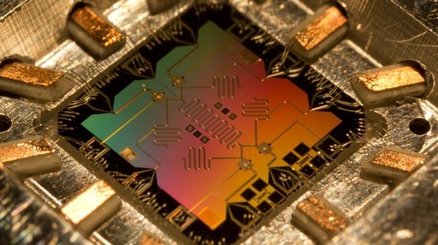
Classical computers power scales polynomially, with each additional bit. So, a 64-bit processor is twice as powerful as a 32-bit one. Quantum computers work by exploiting quantum phenomena. A Quantum Bit (Qubit) placed into a superposition can exist in two states simultaneously. When combined with entanglement, it links multiple Qubits together. The result is an exponential scaling in power. So 64 Qubits are now 4 billion times as powerful as 32.
Many consider Quantum Computers the leading technology for replacing silicon chips. However, Qubits are susceptible to decoherence, where the delicate quantum phenomena are destroyed before they can be measured. To prevent this, isolation from the environment and cooling close to absolute zero are required. However, this becomes harder with each additional Qubit.
However, the most serious issue for quantum computers is that only a handful of quantum algorithms are available. For instance, you can purchase a D-Wave2X for $15 million. That performs the Quantum annealing algorithm. You can get a supercomputer that offers far more flexibility for the same price.
Conclusion
While Moore's Law has slowed, there are plenty of possibilities for increasing processing power, from faster graphene or multilayer silicon processors and integrated communication with light to better AI with neuromorphic computers.
Quantum computers will significantly impact society, energising science, engineering, and mathematics. Don't expect them to be found in the home; they're too delicate and expensive. You can expect to see them through cloud services as a commodity. To this end, IBM is offering anyone the ability to play with a 5 Qubit quantum computer.
I could have mentioned even more developments, like Spintronics or Photonic Computers. However, I'll try to focus on Machine Learning in my next post.
Please feel free to like, share or comment on my post and check out some of my other posts.
Original Article: Read on LinkedIn | Read on Substack