The Future of Medicine: How AI is Changing Healthcare
Introduction
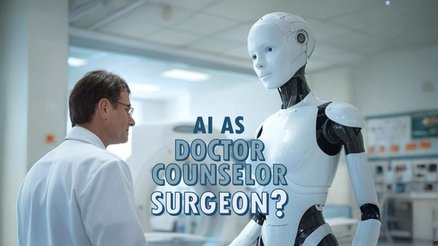
Artificial intelligence (AI) is transforming various aspects, and it's having a significant impact on healthcare. AI is being utilised in multiple ways, from enabling doctors to provide more personalised care to discovering new medicines. This guide gives a simple overview of how AI is transforming healthcare. We'll discuss the improvements, positive developments, and the challenges we still need to address.
Helping Patients Directly
AI is making it easier to give patients the proper care at the right time.
-
Smarter Chatbots: AI can power chatbots that help patients remember to take their medication and track their overall well-being. For example, IQVIA offers tools that facilitate this process (see IQVIA's AI/ML Patient Support Article).
-
Finding Patients at Risk: AI can analyse patient data to identify those who may be at risk of severe illness. This helps doctors intervene early. Philips has systems like this that have reduced issues in hospitals (Philips' 10 Real-World Examples of AI in Healthcare).
-
Monitoring Health with Wearable Tech: AI can work with wearable devices to continuously track individuals' health. For instance, AliveCor develops technology that utilises AI to monitor your heart (Markovate's AI in Remote Patient Monitoring).
What's Good:
-
Patients are more involved in their care and stick to their treatment plans.
-
Doctors can prevent health problems before they become emergencies.
What's Tricky:
-
Different computer systems in hospitals often fail to integrate effectively (as noted in Nature's article on Challenges in Health Information Exchange).
-
Some patients may not trust the suggestions made by AI (Softude's Challenges of AI-Powered Telemedicine).
Better Ways to Find Illnesses
AI is helping doctors find illnesses more quickly and accurately.
-
More innovative Imaging: AI can analyse scans and X-rays to identify problems such as cancer and brain diseases. Companies like Zebra Medical Vision are developing AI to detect illnesses such as pneumonia (ScienceDirect's Imaging Analysis with AI, Medwave's AI Transforming Healthcare).
-
Fewer Mistakes: AI can help doctors avoid mistakes when they're reading scans, such as Qure.ai's technology that allows prioritising patients with a stroke (Medwave's AI Transforming Healthcare, Careful's AI in Healthcare: Transforming Patient Outcomes).
What's Good:
-
Illnesses will be detected faster.
-
Doctors have less work to do.
-
Diagnoses are more accurate, especially for tricky illnesses like breast cancer (Careful's AI in Healthcare: Transforming Patient Outcomes).
What's Tricky:
-
AI can make unfair decisions if the data it learns from isn't diverse enough (LinkedIn's Pros and Cons of AI in Clinical Diagnosis).
-
It can be hard to get approval for new AI tools (Frontier Economics' AI Adoption in Healthcare).
Creating New Medicines
AI is accelerating the development of new drugs.
-
Finding New Drugs: AI can help scientists find new drugs more quickly. For example, Insilico Medicine uses AI to discover drugs for lung disease (Signity Solutions' Role of AI in Drug Discovery).
-
Finding the Right Targets: AI can help scientists find the exact parts of the body that a drug needs to target (Signity Solutions' Role of AI in Drug Discovery, LinkedIn's AI in Drug Discovery).
What's Good:
-
It costs less to develop drugs.
-
New drugs are already being developed at a faster rate.
-
Treatments can be designed for a person's unique genes (Park University's AI in Healthcare, Frontiers in Chemistry's AI in Drug Development).
What's Tricky:
-
AI needs to learn from a wide range of data to work for everyone (LinkedIn's AI in Drug Discovery).
-
New AI drugs require careful testing in the real world, as highlighted in "AI in Drug Development" by Frontiers in Chemistry.
Caring for People Remotely
AI is making it easier for people to access healthcare from the comfort of their own homes.
-
Checking in from Home: AI Can Help Monitor Patients with Long-Term Illnesses. For example, Omron utilises AI to help people track their blood pressure, leveraging Markovate's AI in Remote Patient Monitoring.
-
Virtual Doctor's Visits: AI can help people figure out if they need to see a doctor. Companies like Babylon Health utilise AI to assist with this (Mercer's Future of AI in Telemedicine, Iot World Magazine's AI in Healthcare Market Trends).
What's Good:
-
People don't have to go to the hospital as often.
-
Patient care is more affordable.
-
Older people can live more independently with the help of Markovate's AI in remote patient monitoring.
What's Tricky:
-
We need to ensure that people's health data remains private (Softude's Challenges of AI-Powered Telemedicine).
-
It can be challenging to integrate new AI systems with existing hospital systems (as noted in Softude's Challenges of AI-Powered Telemedicine and Nature's article on Challenges in Health Information Exchange).
Making Hospitals Run Smoothly
AI can help hospitals work more efficiently.
-
Handling Paperwork: AI can automate tasks such as obtaining approvals from insurance companies (IQVIA's AI/ML Patient Support Article).
-
Scheduling Staff: AI can predict how many nurses and doctors are needed on any given day (FutureLearn's What is AI in Healthcare).
What's Good:
-
Doctors and nurses spend less time on paperwork.
-
Hospitals run more smoothly (FutureLearn's What is AI in Healthcare).
-
AI can even write notes during appointments (NIH's AI Auto-Documenting Consultations).
What's Tricky:
-
Some may resist changing the way they work (Nature's article on Challenges in Health Information Exchange).
-
AI systems can be expensive to set up (Softude's Challenges of AI-Powered Telemedicine).
Problems and Doing Things Right
AI in healthcare presents several challenges that we need to address.
-
Keeping Data Safe: We must ensure that patient information is always protected (Softude's Challenges of AI-Powered Telemedicine, NIH's Data Privacy in Telemedicine).
-
Being Fair: AI systems must treat everyone fairly, regardless of their background (LinkedIn's Pros and Cons of AI in Clinical Diagnosis, NIH's AI Bias in Healthcare).
-
Who's Responsible?: We need to know who is responsible if an AI system makes a mistake (Frontier Economics' AI Adoption in Healthcare).
How to Fix It:
-
Make AI more transparent so we can understand how it makes decisions (Softude's Challenges of AI-Powered Telemedicine).
-
Create clear rules for how AI should be used in healthcare (Frontier Economics' AI Adoption in Healthcare).
What's Next?
AI will continue to transform healthcare in exciting ways.
-
Predicting Health Trends: AI can help us predict and prevent illnesses in whole communities (IoT World Magazine's AI in Healthcare Market Trends).
-
Personalised Medicine: AI can combine a person's genetic information with AI to provide them with the most effective treatment (Iot World Magazine's AI in Healthcare Market Trends).
-
Keeping Data Safe with Blockchain: New technologies, such as blockchain, can help us share health data securely (Iot World Magazine's AI in Healthcare Market Trends).
The Big Picture:
-
In the future, hospital computer systems will work together seamlessly, as noted in Nature's article on Challenges in Health Information Exchange.
-
AI will help everyone around the world get better healthcare (NIH's Data Privacy in Telemedicine).
Conclusion
Artificial intelligence has the potential to significantly improve healthcare. To ensure that we utilise AI effectively, we must address the challenges and act ethically. If we approach this correctly, AI can aid people in living healthier lives.
How are you personalising your customer experiences? Share your insights below, and don't forget to ♻️ share with your network! 🚀
Further Reading
-
More on AI in Healthcare: Multimodal's AI in Healthcare
-
How AI Helps Find Illnesses: Spectral AI's AI in Medical Diagnosis
-
Thinking Carefully About AI: The Pitfalls of Panopticon AI: Learning from COVID and Building Trust
-
What's Coming for AI in Healthcare: BCG's AI Solutions in Healthcare
Original Article: Read on LinkedIn | Read on Substack