The Context Gap: AI Code Generation Still Demands Humans
Introduction
While AI adoption in coding has exploded, so has developer scepticism. The 2025 Stack Overflow Developer Survey reveals a fascinating paradox: 84% of developers now use or plan to use AI tools, yet a staggering 46% distrust the accuracy of their outputs, a sharp increase from 31% the previous year Stack Overflow Blog 2025.
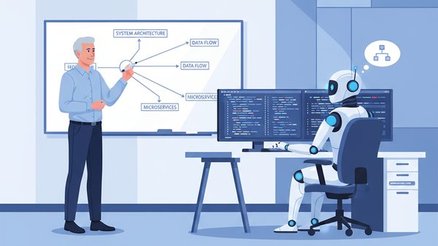
This tension highlights a critical truth: AI is a phenomenal accelerator, not a flawless orchestrator. It can generate code at an unprecedented pace, but it consistently fails to grasp the intricate, holistic context of a software project.
To bridge this "Context Gap," elite developers are adopting a disciplined human-in-the-loop workflow: a cycle of Generate, Consolidate, Refactor, and Iterate to transform raw AI output into robust, production-ready code. This article talks about the flaws of AI-generated code and provides a practical framework for mastering this essential human-AI partnership.
🚀 The Productivity Paradox
The promise of AI-driven development is intoxicating: write a prompt, receive a feature. Tools like have demonstrated real-world productivity gains of 25-35% by automating boilerplate and routine tasks (GitHub Copilot Productivity Medium).
However, these metrics often obscure a more complex reality. A 2025 study found that while Copilot accelerated tasks by 28%, it also introduced a 35% rework rate due to context mismatches within their enterprise platforms (Zoominfo Copilot arXiv). The speed gained in generation was lost in debugging and correction, proving that raw velocity is not the same as forward progress.
🧠 The Anatomy of the Context Gap
This gap between AI speed and project reality stems from its inability to comprehend the unwritten rules, historical decisions, and architectural nuances of a specific codebase. This blindness manifests in several critical flaws:
-
Plausible Hallucinations: AI can generate code that is syntactically perfect but functionally incorrect, as it ignores runtime realities such as database schemas and asynchronous state management. An August 2025 analysis found that 50% of LLM-generated code reviews contained factual distortions (Hallucinations in Code, arXiv).
-
Pattern Blindness: A separate review of 333 LLM-induced bugs found that most stemmed from the AI overlooking project-specific patterns and anti-patterns that a human developer would instinctively recognise. (LLM Code Mistakes arXiv).
✍️ Generate
The Crucial First Step: This stage involves using natural-language prompts to rapidly generate raw code drafts with AI tools like Copilot. This step focuses purely on velocity. However, this generated output is just a starting point, not a final result. To understand how to manage this raw code and master the complete human-in-the-loop workflow, Generate, Consolidate, Refactor, and Iterate, you can check out more about this stage and the subsequent critical steps in the full article: AI-Powered App Development: Building a Comic Creator Web App.
⚙️ Consolidate
Mastering Validation is Essentials: The first step in bridging the Context Gap is Consolidation. This phase is not a simple code review; it's a systematic audit of AI-generated code against the ground truth of your project.
A robust consolidation workflow begins with automated checks like ESLint and TypeScript. However, automation alone is insufficient. The developer must then perform a manual review focused on business logic and architectural alignment. Key questions to ask include:
-
Does this code adhere to our established design patterns?
-
Does it handle edge cases specific to our domain?
-
Does it introduce any security vulnerabilities?
By treating AI output as an untrusted draft, developers can proactively prevent technical debt from accumulating.
🛠️ Refactoring
Architectural Integrity: Once a piece of AI-generated code is validated, the next step is refactoring. This phase moves beyond correctness to ensure the code embodies the project's specific architectural principles.
AI models are trained on vast, generic datasets, so their output is often stylistically neutral and architecturally naive. It is the developer's job to infuse this generic code with the project's unique DNA by restructuring it to fit established patterns, breaking down large functions, and ensuring abstractions are consistent with the rest of the application.
📄 Evolving Testing and Prompt Iteration Tactics
The final phase, Iteration, closes the feedback loop by refining both testing strategies and prompting techniques. Prioritising end-to-end (E2E) testing with frameworks like Playwright is more effective than traditional unit tests. E2E tests validate the actual user outcome, giving developers the freedom to refactor or replace the underlying AI-generated logic.
This testing feedback directly informs prompt engineering. Instead of asking the AI to generate an entire feature, developers find more success with "atomic prompts", small, particular requests for a single function. This maintains architectural control while using AI to accelerate implementation.
🤝 Conclusion
The Future is a Partnership: As AI models become more sophisticated, the Context Gap will shrink, but the need for human oversight will remain. The developer's role is evolving from a pure creator to an architect, validator, and orchestrator of AI-driven systems.
By embracing a structured approach like the Generate-Consolidate-Refactor-Iterate cycle, teams can harness the incredible power of AI without succumbing to its inherent limitations. The future of software isn't about replacing developers; it's about creating a powerful human-AI partnership that builds resilient, context-aware, and truly innovative technology.
💬 What are your experiences with the AI Context Gap? How is your team balancing AI speed with code quality?
Share your thoughts in the comments below, and don't forget to ♻️ share this article with your network!
Further Reading
-
DORA Report on AI (2025): Found that while AI boosted individual output (+98% PRs), organisational delivery metrics remained flat due to a 91% increase in code review time and a 9% rise in bug rates.
-
Qodo State of AI Code Quality (2025): Reports that 65% of developers using AI for writing or refactoring code say the assistant "misses relevant context."
-
Netcorp AI-Generated Code Statistics (2025): Notes that AI-assisted coding is linked to 4x more code cloning, indicating a decline in modular and maintainable code (DRY principle).
More from me
Original Article: Read on LinkedIn | Read on Substack