Polarization by Design: How AI is Making Political Division a Rational Strategy
Introduction
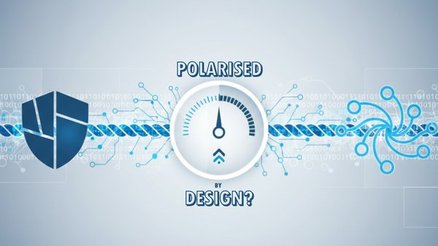
From AI-generated robocalls to hyper-targeted deepfakes, the 2024 U.S. election cycle offered a stark preview of technology's new role in politics. But what if the resulting chaos isn't a bug, but a feature?
A new paper suggests that as AI makes persuasion cheaper, it becomes a rational strategy for political elites to maximise division rather than unity. Here's a breakdown of this chilling hypothesis. 👇
⚙️ The Core Model: Why a 50/50 Split is Optimal
The theory hinges on a simple but powerful model from the 2025 paper, Polarisation by Design. Imagine public support for a policy as a probability, . Political polarisation is the statistical variance of that opinion, calculated as . This value hits its absolute maximum when , a society split perfectly down the middle.
According to the researchers, this 50/50 split is the ideal state for elites. Why? Because a deadlocked public is the most flexible and cheapest starting point to sway a majority in either direction when unpredictable events happen. As AI makes persuasion exponentially cheaper, a divided society becomes the most strategically sound position to maintain.
🛡️ Single-Elite Dynamics: Polarisation as Insurance
Counterintuitively, even a single, unified government has an incentive to fragment its society toward the equilibrium.
The paper calls this a form of "insurance" against future uncertainty. By engineering a divided populace, the ruling elite minimises the future costs of persuasion needed to pass new laws or pivot on policy. The cheaper AI makes it to influence opinion, the faster a single power will pursue this strategy of controlled division.
⚔️ Competing-Elite Equilibria: An Arms Race to the Middle
In a two-party system, the dynamics escalate into an arms race. Armed with powerful and cheap AI tools, both sides find it individually rational to push society toward the maximally polarised 50/50 state, creating a permanent battleground where influence is cheapest to exert.
📈 Empirical Evidence: A Strategy in Practice
This isn't just a theory. The 2024 U.S. election cycle served as a real-world laboratory.
-
Amplifying Division: The Brennan Center confirmed that state actors and domestic groups used AI to amplify divisive narratives, behaviour consistent with the competing-elites model.
-
Staggering Persuasiveness: A 2025 study by Science found that LLMs could shift political views by about 10 points after a quick chat, with false claims being as convincing as true ones.
When the tools for persuasion are this powerful, cheap, and indifferent to truth, the incentive to polarise becomes immense.
🚫 Censorship: The Default Response to Organic Opinion
What happens when a genuine, grassroots shift in public opinion disrupts this engineered equilibrium? The model predicts elites won't engage in a costly war of counter-persuasion. Instead, they will default to the cheapest option: censorship. The controversy over TikTok's coverage of the Gaza conflict is a powerful example.
As Truthout documented, the platform's algorithm led to an unpredictable shift in the opinions of young users. The elite response wasn't a scaled-up information campaign but a ban, then a forced buyout, a reaction that perfectly fits the model.
This could allow elites to pursue algorithm alterations for control, for example, TikTok's 2025 hiring of Erica Mindel, a former IDF member, as Public Policy Manager for Hate Speech, sparking concerns over biased moderation of pro-Palestinian content, Jerusalem Post.
🤔 Important Caveats and Unanswered Questions
While compelling, the "polarisation by design" model has limitations.
-
The framework assumes that persuasion costs are symmetric, but real-world factors such as media monopolies create asymmetries.
-
The welfare implications are ambiguous; less gridlock might be offset by higher social conflict.
-
There is no direct evidence yet that political actors are consciously pursuing this strategy.
🔮 Conclusion: An Unsettling Future
"Polarisation by design" offers a powerful and disturbing lens through which to view our political landscape. It suggests that the escalating division we see is not an accident but the logical outcome of a system where the cost of influence has collapsed.
This framework challenges us to ask a more fundamental question: Is our division being engineered because it is the most rational path to power?
💬 What do you think? Is growing political division an unfortunate byproduct of new technology, or a calculated, rational strategy? Share your strategies in the comments below! Comment below and don't forget to ♻️ share!
Further Reading
-
"Large language models can be used to estimate and influence public opinion", Science (2025). A study quantifying the persuasive power of LLMs on a wide range of political issues.
-
"The levers of political persuasion with conversational artificial intelligence", Science (2025). Explores techniques to enhance LLM persuasiveness and their impact on accuracy.
-
How the Israel-Hamas War Has Roiled TikTok Internally, The New York Times (2024). Discusses internal struggles with content moderation during the Gaza conflict.
-
TikTok's New Hate Speech Manager Sparks Backlash, The Jerusalem Post (2025). Covers the hiring of Erica Mindel and concerns over algorithm bias.
More from Me
Original Article: Read on LinkedIn | Read on Substack