Bridging the Gap: Programmering Tools for All
Introduction
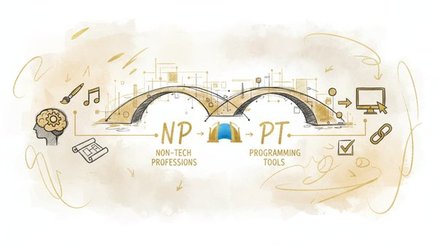
The End of the Digital Divide: For decades, a digital divide separated those who "spoke" code from those who did not. In 2026, that boundary has vanished. Specialized software once reserved for the Linux kernel is now being used to draft legal briefs, architect children's stories, and manage retail prototypes. As explored in Your Career Runway Just Got Longer, modern professionals can now focus on domain wisdom rather than technical implementation. By adopting tools like Git and Markdown, non-tech professionals are moving beyond simply "using" software to "orchestrating" it, optimizing workflows for an increasingly automated world.
The Foundation
Git and Markdown: The transition toward developer tools in general knowledge work centers on two foundational standards: distributed version control and plain-text markup.
Git: Managing Version History
Developed by Linus Torvalds, Git provides structured revision history and asynchronous collaboration.
-
For Creatives & Writers: It provides an immutable audit trail, maintaining a complete record of revisions.
-
For Legal & Compliance: Professionals use signed commits to cryptographically verify authorship, providing undeniable evidence in copyright or legal disputes.
Markdown: The Language of Thought
Created by John Gruber, Markdown has moved from developer README files into the standard syntax for journalism and business. It is a plain-text format that is human-readable yet easily convertible into professional PDFs, websites, or reports. Why these tools matter now:
-
Efficiency: Git eliminates "Final_v2_REAL.docx" confusion by maintaining one source of truth.
-
Focus: Markdown allows you to focus on drafting content without being distracted by complex layout menus.
-
AI Compatibility: Both tools are the native "languages" of AI agents, making your work easier for AI to process and enhance.
Visual Editors & AI Orchestration
The barrier to entry has dropped thanks to modern interfaces that turn technical environments into intuitive command centres.
-
VS Code: Microsoft's free editor now features native AI integration. Users can manage version history through a visual interface and use AI extensions to refactor reports or generate document structures directly within the editor.
-
Obsidian: This "second brain" app allows researchers to create linked notes. By integrating Git and AI plugins, users can "chat" with their personal knowledge base to find connections they might have missed.
These tools are central to "Vibe Coding," where the professional directs the logic and "vibe" of a project while the tools handle the technical heavy lifting.
Industry Applications
-
Design & Art: Teams use Git to track iterations of visual assets, ensuring contributions from multiple members merge cleanly without losing progress.
-
Education: Educators share and version lesson plans via GitHub, creating a transparent, global history of curriculum changes.
-
Healthcare: Markdown is used for lightweight, searchable reports that meet long-term digital preservation standards.
-
Business: Internal wikis built on Markdown require less training and maintenance than proprietary Content Management Systems (CMS).
Addressing Challenges
The Learning Curve: Transitioning to these tools requires workflow discipline. The cognitive barriers described in Navigating the Limits to T-Shaped Skills remain a consideration. Furthermore, as noted in The Context Gap, tools can generate the "how," but humans must still provide the "why."
The goal isn't to turn every professional into a software engineer; it's to provide effective tools for the digital age.
Conclusion
The adoption of developer tools across industries is closing historical silos. From cryptographically verified audit trails to AI-enhanced drafting, these standards offer a future where technical barriers no longer constrain professional output.
How is your organization integrating version control and plain-text standards across knowledge workflows? Share your perspective below.
Further Reading
More from Me
Original Article: Read on LinkedIn | Read on Substack