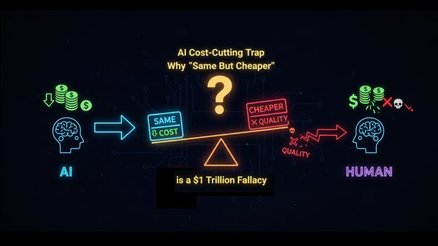
The AI Cost-Cutting Trap: Why "Same But Cheaper" is a $1 Trillion Fallacy
Introduction
The 'Delete Employee, Insert Prompt' business model is not the future of productivity. It's a strategic trap.
Driven by a desire for immediate overhead reduction, organizations are racing to replace expensive human expertise with Generative AI, assuming they can achieve the same quality of output at a fraction of the cost.
However, this "same but cheaper" mentality is proving to be a dangerous strategic error. It ignores the complex economic and operational realities of artificial intelligence, potentially trading long-term brand equity for short-term balance sheet gains.
The "Iceberg" of Hidden AI Expenses
The dream of "free" labor quickly evaporates. Companies are discovering a massive "iceberg" of hidden costs far beyond simple subscription fees:
-
The Data Engineering Burden: Industry benchmarks estimate that roughly 80% of implementation effort centers on data pipeline preparation and cleaning legacy schemas—costs frequently omitted from initial estimates (MIT Sloan Management Review).
-
🔍‰ The Reviewer Paradox: A study found that 77% of employees using AI report decreased productivity and increased workloads. Staff now spend more time reviewing AI-generated content and learning effective prompting than they did performing the original tasks (Upwork Research Institute).
-
💰 Regulatory Overhead: Factor in the escalating costs of API tokens and the looming regulatory expenses of frameworks like the EU AI Act—which could cost companies up to €30,000 ($33,000) for high-risk systems (Center for Data Innovation). The "cheap" alternative is suddenly remarkably expensive.
The Quality Paradox and the Efficiency Trap
The move toward total automation often triggers a "race to the middle." When organizations rely on generic Large Language Model (LLM) outputs, they risk "brand decay" and a loss of unique voice. This can lead to a 40% decrease in consumer trust (Forrester Research). There is also a functional "Jagged Frontier" to AI performance:
-
Analytical Limitations: Research by Harvard Business School and BCG demonstrated that while AI aids creative ideation, it made consultants 19% less likely to find correct solutions for complex business problems.
-
Model Drift: Performance can drift significantly. GPT-4's accuracy in specific mathematical tasks plummeted from 97.6% to 2.4% in just months, necessitating continuous, costly monitoring (Stanford and UC Berkeley research).
-
Skill Atrophy: Technology critic Nicholas Carr warns of the long-term erosion of institutional knowledge that occurs when cognitive tasks are automated. This loss of human insight often far outweighs the short-term gains of a reduced headcount.
These combined factors explain why 30% of generative AI projects will be abandoned by the end of 2025 (Gartner).
Strategic Pivot: From Savings to Capability
The path forward requires moving from a mindset of labor-arbitrage to one of insight-arbitrage. Currently, only 5% of organizations report seeing significant financial returns from AI (Lucidworks). The successful minority are those using AI as a capability multiplier—performing tasks that were previously impossible, rather than just tasks that were expensive.
Instead of asking "How many writers can we replace?", leaders should ask: "How can our writers use AI to analyze 10,000 customer transcripts in an hour?"
This shift from replacement to augmentation allows for the creation of proprietary moats. As Goldman Sachs analysts warn, for the $1 trillion planned investment in AI to provide a return, the technology must solve the "last mile" of accuracy that only human-led, AI-augmented workflows can currently navigate.
Conclusion
The "Same But Cheaper" promise of AI is a fallacy because it assumes output quality remains constant while costs drop. Aggressive cost-cutting can degrade deliverables, erode institutional knowledge, and introduce complex verification overheads.
Durable value is found in domain expertise, context, and human accountability. Organizations should focus on expanding analytical capabilities rather than purely reducing headcount.
The future belongs not to the companies that used AI to shrink, but to those that used it to expand their horizons.
Are you using AI to shrink your budget, or to expand your impact? 💬 Share your perspective in the comments and ♻️ repost to help your network rethink their AI strategy!
Further Reading
More from Me
Original Article: Read on LinkedIn | Read on Substack