AI's Big Split: Chicago Efficiency vs. Austrian Discovery
Introduction
The Invisible Choice: Something fascinating is happening in boardrooms everywhere. While most headlines focus on the technical capabilities of artificial intelligence, a deeper debate is quietly unfolding. It is a fundamental disagreement over how we should use this power.
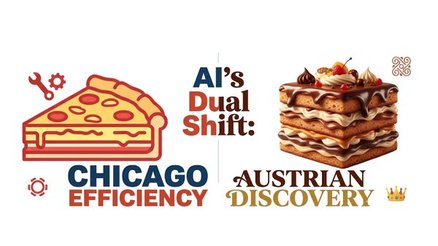
One side focuses on ruthless efficiency—using AI to automate tasks, reduce costs, and deliver measurable ROI. The other side views AI as a tool for discovery, creativity, and finding new ways to delight customers that a spreadsheet could never predict.
This isn't just a tech debate; it is a modern-day clash between two legendary economic schools of thought. On one side stands the Chicago School, rooted in objective efficiency. On the other hand, the Austrian School is centred on subjective discovery. Your choice between them will determine whether your AI strategy builds a future-proof business or makes you very efficient at becoming obsolete.
Two Ways to Think About AI
The Spreadsheet vs The Story: Let's break down these two competing philosophies.
-
The "Spreadsheet" (Chicago School) Approach
This philosophy views a business as a machine to be fine-tuned. Here, value is something you can quantify through data-driven efficiency (Data.Blog). This is the "safe" corporate bet because, as marketing guru Rory Sutherland points out, "it fits on a spreadsheet" (Dan Ilients). It is easy to justify AI tools that reduce headcount or automate processes because the ROI is immediate and visible.
-
The "Story" (Austrian School) Approach
This view treats business as a process of discovery. Value is subjective, shifting, and created when entrepreneurs figure out what people need before the customers even know it themselves (Mises Institute). From this angle, AI isn't just a cost-cutter; it's an engine for experimentation. By lowering the cost of testing new ideas, AI "magnifies rather than diminishes this entrepreneurial function," allowing small teams to innovate at a scale once reserved for giants (Mises Institute).
The Doorman Fallacy
The Danger of the Efficiency Trap: The risk of a purely efficiency-focused mindset is best illustrated by Rory Sutherland's "Doorman Fallacy" (via YouTube).
Imagine a consultant saves a hotel £40,000 a year by replacing a human doorkeeper with automatic doors. On paper, it's a brilliant move. However, if the hotel fails two years later, the spreadsheet won't show you why. It couldn't measure the doorman's true value: the sense of security he provided, the personalised welcome for returning guests, or the prestige he signalled to the street.
This is the exact trap companies face with AI. While businesses are seeing median productivity gains of 30% in measurable tasks (Fortune), that same focus can push a brand toward becoming a commodity. Chasing "same but cheaper" is often a dead-end, a concept I explore further in "The AI Cost-Cutting Trap: Why 'Same But Cheaper' is a $1 Trillion Fallacy."
Conclusion
Choosing Your Path: The path you take with AI is a choice, not an inevitability. You can use it to fine-tune what you already do, following the Chicago School's map toward efficiency—and potential commoditization. Or, you can use it to explore the unknown, leaning into the Austrian spirit of discovery to create hyper-personalised value.
The greatest risk is defaulting to the spreadsheet-friendly option and losing the human "doorman" elements that build a lasting brand. As Sutherland warns, if leaders don't defend the intangible, they end up making "seriously f---ing dumb" decisions based purely on metrics (Rory Sutherland via YouTube).
Which path is your company on? Are you automating the past, or discovering the future? I'd love to hear your thoughts in the comments.
Coming Soon
A Deeper Dive: To truly master your AI strategy, you need to understand the mechanics behind these two schools of thought. Stay tuned for my next two articles:
-
The Chicago Playbook: How to use AI for peak operational excellence without losing your soul.
-
The Austrian Engine: Why the future of AI belongs to the experimenters and how to build a "Discovery-First" organisation.
Further Reading
-
Economics for AI: Dispelling the Fears and Embracing the Entrepreneurship
-
Revolutionising Bureaucracy with AI: Balancing Efficiency and Human Impact
More from Me
Original Article: Read on LinkedIn | Read on Substack