Power Automate to LangFlow: The AI Complexity Ladder Businesses Must Climb
Introduction
Are you stuck in the "no-code trap" of AI automation?
Businesses are rushing into AI automation, often starting with accessible, no-code tools that promise quick wins via visual interfaces and natural-language prompts. Platforms like Base44, n8n, and Microsoft Power Automate excel at rapid prototyping, allowing non-technical users to integrate everyday processes and embed basic AI without writing a single line of code.
However, as AI ambitions evolve toward autonomous, context-aware agentic systems that can reason, remember, and execute complex tasks, organisations frequently hit a wall.
This is where low-code visual frameworks like LangFlow and Flowise provide a critical step up, enabling sophisticated Large Language Model (LLM) chains, retrieval-augmented generation (RAG), and multi-agent collaboration. Understanding this spectrum is essential before making any serious AI investment.
While simpler no-code tools deliver speed, they cap at basic orchestration. Conversely, LangFlow and Flowise unlock transformative capabilities but require greater technical oversight. This article explores the differences, trade-offs, and strategic roadmap needed to avoid the "no-code trap" and scale AI effectively.
No-Code Automation Foundations
The entry point for many organisations involves no-code platforms that prioritise speed and accessibility.
-
Base44: Generates functional web apps and basic workflows from prompts in minutes, making it ideal for rapid Minimum Viable Products (MVPs) in startups.
-
n8n: Shines in operational reliability, offering 300""700+ integrations for robust data plumbing, scheduling, and error handling. It also provides self-hosting for full control over your data.
-
Microsoft Power Automate: Provides seamless Copilot-driven flow creation, robust Data Loss Prevention (DLP) policies, and document processing for enterprises deeply embedded in the Microsoft ecosystem.
As noted in Bridging the Gap: Programming Tools for All, these tools democratize development for business users. They are perfect for rule-based tasks like HR onboarding, invoice processing, and lead nurturing.
The Catch: While security is generally enterprise-grade (Base44 is SOC 2 Type II and ISO 27001 certified), these platforms struggle with deep reasoning and complex AI logic. Furthermore, they are not without risk; some users have reported field-level data exposure risks in public entities using Base44. Ultimately, these tools are best suited for operational efficiency rather than creating a competitive advantage through advanced AI.
Low-Code Visual AI Orchestration
When businesses need autonomous agents that can reason and make decisions, they should use low-code visual AI builders.
These offer drag-and-drop canvases that leverage the vast LangChain ecosystem. They enable the creation of sophisticated RAG pipelines, chatbots with long-term memory, and multi-agent collaborations. Integrating these advanced agents with external data is a primary challenge, often requiring robust infrastructure as discussed in Model Context Protocol: Universal Adapter for Agentic AI🌐.
These platforms excel in transformative applications like:
-
Financial fraud detection
-
Clinical summarisation in healthcare
-
Cybersecurity threat intelligence
The Security Imperative: This power comes with implementation-dependent security risks. For instance, LangFlow has faced critical vulnerabilities, such as CVE-2026-33017 (an actively exploited, unauthenticated remote code execution flaw), requiring immediate patching to version 1.9+ and strict DevOps hardening. Production deployments demand robust observability, proper secrets management, and regular audits to ensure data integrity.
Key Capability Differences & The Business Imperative
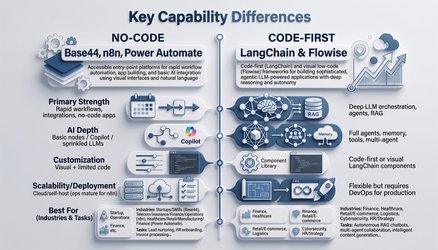
The divide between these tiers is stark.
-
No-Code Tools: Built for rapid workflows and operational efficiency, utilising built-in, one-click connectors. They handle orchestration exceptionally well but lack native depth in prompt tuning or agent collaboration.
-
Low-Code Visual Tools: Focus on deep LLM orchestration, autonomous reasoning, and custom integrations via the LangChain ecosystem, though they often require more effort to connect with external APIs.
Staying solely with no-code tools risks "AI herding", shallow automation that fails at scale or lacks true differentiation.
With LangFlow and Flowise, businesses get a competitive edge through intelligent agents that reduce manual oversight and open new value streams, such as autonomous research pipelines. However, this complexity jump requires upskilling, hybrid teams, or DevOps investment. Ignoring these requirements can lead to stalled initiatives or inflated costs from unsustainable workarounds.
Implementation Roadmap & Decision Framework
To successfully navigate the AI complexity ladder, organisations should adopt a staged approach:
-
Assess and Pilot: Start with Base44, n8n, or Microsoft Power Automate for quick operational wins, MVPs, and establishing a strong baseline for integrations and security.
-
Prototype Agentic Workflows: Test complex, reasoning-heavy prototypes in LangFlow or Flowise. Ensure all security patches are applied, and unauthenticated endpoints are disabled.
-
Scale and Govern: Export and scale with underlying LangChain or LangGraph code where needed, enforcing proper governance, observability (e.g., LangSmith or LangFuse), and secrets management.
💡 Pro Tip: Many successful teams use hybrid stacks, for example, using n8n for reliable orchestration and data plumbing to call advanced Flowise agents, balancing operational stability with deep AI reasoning.
Conclusion
Navigating the AI complexity ladder requires a strategic, staged approach. By understanding the distinct strengths and security implications of both no-code foundations and low-code visual orchestrators, businesses can avoid over-reliance on simple tools that hit hard limits.
A well-planned roadmap helps AI initiatives move from basic triggers to transformative, autonomous systems that deliver measurable ROI, not hype-driven disappointment.
💬What tier of the AI complexity ladder is your business currently on? Are you relying on no-code speed or building low-code autonomy? Share your insights below and ♻️ share this post with your network!
Further Reading
More from Me
Original Article: Read on LinkedIn | Read on Substack