All the Langs: LangChain, LangSmith, LangGraph, and LangFlow!
Introduction
Building production Large Language Model (LLM) applications requires structuring components into modular, observable architectures. While frontier models offer broad reasoning abilities, integrating them into robust enterprise systems demands clear state management and observability.
This guide outlines the four components of the LangChain ecosystem: LangChain, LangSmith, LangGraph, and LangFlow.
The How-To Guide: Navigating the Ecosystem
LangChain
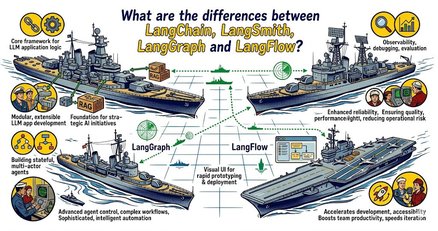
The Core Orchestration Framework: LangChain is the foundational framework for building LLM applications. It provides structured interfaces for linking modular components (such as prompt templates, model providers, and memory modules) into sequential chains.
At the architectural level, LangChain operates as the primary orchestration layer, standardising tool calls and enabling autonomous agents to interact with external APIs.
LangSmith
Observability and Production Tracing: As LLM workflows become multi-step, maintaining observability is essential. LangSmith provides a centralised platform for debugging, evaluating, and monitoring application runs in real time.
By capturing detailed execution traces across agent runs, it exposes latency bottlenecks, token consumption metrics, and failure points in production environments.
LangGraph
Stateful Multi-Actor Workflows: To move beyond linear chains, LangGraph enables cyclic, stateful multi-agent architectures by modeling workflows as graphs.
In this model, nodes represent individual actions (model queries, tool executions, or business logic), while edges define transition rules. This architecture is purpose-built for multi-agent loops and complex human-in-the-loop validation checkpoints.
LangFlow
Visual Prototyping Canvas: LangFlow provides a low-code, visual canvas for prototyping LangChain pipelines.
The drag-and-drop UI enables rapid pipeline composition and testing, allowing engineering teams and stakeholders to validate agent flows before committing to production code.
Conclusion
The Integrated AI Stack: The LangChain ecosystem functions as a comprehensive stack for LLM engineering: LangChain for foundational logic, LangGraph for stateful multi-agent orchestration, LangSmith for operational tracing, and LangFlow for visual prototyping.
Structuring production AI systems requires moving beyond single-prompt designs toward robust cyclic reasoning, observable telemetry, and governed execution.
Further Reading
-
LangChain Documentation: Conceptual Guide - A deep dive into the framework architecture.
-
LangGraph: Multi-Agent Workflows - Technical documentation for stateful, cyclic graphs.
-
LangSmith: Tracing and Evaluation - Production monitoring and test evaluation patterns.
-
State of AI Agents (LangChain Blog) - Practical insights on moving from RAG to autonomous agent architectures.
Check Out More from Me
Original Article: Read on LinkedIn | Read on Substack