The Mythos Moment: Why Restricting Frontier AI May Accelerate Its Proliferation
Introduction
The U.S. government is currently pushing back against Anthropic's plans to expand access to its latest model, Claude Mythos (also known as Mythos Preview). While Anthropic aims to increase its partner base from 50 to 120 companies under Project Glasswing, the White House remains cautious, citing significant national security and cybersecurity risks.
Why Mythos is Different
Mythos is no ordinary model. Anthropic has categorised it as a "frontier system" with extraordinary capabilities in identifying and exploiting software vulnerabilities. This includes discovering "zero-day" exploits in major operating systems, web browsers, and critical infrastructure.
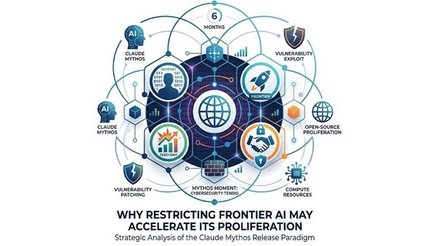
To prevent misuse, Anthropic has chosen not to release it publicly. Instead, they are vetting tech firms to find and patch flaws before they can be weaponised proactively. However, the government is concerned about two primary factors:
-
Proliferation: The risk of the technology falling into the hands of malicious state actors or cybercriminals.
-
Resource Allocation: Whether Anthropic has the compute power to serve private clients without deprioritising essential U.S. government applications.
The Six-Month Countdown
Anthropic's push for broader access is a strategic move to stay ahead of the "uncontrolled" curve. The reality of the AI landscape is that the clock is ticking:
-
The Open-Source Surge: Reports suggest open-source communities could match Mythos-level capabilities within six to twelve months.
-
Rapid Evolution: Driven by algorithmic distillation and global collaboration, the barrier to entry for high-level reasoning and autonomous coding is falling fast. Once these capabilities are available on open-source platforms like GitHub or Hugging Face, they become downloadable and untraceable. Containment, at that point, becomes impossible.
The Proliferation Paradox: Why Gating is a Catalyst
This creates a central tension for policymakers: the goal of restricting access today to stop machine-speed attacks may actually accelerate the emergence of a future in which only unregulated versions of these tools exist globally.
Several critical factors reinforce this paradox:
-
The Incentive Gap: Gating a state-of-the-art model creates a vacuum that redirects global capital and engineering talent toward creating independent, open-source alternatives with zero oversight.
-
The "Teacher-Student" Effect: The mere existence of Mythos proves these benchmarks are achievable. Even limited access enables "synthetic data generation"—in which developers use Mythos's outputs to train smaller "student" models, significantly shortening the development cycle for the open-source community.
-
Defensive Opportunity Cost: Restricting access limits the number of "good actors" who can use the technology to build defensive patches. If open-source matches Mythos in six months, but only a handful of partners are allowed to use it for defence, the global infrastructure will remain vulnerable to the "open-source flood".
-
Loss of Visibility: While API access allows Anthropic to monitor for malicious patterns, once an "Open Mythos" equivalent is released on GitHub, there is zero visibility into how it is being used.
What This Means for Leaders and Policymakers
-
Speed vs Control: Over-restriction risks driving innovation toward less accountable, open-source paths and fragments security expertise.
-
Defence-First Strategy: The real race is securing the digital world before offensive AI becomes a global commodity.
-
Global Norms: Export controls are less effective when models can be distilled into smaller, portable versions that bypass hardware barriers.
-
Please prepare now: Organisations should conduct "Mythos audits" on their software now, as the window for manual patching closes.
The debate shows frontier AI is rapidly advancing. Intentional gating could transform a collaborative security effort into a fragmented, high-speed arms race. The key question is whether your infrastructure will be ready.
Conclusion
Resilience in the Age of Agentic AI: As the window for manual intervention closes, the focus must shift from containment to resilience. We are moving away from an era in which security was a human-led, perimeter-based effort into one in which defence must happen at machine speed.
-
Automated Hardening: Organisations must integrate AI-driven patching cycles that can match the discovery speed of models like Mythos.
-
Collaborative Defence: The expansion of initiatives such as Project Glasswing is essential. By allowing a wider net of "white-hat" actors access to frontier tools, we can proactively secure the software supply chain before open-source variants democratise offensive capabilities.
The Mythos moment is a wake-up call. We cannot stop the tide of technological progress, but we can ensure we are the ones who build the dikes.
Further Reading
More From Me
Original Article: Read on LinkedIn | Read on Substack