Github Spec Kit: Executing Spec-Driven Development with AI
Introduction
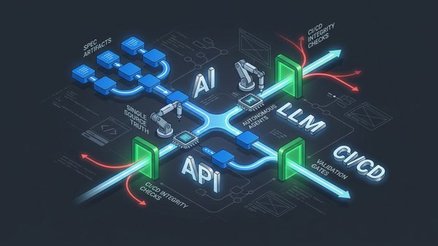
The Evolution of Development Guardrails: The rapid acceleration of AI-powered code generation often bypasses foundational engineering rigour. Implementing formalised methodologies like Spec-Driven Development (SDD) provides the necessary structural guardrails across all development workflows.
A well-defined SDD framework delivers significant strategic benefits:
- Reduced Rework: Ambiguity is eliminated before a single line of code is committed.
- Systematic Integrity: We ensure that AI-generated logic adheres to predefined architectural and security standards.
- Predictable Outcomes: Project timelines become more reliable as functional requirements are explicitly defined.
- Knowledge Portability: Well-documented specs facilitate seamless transitions between different engineering teams.
The Spec-Driven Development (SDD) Lifecycle
In a modern engineering environment, the SDD lifecycle integrates these four critical phases to maintain velocity without sacrificing quality:
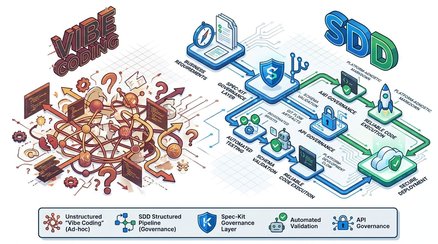
- Discovery & Architecture: We meticulously define the problem space and architectural requirements, ensuring alignment between user needs and technical feasibility.
- Specification Drafting: We transform architectural decisions into high-fidelity technical specifications, utilizing Markdown for clear and collaborative documentation.
- Validation & Verification: Every specification is rigorously tested against predefined project standards, preventing common logic errors before implementation begins.
- AI-Assisted Implementation: We provide LLMs with context-rich specifications, dramatically increasing the accuracy and relevance of generated code.
Github Spec-Kit: Bridging Design and Code
While the SDD philosophy provides the map, the Github Spec-Kit serves as the engine. This collection of GitHub-hosted protocols and templates provides a standardised method for executing Spec-Driven Development.
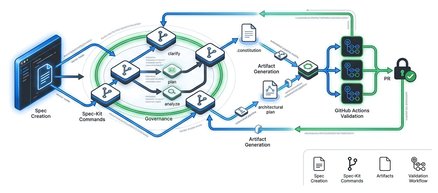
Utilising Spec-Kit offers distinct engineering advantages:
- Standardised Metadata: We utilize structured metadata in specification files to ensure consistent project tracking and observability.
- Integrated Linting: Automated tools can be used to validate specifications against your organisation's unique architectural constraints.
- Collaborative Workflows: Built natively for GitHub, it simplifies the review process, enabling peer feedback on the technical plan before execution.
- Agent-Ready Inputs: Spec-Kit is designed specifically to feed modern AI agents, such as Antigravity, the precise context they need for complex tasks.
The Implementation Imperative
Organisations that fail to implement a disciplined specification framework are increasingly vulnerable to "AI Drift"—where generative tools introduce subtle but catastrophic logic errors and security vulnerabilities over time.
Adopting Github Spec-Kit ensures that your organisation remains in total control of the final output:
- Architectural Sovereignty: You define the rules; the AI executes within those constraints.
- Security-by-Design: Threat modeling is performed at the specification level, far earlier than traditional methods allow.
- Scalable Quality: As your codebase grows, the rigor of your specifications prevents the accumulation of unmanaged technical debt.
Conclusion & Strategic Advice
Transitioning to Spec-Driven Development with Github Spec-Kit is more than a process change—it's a mindset shift that prioritises intentional design over accidental execution.
- Draft First: Never start a complex feature without a formal technical specification in Markdown.
- Audit Constantly: Utilise automated linting to ensure every spec meets your architectural and security standards.
- Empower Your Agents: Use Spec-Kit templates to provide your AI development tools with the structured context they demand.
- Standardise Early: Implement Spec-Kit protocols across your entire GitHub organisation for maximum cross-team efficiency.
Further Reading
More From Me
Original Article: Read on LinkedIn | Read on Substack