Optimizely Opal: Architecting Hybrid Intelligence
Introduction
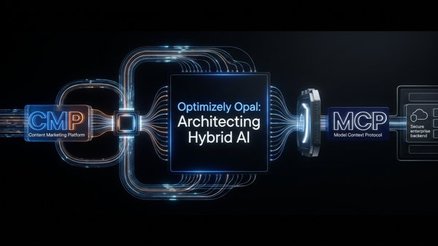
The modern Digital Experience Platform (DXP) has evolved from a static system of record into an active, cognitive execution engine. At the centre of this shift is Optimizely Opal, a native agent orchestration layer embedded directly across the Optimizely One operating system.
Driven by Google's Gemini engine, Opal eliminates friction between strategic intent and execution through three core architectures:
- Cognitive Execution Engine: Provides contextual AI assistance directly within native digital workflows.
- SaaS Velocity: Native SaaS deployment by-passes standard, decoupled API integration latency.
- Strategic Alignment: Programmatically bridges the gap between high-level campaign planning and technical deployment.
To evaluate the native capability, we map Opal's operational footprint against strict Enterprise AI demands: uncompromising data governance, intellectual property protection, and stateful compliance. This technical tension dictates an immediate shift from standard integrations to a hybrid model defined by three foundational requirements:
- Sovereign Control: Absolute localised authority over model weights, training data datasets, and local data residency.
- Baseline Capabilities: Establishing Opal's native SaaS capabilities as the essential starting edge for architectural planning.
- Bridging Environments: Securing the connection between the agile SaaS execution edge and a protected, sovereign infrastructure core.

The Native Footprint of Opal Across the DXP
1. Opal in the Content Marketing Platform (CMP): Cross-Asset Harmonisation
The campaign lifecycle often runs into execution friction when translating unstructured strategic briefs into interconnected, multi-channel technical assets. Within the Optimizely CMP, Opal operates as an embedded agentic orchestrator for content operations.
Moving beyond basic generative text drafting, the engine executes complex cross-asset harmonisation via three technical mechanisms:
- Semantic Mapping: Autonomous extraction of contextual relationships between isolated assets by parsing historical performance metrics and active campaign repositories.
- Payload Adaptation: Programmatic translation of overarching campaign architectures into targeted messaging payloads optimised for individual downstream distribution channels.
- Workflow Orchestration: Real-time consistency checks executed against defined strategic objectives to govern the creative pipeline rather than merely generating text payloads, Optimizely Artificial Intelligence (Opal).
2. Opal in the Content Management System (CMS): Dynamic Schema Generation & Intent-Matching
When content reaches the publishing tier within the Content Management System (CMS), Opal shifts operations from text manipulation to structural orchestration. Digital architects can bypass manual schema design and invoke the engine for advanced structural engineering tasks:
- Dynamic Schema Generation: Automated construction of complex, linked-data graphs and extensible metadata structures.
- Proprietary Alignment: Programmatic mapping of generated schemas against internal, proprietary organisation taxonomies.
- Semantic Intent-Matching: Real-time evaluation of active user context to dynamically adapt structural content payloads, optimising global localisation while reducing manual engineering overhead, Optimizely One Overview.
3. Opal in the Optimizely Data Platform (ODP): Semantic Data Harmonisation
Enterprise customer data platforms (CDPs) frequently operate as opaque data silos requiring specialised analytics resources or complex SQL construction. Within the ODP environment, Opal functions as a cognitive abstraction layer.
Moving beyond basic Boolean query logic, the engine executes full semantic data harmonisation driven by unstructured inputs:
- Natural Language Processing: Direct interpretation of multi-layered, conditional user queries (e.g., "Find customers who browsed our enterprise products twice in the last week but haven't opened our newsletter.").
- Contextual Translation: Compilation of highly contextual natural language intent into deterministic, executable cohort queries.
- Actionable Intelligence: Synthesising unstructured behavioural signals to democratize data access across distributed operational teams.
4. Opal in Experimentation and Personalisation: Autonomous Workflow Orchestration
Robust optimisation and experimentation programs face persistent scaling bottlenecks due to the manual overhead of designing, validating, and deploying variant configurations. Opal overcomes this limitation by comparing live landing page performance against historical conversion baselines to drive autonomous workflow orchestration.
The optimisation engine handles three critical execution tasks at scale:
- Agentic Integrations: Utilising agentic API interactions to discover and suggest high-impact optimisation variables autonomously.
- Testing Frameworks: Rapid programmatic generation of alternative layout configurations, complex call-to-action paths, and multivariate testing frameworks.
- Optimisation Velocity: Injecting specific domain knowledge directly into the contextualised AI runtime to accelerate deployment velocity Developer Experiences with a Contextualized AI Coding Assistant: Usability, Expectations, and Outcomes.
5. The Integration Frontier: The Sovereign Imperative
Opal's native integration in Optimizely One provides immediate operational velocity by inheriting system-state context. This architecture directly mitigates the "empty prompt" limitation typical of generic, decoupled Large Language Models Contextual AI Journaling: Integrating LLM and Time Series Behavioral Sensing Technology.
However, relying on this native layer as the definitive enterprise destination introduces significant structural risks when interacting with specialised backend systems:
- The Silo Wall: When Opal attempts to query proprietary inventory databases, validate generation against stateful regulations, or trigger complex enterprise CRM actions, it encounters the hard boundaries of enterprise governance.
- Compliance Violations: Transmitting proprietary, PII-laden CRM data or regulated financial parameters into a multi-tenant SaaS endpoint breaches strict compliance, data privacy, and IP protection protocols.
- Sovereign Mandate: This boundary is a non-negotiable governance imperative. Resolving this tension requires a hybrid, hub-and-spoke model incorporating three distinct retrieval components:
- Secure Core Operations: An air-gapped, sovereign core securely retrieves and synthesises proprietary data using the principles of Generative Information Retrieval (GenIR), Foundations of GenIR.
- Sanitised Context: The secure core exposes only anonymised, sanitised semantic context to the Opal SaaS edge via Agentic API tool-calling (optimised in Gemini 1.5 Pro).
- Localised Processing: Highly localised Small Language Models (SLMs,) Small but Significant: On the Promise of Small Language Models for Accessible AIED are deployed within the secure perimeter to pre-process sensitive data payloads before cloud egress.
Conclusion & Strategic Advice
Opal gives you a strong experience edge, speeding up native workflows and coordinating complex logic across the CMP, CMS, ODP, and Experimentation suites. However, optimising execution velocity shouldn't override the core mandate for strict data governance.
Systems architects must structure future DXP deployments using a phased, security-first engineering methodology:
- Workflow Mapping: Audit and map all native edge workflows against incoming sovereign data residency and compliance requirements.
- Hub-and-Spoke Deployment: Treat Optimizely Opal as an agile, specialised front-end spoke servicing a rigorously protected, sovereign enterprise hub.
- Bridging the Gap: This architectural approach combines SaaS-level execution speed with full backend control.
Next in the Series:
Further Reading
- Adversarial Transformer Language Models for Contextual Commonsense Inference
- Foundations of GenIR
- Small but Significant: On the Promise of Small Language Models for Accessible AIED
- Contextual AI Journaling: Integrating LLM and Time Series Behavioral Sensing Technology
More From Me
Original Article: Read on LinkedIn | Read on Substack