Optimizely Opal: Why Isolated Intelligence Encounters the Enterprise Wall
Introduction
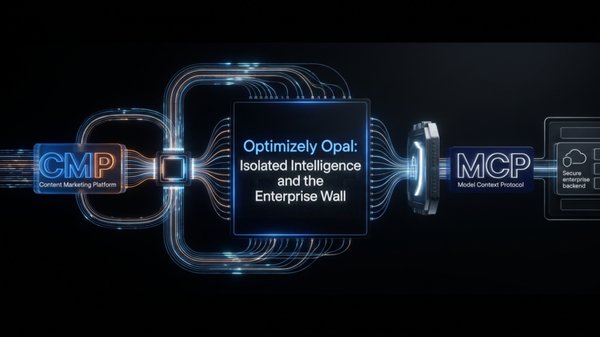
A high-velocity digital experience platform (DXP) is a foundational capability, but orchestrating its generative intelligence securely across enterprise systems is the next competitive frontier. As established in Optimizely Opal: Architecting Hybrid Intelligence , native AI workflows fundamentally transform platform agility .
To achieve true enterprise scale beyond the immediate UI agility of the Content Marketing Platform (CMP) , architects must design a structural bridge:
- Custom Integrations : Complex environments require deterministic access to proprietary databases and stateful compliance guardrails.
- Architectural State : Opal's isolation is an architectural state rather than a platform flaw, demanding Optimizely's extensibility to build the necessary integration bridges.
- Scaling Limitations : Isolated SaaS AI layers inevitably hit a scaling wall when disconnected from broader enterprise data fabrics .
This guide examines the structural constraints of standalone orchestration and details the Hub-and-Spoke model for decoupled intelligence. By identifying integration bottlenecks, you can separate cognitive processing from edge execution, enabling you to deploy high-velocity, structurally secure AI workflows.
1. The Role of Opal at the Experience Edge
Optimizely Opal functions as a native, context-aware agent orchestration layer embedded directly inside the marketing environment, as detailed in the Optimizely Opal Documentation . Operating strictly within the boundaries of the CMP and Content Management System (CMS) , the platform executes specific edge functions:
- Metadata Preservation : The engine retains critical system context, including brand guidelines, creative briefs, performance history, and audience tags.
- Execution Acceleration : Native DXP AI orchestration reduces "cold-start" prompting issues, compressing the time between strategy and execution.
- Measurable Velocity : Generating assets, drafting copy, and managing A/B test variations natively reduces campaign time-to-market by up to 40% [ Gartner Magic Quadrant for DXPs ].
From a systems-design perspective, Opal evaluates prompts and routes requests to specialised models at the UI level. This architecture operates as an autonomous engine for creative execution.
2. The Inherent Limits of Standalone SaaS AI
When evaluating frontend agility, treating Opal as a standalone monolithic engine exposes significant structural limitations. Modern compound AI systems require expansive software infrastructures to coordinate multiple models, retrievers, and databases over single-vendor LLM interfaces [ A Blueprint Architecture of Compound AI Systems for Enterprise ].
Relying exclusively on a single vendor's API restricts core capabilities across the technology stack:
- Network Constraints : Monolithic deployments limit the ability to run multi-model routing networks or deploy fine-tuned open weights models.
- Sovereign Control : Vendor lock-in compromises sovereign control over the broader architectural ecosystem.
- Observability Deficits : Isolated SaaS platforms lack the database-level observability required to track detailed token usage, latencies, and granular computing costs [ The Forrester Wave: Digital Experience Platforms ].
This persistent opacity leaves system architects blind to structural inefficiencies. Consequently, monolithic intelligence becomes difficult to scale across distributed enterprise environments.
3. Data Isolation and the Compliance Gap
High-velocity operations necessitate real-time synchronisation with heterogeneous systems, such as ERPs for inventory, CRMs for customer lifetime value, and private vector databases for product specifications. A critical data isolation problem emerges because standard SaaS sandboxes cannot securely query these external stores without extensive architectural bridging [ Hybrid AI Architectures in Enterprise Systems ].
To enforce the rigid safeguards required by enterprise standards, organisations must implement three core compliance controls:
- Regulatory Audits : In sectors such as finance and healthcare, content must reliably clear multi-stage safety audits.
- Deterministic Isolation : Deploying compliant decision memory relies on stateless, deterministic multi-tenant isolation to ensure every action carries an auditable rationale [ Stateless Decision Memory for Enterprise AI Agents ].
- Workflow Constraints : Standalone interfaces cannot independently enforce the cyclical, stateful agent workflows necessary to guarantee deterministic outcomes.
When content reaches the publishing tier within the Content Management System (CMS), operations shift to a strict validation model. The framework evaluates live landing page performance metrics against historical conversion baselines to drive autonomous workflow orchestration.
While embedded AI offers immense speed, it does not natively inherit the enterprise's broader zero-trust or compliance frameworks without active back-end integration.
4. The Blueprint for Sovereign Hybrid Architectures
To overcome the enterprise wall, systems engineers must pivot toward decoupled intelligence through a structured Hub-and-Spoke architecture. In this model, Optimizely Opal functions exclusively as the "Spoke"—serving as the creative curation interface and the human-in-the-loop approval layer.
Connecting the Hub and Spoke requires a "Fabric," functioning as a concrete engineering reality that links components through three distinct retrieval mechanisms:
- The Cognitive Hub : Heavy computational lifting is offloaded to the Cognitive Core, which manages stateful logic, queries internal vector databases , and enforces deterministic compliance checks.
- Architectural Protocols : The Fabric must be engineered using event-driven API gateways, GraphQL data-mesh layers (such as Optimizely Graph), and schema-validated Model Context Protocols (MCP) [ Architectures for Building Agentic AI ].
- Secure Routing : By utilising webhooks and event-driven REST APIs triggered from CMP workflows, Opal securely routes structured payloads out of its sandbox.
Executing this blueprint requires organizational alignment across a Unified AI Complexity Ladder, from practitioners using the Spoke to AI Engineers designing the core. Ultimately, agentic AI's reliability depends on disciplined interfaces and schema-constrained tool calls to control the creative pipeline, not just text generation.
Conclusion & Strategic Advice
Transitioning from isolated generative sandboxes to a sovereign, hybrid architecture unlocks the potential of compound AI systems. By decoupling intelligence, keeping Optimizely Opal as the agile Spoke and deploying a secure Cognitive Core as the Hub, organisations gain creative velocity and deterministic compliance.
When deploying this architecture, adhere to the following selection matrix:
- Rapid Content Iteration : Rely on the embedded Spoke to maximise front-end agility.
- Enterprise-Scale Operations : If workflows require querying proprietary ERP/CRM data or mandating auditable regulatory steps, invest heavily in provisioning the Cognitive Core and Fabric.
Begin by mapping your current integration bottlenecks and auditing your SaaS AI dependencies. Optimizely Opal: The Hub-and-Spoke Architecture outlines the specific technical steps to establish this integration fabric. Build the structural bridge between frontend agility and backend sovereignty today to secure your digital operations.
💬 How is your organisation balancing the demand for lightning-fast marketing velocity with the non-negotiable need for technical AI sovereignty? Drop your thoughts in the comments and ♻️ share this post with your network to keep the conversation going!
Next in the Series:
- Optimizely Opal: Intelligent in Isolation Hits the Enterprise Wall
- Optimizely Opal: The Hub-and-Spoke Architecture
Further Reading
- Orchestrating Agents and Data for Enterprise: A Blueprint Architecture for Compound AI
- Flow State: Humans Enabling AI Systems to Program Themselves
- Blue Data Intelligence Layer: Streaming Data and Agents for Multi-source Applications
More From Me
Original Article: Read on LinkedIn | Read on Substack