Generative Engine Optimisation: Schemas and Content Models for AI Crawlers

Part 2 of 3 - Schemas, Code-Level Delivery, and Static Architectures
Introduction
Building on the retrieval theories established in Part 1 of this series, we now turn to concrete execution. Structuring web assets purely for human visual consumption is no longer sufficient.
To ensure our digital footprint is processed cleanly by conversational synthesis agents, we must architect our pipelines for machine readability first.
While traditional SEO relies on legacy JSON-LD for surface-level categorisation, Generative Engine Optimisation (GEO) mandates deep integration with Retrieval-Augmented Generation (RAG) systems. This architectural shift demands three operational updates:
- Vector Chunking : Designing rigid textual divisions for semantic embeddings.
- Meso-structures : Applying explicit intermediary layouts for precise data extraction.
- Entity Disambiguation : Executing deterministic entity disambiguation protocols that older semantic web practices omit.
This tutorial outlines the code-level delivery mechanisms you need to ensure digital assets are retrievable for 2026 AI discovery platforms. We define a Headless/Decoupled architecture that uses an enterprise DXP as a headless content repository to trigger high-speed Static Site Generation (SSG) builds, securing friction-free ingestion.
Executing this pipeline yields three core competencies:
- Semantic Anchoring : Implementing deterministic validation via TechArticle schemas and sameAs entity disambiguation.
- Penalty Mitigation : Preventing algorithmic indexing faults linked to schema over-optimisation by compiling payloads at build-time.
- Pipeline Construction : Architecting a "Headless Content API to Git-based Static Site Generator" configuration that binds strict enterprise CMS modelling with high-speed static delivery.
1. The Core Logic of Machine-Readable Structure
An extraction layer requires explicit structural parameters to parse the underlying document without semantic ambiguity. Text embedded within chaotic, deeply nested visual layouts degrades crawling efficiency and elevates compute overhead.
Deploying unformatted text blocks subjects content indexing to stochastic scraping conditions, resulting in unreliable citation metrics.
Modern retrieval engines demand deterministic data structures to drive two specific architectural realignments:
- Structural Decomposition : Recent studies in Generative Engine Optimisation confirm that stratifying content into macro, meso, and micro-structures directly commands an LLM's retrieval module.
- Hierarchical Sequencing : Providing highly legible layouts through strict heading constraints ( H2/H3 boundaries ), with standalone answer blocks immediately following headers, converts natural language into query-matching fragments ready for vectorisation .

Caution : We must calculate the Schema Over-Optimisation Risk before deployment.
Executing hyper-dense metadata injections that diverge from the user-facing text layout triggers adversarial classification filters inside modern LLM extraction pipelines. Structural alignment between the visual presentation and the machine code represents a strict baseline requirement.
2. Deep-Dive: The Perfect JSON-LD Schema Payload
Explicit semantic signalling via JSON-LD establishes the foundational matrix required for entity validation across the open web. Modern RAG architectures mandate high semantic density and unambiguous entity disambiguation to construct precise retrieval contexts.
Configuring the verified Schema.org TechArticle Specification maps the exact professional footprint through two explicit integration layers:
- Baseline Node Mapping : Configuring mandatory fields, including jobTitle, publisher, and absolute source URLs, provides foundational crawler orientation.
- Deterministic Authority Mapping : Applying the sameAs property protocol to link a Person or Organisation to a verified external knowledge graph—such as Wikidata , ORCID , or the Google Knowledge Graph —generates exact node resolution instead of relying on fuzzy text strings.

Applying the Schema Markup Validator guarantees exact syntax correctness.
Explicitly matching mapped data points against authoritative vector spaces immediately verifies domain authority and reinforces baseline E-E-A-T markers.
{
  "@context": "https://schema.org",
  "@type": "TechArticle",
  "headline": "Blueprinting GEO: Designing Schemas and Content Models",
  "author": {
    "@type": "Person",
    "name": "Author Name",
    "jobTitle": "Technical Director",
    "sameAs": [
      "https://orcid.org/0000-0000-0000-0000",
      "https://www.wikidata.org/wiki/Q123456"
    ]
  },
  "publisher": {
    "@type": "Organization",
    "name": "Enterprise DXP Global Hub",
    "sameAs": "https://www.wikidata.org/wiki/Q654321"
  }
}
Caution : Integrating these payloads requires specific safeguards against File Fragmentation .
Storing inline schema blocks directly inside dynamic database schemas generates layout bloat and processing friction. Securing zero-overhead performance requires extracting these schemas into build-time static generation fragments using two principal frameworks:
- Component Extraction : Compiling schema logic at build time using Next.js guarantees immediate machine availability.
- Static Payload Delivery : Running equivalent build-time schema injection via Astro isolates metadata processing from client-side execution loops.
3. Decoupled Architecture: Enterprise DXP Meets Static Delivery
As we scale across a global footprint, we adopt a Decoupled Paradigm that aligns enterprise CMS platforms with static web frameworks. From a systems design perspective, operating an enterprise system such as the Optimizely DXP requires configuring the platform exclusively as a headless content repository.
Enforcing rigid governance across the Content API relies on three programmatic configurations:
- Taxonomy Enforcement : Standardising exact taxonomy tags across all backend inputs.
- Author Validation : Mapping explicit author references within the metadata constraints.
- Unified Properties : Standardising metadata formats globally to guarantee every payload matches the baseline operational requirements.
This structured backend connects directly to a Headless Content API to a Git-based Static Site Generator pipeline.
Heavy Single Page Application (SPA) architectures that use client-side compilation suffer lower indexing priority under continuous, compute-limited extraction cycles. Operating a pre-rendered environment built entirely on markdown and low-friction HTML provides zero loading overhead.
This pipeline leverages two specific asset deployment channels:
- Static Repositories : Implementing Git-based repositories—such as the LinkedIn article archive , ensures spiders immediately index the flat documents.
- Scraping Continuity : We deliver clean semantic HTML without heavy client-side scripts, ensuring indexing timelines via continuously updated XML feeds (e.g., /feed.xml).
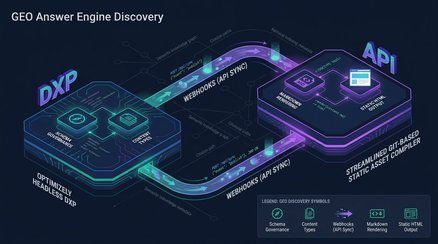
Running this hybrid pipeline gives you full structural autonomy. The backend relies on the extensive workflow tools of an enterprise DXP to enforce strict data structures, and the delivery layer fires an SSG build to serve high-velocity, machine-readable HTML.
Conclusion & Strategic Advice
Engineering explicit machine-readable structures guarantees exact placement within AI retrieval contexts. By merging strict taxonomy governance via headless APIs with the speed of build-time static asset delivery, we create a highly authoritative, frictionless ingestion pipeline.
Operating this dual-layer pipeline requires two primary implementations:
- Headless DXP Repositories : This data layer helps you manage complex workflows, multi-author environments, and global taxonomy scaling, serving as the structured single source of truth .
- Git-based static site generators: Deploying this delivery layer prioritises platform autonomy, build-time schema injection, rendering speed, and uninterrupted scraping loops.
Auditing your current delivery pipeline is the next step to secure technical discovery. Extract dynamic JSON-LD structures and convert them into streamlined build-time static generation fragments.
Automated validation protocols are detailed in the subsequent blueprint: GEO for Optimizely Part 3: Algorithmic Orchestration and Measuring AI Citation Rates.
💬 How is your engineering team preparing your content architecture for the next wave of AI discovery platforms? Share your insights below and ♻️ repost to help your network stay ahead!
Further Reading
- Structural Feature Engineering for Generative Engine Optimization: How Content Structure Shapes Citation Behavior
- Schema.org TechArticle Specification
- Schema Markup Validator
More From Me
Original Article: Read on LinkedIn | Read on Substack