Optimizely Opal: The Hub-and-Spoke Architecture
Introduction
Building on the concepts in Optimizely Opal: Architecting Hybrid Intelligence , the foundational challenge of modern enterprise AI is addressed in resolving organisational misalignment. Forcing a single, monolithic tool to satisfy divergent departmental requirements creates severe systemic friction:
- Marketing Agility : Demands immediate creative velocity for omnichannel campaigns.
- Engineering Governance : Mandates absolute data sovereignty and strict Security protocols.
- Systemic Bottlenecks : Forcing both needs into a singular environment inevitably leads to congested production pipelines or compromised technical security.
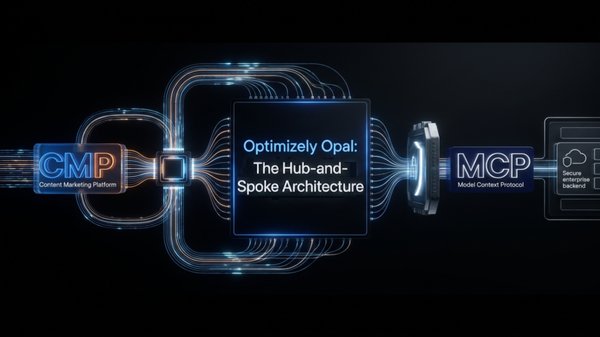
The Hub-and-Spoke Architecture resolves this tension by physically and logically separating operational environments. Organisations achieve the dual objectives of frontend agility and backend control by structuring the system into distinct operational zones:
- The Creative Spoke : A user-facing interface operating Opal directly within a Content Marketing Platform (CMP).
- The Cognitive Hub : A strictly governed backend housing stateful reasoning engines.
Crucially, this decoupling introduces a deliberate architectural tax rather than acting as a magic bullet. This framework represents a calculated trade-off, strictly favouring sovereign security and scalable backend logic over superficial simplicity:
- Infrastructural Complexity : Organisations must actively manage and secure multiple decentralised operating environments.
- Resource Allocation : Maintaining the architecture requires retaining a highly skilled, multi-tiered technical workforce.
This architectural blueprint evaluates the ecosystem integration mapping across the Unified AI Complexity Ladder . By examining structured data flows and evaluating distinct integration layers, you gain a definitive framework to orchestrate secure agentic workflows without vendor lock-in :
- Workflow Automation : Utilising n8n and Power Automate to establish reliable data bridges.
- Visual Orchestration : Using LangFlow to model and expose complex agent graphs visually.
- Universal Protocol Layer : Adopting the Model Context Protocol (MCP) as the foundational standard for secure integrations.
1. Decoupling Creative Curation from Enterprise Cognition
From a systems design perspective, the Hub-and-Spoke Paradigm addresses the critical risk of running intensive cognitive processing directly inside the core platform. By splitting the architecture, the Spoke operates purely at the experience edge within the CMP or CMS :
- Natural Language Interfaces : Functions as the primary endpoint, allowing operators to execute prompts, draft assets, and assemble templates seamlessly.
- Review Mechanisms : Facilitates essential human-in-the-loop validations before execution.
Conversely, the Hub (Cognitive Core) resides deep within a secure enterprise perimeter. Isolating the reasoning core provides absolute data sovereignty, mitigates vendor model lock-in, and supports complex multi-model routing, Optimizely Opal: Architecting Hybrid Intelligence :
- State Management : Manages stateful agent graphs and queries secure private vector stores .
- Persistent Memory : Maintains long-term context while logging operational observability metadata via tools like LangSmith; All the Langs: LangChain, LangSmith, LangGraph, and LangFlow! .
- Model Deployment : Enables the secure internal hosting of fine-tuned open-weights models .
2. Loose Coupling via API Tool Calling
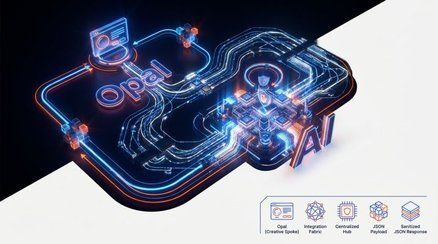
When the edge interface requires access to external knowledge or strict compliance auditing, it invokes a registered external tool. This design relies on a highly structured integration pattern optimised for boundary control:
- Payload Formatting : Requests are formatted strictly as structured payloads.
- Intermediary Routing : Data flows securely through an established integration fabric to reach the centralised hub.
- Centralised Validation : The hub receives the payload, queries private databases, performs the required security validations, and returns a sanitised response payload.
Omitting the systemic costs of this abstraction violates the pragmatic standards of enterprise systems design. API tool calling and structured payload transfers fundamentally introduce network latency and asynchronous state challenges:
- Execution Delays : Complex LangGraph agent architectures frequently execute multi-step reasoning loops spanning tens of seconds to minutes.
- UX Degradation : If the Spoke UI blocks while waiting for a synchronous payload response, the operator experience will degrade drastically.
As a result, this decoupling mandates rigorous asynchronous user experience design within the Spoke. This authentic loose coupling ensures backend models and reasoning agents can be continuously updated or replaced without disrupting the user-facing interface:
- Event-Driven Communication : Platforms must employ mechanisms such as long-polling , webhook callbacks, or Server-Sent Events (SSE) to prevent frontend interface timeouts.
- Heavy Compute Isolation : Keeps the interface highly responsive while the Hub conducts extensive Retrieval-Augmented Generation (RAG) and backend compliance checks.
- Parallel Optimisation : Allows operators to interact with the platform continuously while engineers optimise backend logic on parallel tracks, uninterrupted.
3. The Unified AI Complexity Ladder
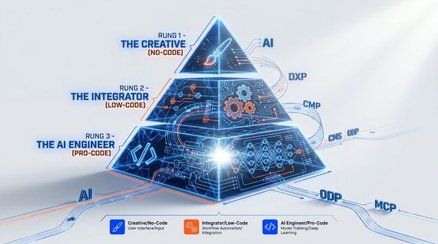
To scale this architecture and manage its complexity, we need to structure our tooling and talent against a Unified AI Complexity Ladder . We categorise this operational distribution into three distinct functional tiers:
- Rung 1 - The Creative ( No-Code ) : Operating exclusively at the Spoke, these operators prompt the system within the content platform to generate assets, focusing entirely on campaign velocity.
- Rung 2 - The Integrator ( Low-Code ) : Managing the integration fabric, systems analysts construct visual pipelines and configure webhooks (e.g., via n8n ) to route payloads and handle asynchronous state transfers; Power Automate to LangFlow: The AI Complexity Ladder Businesses Must Climb .
- Rung 3 - The AI Engineer (Pro-Code) : Positioned entirely at the Hub, software engineers build the cognitive backend. They utilise frameworks like LangGraph and deploy secure infrastructure to ensure high-fidelity Retrieval-Augmented Generation All the Langs: LangChain, LangSmith, LangGraph, and LangFlow! .
4. Categorising the Integration Fabric
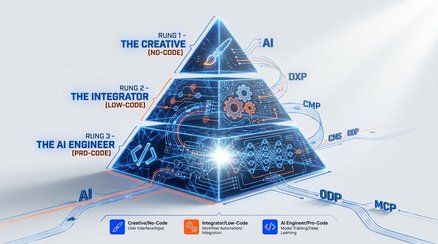
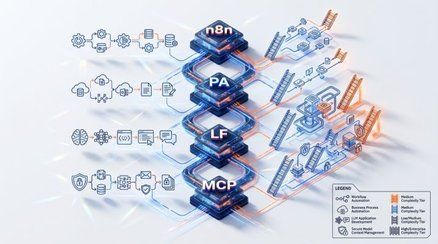
The integration fabric serves as the vital connective tissue, mapping requests between the creative spoke and the cognitive hub. Evaluating the appropriate tooling ensures secure, rigorous operational handoffs:
- n8n : Provides secure workflow automation tailored for Rung 2 integrators, enabling highly secure, self-hosted webhook bridges Power Automate to LangFlow: The AI Complexity Ladder Businesses Must Climb .
- Power Automate : Serves organisations heavily entrenched in the established Microsoft ecosystem.
- LangFlow : Offers a visual canvas for modelling agentic graphs, allowing engineers to expose complex workflows cleanly as structured APIs; All the Langs: LangChain, LangSmith, LangGraph, and LangFlow!
When assessing the Model Context Protocol (MCP) , please understand it as the foundational protocol layer, not as a competing platform to the tools above. It functions as the open standard adapter that normalises the tool-call payloads routed between the Spoke, the integration fabric, and diverse data repositories:
- Dynamic Discovery : Enables standardised discovery and dynamic invocation of tools across diverse backends; Model Context Protocol: Universal Adapter for Agentic AI🌐 .
- Sandboxed Execution : Integrating CodeAct execution directly with MCP allows operational commands to run strictly inside secure, sandboxed infrastructure.
- Database Protection : Protects primary databases while granting autonomous agents essential operational freedom; Understanding CodeAct and MCP: A Guide for Professionals .
Conclusion & Strategic Advice
The Hub-and-Spoke Architecture does not eliminate friction; it strategically relocates it from the compliance layer to the integration fabric, allowing organisations to manage it securely. Mapping specialised tooling against the Unified AI Complexity Ladder establishes a highly resilient, vendor-agnostic architecture capable of balancing rapid frontend agility with rigorous enterprise sovereignty:
- Microsoft Workflows : For rapid, Microsoft-centric workflow bridging, select Power Automate .
- Sovereign Deployments : For self-hosted, sovereign data transformations, implement n8n .
- Universal Standardisation : To establish a universal protocol for payload routing and agentic tool invocation across all backend repositories, adopt the Model Context Protocol (MCP) .
Review the technical maturity of your current platform environments against these tiers to identify immediate architectural gaps. Transitioning from theoretical frameworks to engineering execution requires a structured sequence:
- Strategic Roadmap : Our next instalment provides the definitive roadmap: Part 4: Implementation Blueprint & Strategic Roadmap.
💬 How is your organisation balancing the tug-of-war between frontend creative velocity and backend data governance? Drop your thoughts below and ♻️ share this architectural framework with your network!
Further Reading
- Model Context Protocol (MCP) Official Documentation
- LangGraph by LangChain: Building Stateful Agents
- Optimizely Content Marketing Platform (CMP) Overview
More From Me
Original Article: Read on LinkedIn | Read on Substack