AI Impacts: The AI Career Crossroads
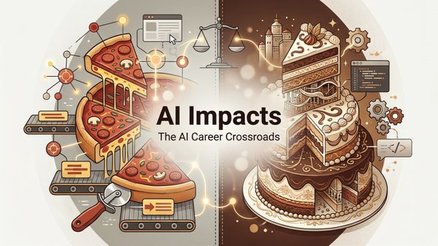
- part 8 of 8: Specialist versus Generalist
Introduction
Building on our exploration of core knowledge retention in AI Impacts: Preserving Skill in the Age of AI, keeping your baseline expertise is the first step to surviving the current ecosystem shift. The competent middle tier of professional execution is undergoing rapid commoditisation.
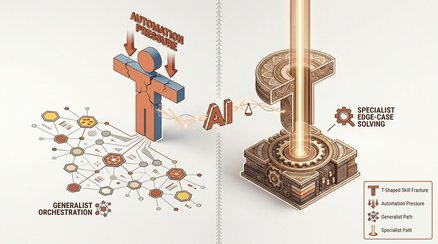
This structural erosion fractures the traditional T-shaped skill profile through two converging automation trends:
- Execution Commoditisation : Operational tasks requiring foundational expertise—baseline code assembly, pipeline configuration, and standard system formatting—execute in milliseconds.
- Strategic Divergence : Practitioners must choose between orchestrating vast horizontal systems or mastering specialised, low-data niches.
As AI evolves from autoregressive pattern-matching ( System 1 ) to agentic , test-time reasoning ( System 2 ), the boundaries of these niches shift rapidly. Analysing this bifurcation provides three distinct career evaluation metrics:
- Trajectory Evaluation : Equip yourself to evaluate your technical trajectory against automated baselines.
- Boundary Navigation : Navigate the fluid boundary between unvetted workflows and highly specialised orchestration.
- Resilience Architecture : Architect a resilient, dynamically adapting career path in an automated landscape
Path A: The Hyper-Generalist
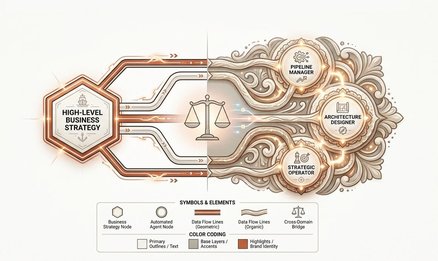
From a systems-design perspective, the hyper-generalist transitions from tactical execution to high-level architecture. Instead of writing custom integrations, these architects deploy multi-agent frameworks to direct parallel workflows across engineering, strategic operations, and interface design.
This horizontal expansion introduces a critical structural vulnerability through three primary mechanisms:
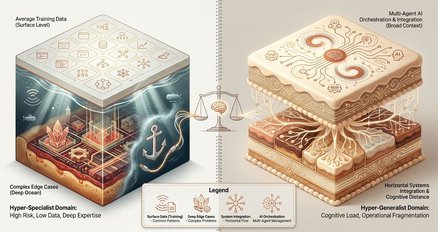
- Cognitive Distance Tax : Operating across radically diverse domains enforces continuous, resource-heavy context switching.
- Load Accumulation : Cognitive ergonomics research from the American Psychological Association (APA) proves that managing multiple complex, automated pipelines simultaneously accrues a heavy cognitive load .
- Audit Degradation : This tax directly reduces the capacity to audit latent errors, hallucinated variables, or edge-case failures.
Unchecked, these accumulated faults leave the entire system exposed to undetected cascading failures.
Path B: The Hyper-Specialist
Scaling vertically requires mastering advanced mathematical validation and first-principles reasoning. With the deployment of advanced inference-time compute and reinforcement learning models such as OpenAI's o1 architecture and AlphaProof , automated systems are actively penetrating synthetic mathematical logic.
To stay ahead, true hyper-specialisation requires continuous pivoting ahead of the automation curve. The shrinking 1% of unmapped edge cases cluster around four strict domains:
- Physical-World Integrations : Hyper-niche hardware interfaces that resist pure synthetic modelling.
- Proprietary Ecosystems : Closed-loop data environments and bespoke legacy infrastructure.
- Regulatory Compliance : High-stakes ethical boundaries and zero-trust governance structures.
- Systemic Diagnostics : Complex diagnostic debugging and custom kernel optimisation .
The Stanford HAI AI Index Report notes that specialised human oversight remains strictly non-negotiable for these constrained environments. Specialists sustain their value by executing within physical and systemic constraints that remain isolated from broad data distributions.
The Danger Zone: The AI Wrapper
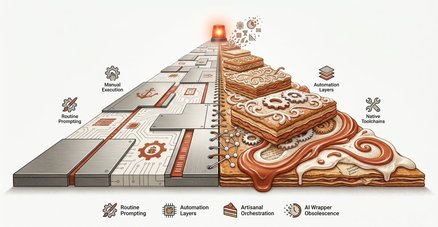
Practitioners operating as passive conduits for basic prompting without adding structural logic face an aggressive automation curve. According to the McKinsey Global Institute , the manual "prompt-and-paste" intermediary role is at risk of elimination.
Two accelerating integration mechanisms drive this obsolescence:
- Toolchain Integration : Foundational models directly embed into raw developer toolchains.
- Environment Native : AI agents execute natively within IDE layers.
Operating in this middle ground enforces a severe dilution deficit. It lacks the horizontal orchestration of the generalist and the diagnostic depth of the specialist, making it vulnerable to advancing technological baselines.
Designing Your Career Runway
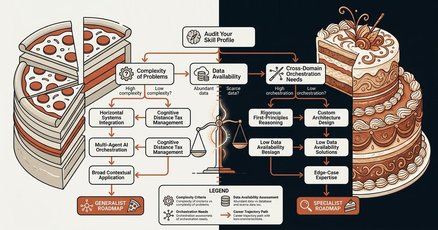
Formulating a deliberate vector away from execution-heavy tasks requires assessing adoption rates between startups and mature enterprises. This evaluation determines which architectural path offers immediate operational value.
Securing the generalist roadmap requires a shift towards two core disciplines:
- Structural Orchestration : Governing cross-disciplinary data architecture and organisational pipelines.
- Context Preservation : Implementing disciplined interface engineering and distraction-free time blocks to survive context-switching penalties documented by the University of California, Irvine (UCI).
The specialist roadmap focuses on deep entrenchment in domains constrained by physical-world limitations and bespoke legacy infrastructure. Technical workforce data from MIT Sloan Management Review confirm that these environments resist synthetic abstraction.
Navigating this vertical demands a continuous focus on adapting systems to human cognitive limits:
- Edge-Case Migration : Future breakthroughs in test-time compute automatically resolve current anomalies, forcing continuous relocation to unmapped domains.
- Ergonomic Alignment : Pre-print research, such as " CogErgLLM: Exploring Large Language Model Systems Design Perspective Using Cognitive Ergonomics", proves that system design must align with human cognitive thresholds.
- Vulnerability Mitigation : Ignoring cognitive limits accelerates the structural failure rates of both generalist and specialist architectures.
Conclusion & Strategic Advice
The traditional execution-heavy career path is definitely fracturing. The primary objective is to systematically separate your operational output from the easily automated middle tier.
Evaluate your technical environment immediately to select one of two viable survival vectors:
- Horizontal Integration : Generalists secure their position by mastering multi-agent orchestration and actively mitigating cognitive load across diverse pipelines.
- Vertical Depth : Specialists maintain defensibility by continuously pivoting to dominate novel, low-data physical anomalies and regulatory edge cases.
- Output Assessment : If your current output relies on average speed over complex diagnostic judgment, mandate an immediate architectural pivot.
As we conclude this overarching series, the final thesis remains clear: AI does not eliminate the need for human expertise, but it ruthlessly reallocates its value in line with structural scarcity.
Recognising initial skill atrophy and selecting your specialised or generalised trajectory are mandatory engineering requirements. True resilience comes from placing your cognitive strengths in the physical, bespoke, and regulatory spaces where synthetic reasoning models struggle.
In an automated ecosystem, human value is defined by either visionary system orchestration or uncompromising technical rigour. 💬 Are you scaling out to orchestrate the broader system, or retreating deep into specialised edge cases? Share your path below and ♻️ share this post to help others navigate the shift!
Further Reading
- The Rise of the AI Engineer
- Emerging Architectures for LLM Applications
- Building Defensible LLM Applications
More From Me
- Cognitive Distance: Navigating the Limits to T-Shaped Skills
- Your Career Runway Just Got Longer: How AI Lets You Focus on Wisdom, Not Tech
- The Hidden Perils of Cost-Cutting in AI: Safeguarding Expertise in a Knowledge Economy
- The LLM Revolution: Threat or Opportunity for Software Developers?
- AI & The Future of Employment: Preparing for the AI-Driven Future (Part 3)
- AI & The Future of Employment: New Opportunities and Challenges in the Age of AI (Part 2)
- AI & The Future of Employment: How AI Is Transforming the World of Work (Part 1)
- The God Prompt Trap: Single-Prompt Reasoning Amplifies AI Failures
- LLM Anti-Patterns: 'One Prompt to Rule Them All'
- Beyond the 'God Prompt': A New Playbook for High-Stakes AI
Original Article: Read on LinkedIn | Read on Substack