AI Impacts: Preserving Skill in the Age of AI
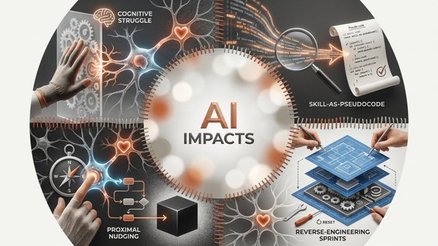
- Part 7 of 8: Skills Atrophy
Introduction to Skill Transition
Our previous examination in AI Impacts: The Illusion of AI Competence established how generative tools create an illusion of competence. The mechanics of knowledge work are undergoing a fundamental shift defined by three collapsing manual execution tasks:
- Code Generation : Writing verbose boilerplate code .
- Data Structuring : Formatting data layers.
- Documentation : Structuring routine documentation.
In multi-agent frameworks, primary responsibilities shift toward high-level system architecture, agentic orchestration, and rigorous execution auditing, while aggressively automating these manual tasks.
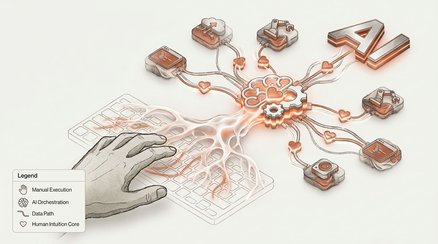
This transition reveals a severe structural risk known as the ' Agentic Delegation Effect ', in which trusting autonomous agents with structural architecture offloads the cognitive friction required to understand underlying mechanics. This guide establishes three operational frameworks for inverting multi-agent systems from black-box executors into interactive, knowledge-preserving constraints:
- Cognitive Struggle Loops : Enforcing mandatory friction during execution.
- Expertise Safeguards : Protecting foundational engineering logic.
- Auditing Ecosystems : Constructing dynamic structures to scale systemic comprehension across teams.
The Necessity of the Struggle
Conceptual mastery and long-term memory depend entirely on 'desirable difficulties' experienced during complex problem-solving. Autonomous agentic workflows mask an underlying lack of understanding through two execution patterns:
- Friction Elimination : Removing productive cognitive barriers.
- Instant Architecture : Supplying polished structural output after executing multi-step reasoning.
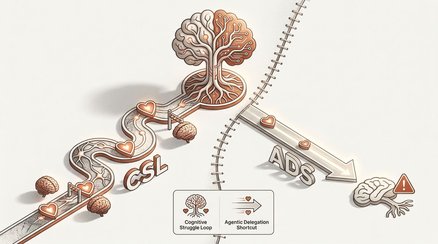
Research from the American Psychological Association (APA) demonstrates that active executive control forces the brain to build durable mental models. Bypassing this friction initiates the Agentic Delegation Effect, resulting in two operational hazards:
- Artificial Velocity : Increasing engineering speed without foundational comprehension.
- Unprocessed Acceptance : Accepting synthesised architecture without processing the underlying logic or security implications.
A 2024 empirical study, " Multimedia and Immersive Training Materials Influence Impressions of Learning But Not Learning Outcomes" , highlighted how reduced training difficulty can create a false impression of competence. The frontier of this problem has shifted to a modern solution detailed in Proximal State Nudging: Reducing Skill Atrophy from AI Assistance , which establishes three core mandates for preserving mental models:
- Proximal Interaction : Forcing engineers to interact with state transitions and architectural logic during agent execution.
- Passive Output Prevention : Eliminating the passive reception of final outputs in highly automated environments.
- Atrophy Mitigation : Arresting the downstream skill degradation identified in the Stanford HAI AI Index Report that leaves operators as fragile editors of incomprehensible complex systems.
AI as the Knowledge Preserver
The underlying architecture of multi-agent frameworks must integrate systemic cognitive constraints to govern the execution pipeline.
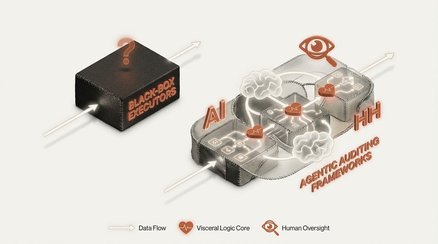
Deploying agentic auditing frameworks forces autonomous systems to expose their reasoning through systemic implementations. Recent developments in Agentic Skill Discovery demonstrate that robust internal pathways are built via two active supervision methods:
- Trajectory Mapping : Involving developers directly in charting an agent's operational boundaries.
- Execution Supervision : Governing the intermediate steps of the agent's logic to replace the evaluation of final outputs.
Implementing paradigms like Skill-as-Pseudocode: Refactoring Skill Libraries to Pseudocode for LLM Agents mandates structural transparency across the development workflow. This model translates complex, multi-step actions into readable pseudo-code before full execution, enforcing three operational requirements:
- Logic Verification : Compelling the human operator to read, understand, and approve the structural logic.
- Pipeline Friction : Reintroducing desirable difficulties directly into the CI/CD pipeline .
- Comprehension Scaling : Ensuring systemic understanding scales proportionally with a cloud architecture 's footprint through integrated, interactive audits.
Safeguarding Foundations of Expertise
To prevent deep knowledge erosion, organisational evaluation frameworks must pivot from raw line-count generation and velocity metrics.
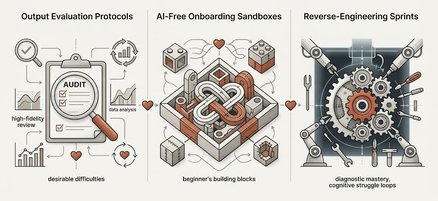
The focus must centre on systemic critique and multi-step auditing capabilities executed through three core directives:
- The Reviewer-to-Teacher Shift : Reward first-principles audits of an agent's multi-step execution log to eliminate the need to review static synthetic output blocks. Operators must trace the agent's decision trees , defend design patterns , evaluate dependencies, and predict points of failure within the autonomous workflow.
- Systemic Implementations of Skill-as-Pseudocode : Embed 'Skill-as-Pseudocode libraries' directly into the development pipeline to replace single-prompt interactions. Before any autonomous agent commits structural changes, it must generate interactive, pseudocode-based constraints for mandatory manual refinement and approval.
- Agentic Reverse-Engineering Sprints : Dedicate development cycles to stripping away orchestration layers. Forcing manual refactoring and the reverse-engineering of agent-generated legacy systems preserves foundational diagnostics, a practice validated by cognitive retention studies indexed in the National Center for Biotechnology Information (NCBI) .
Conflicts & Caveats : Enforcing manual struggle during high-pressure deadlines introduces delivery risks. To mitigate counterproductive outcomes, implementations must follow two distinct parameters:
- Scheduled Prioritisation : Confining agentic auditing sandboxes and pseudocode constraints to explicitly designated learning intervals and core architectural reviews.
- Experience-Based Degradation : Accounting for highly non-linear skill degradation rates that vary significantly between senior professionals with established mental models and junior practitioners lacking manual structural design experience.
Conclusion & Strategic Advice
The transition from manual syntax generation to multi-agent orchestration demands a deliberate recalibration of expertise cultivation. Unchecked delegation to autonomous workflows dictates cognitive surrender, requiring three systemic interventions to form a robust defence against skill atrophy:
- Proximal State Nudging : Forcing continuous interaction with execution state changes.
- Skill-as-Pseudocode Libraries : Embedding structural transparency into the deployment pipeline.
- Reverse-Engineering Sprints : Mandating periodic teardowns of automated architectures.
Selection Matrix : Effective implementation requires context-specific application across three primary operational tiers:
- For High-Velocity Delivery : Utilise automated orchestration combined with strict post-deployment first-principles audits of multi-step execution logs.
- For Onboarding & Mentorship : Deploy Proximal State Nudging frameworks to mandate interactive agentic auditing periods, replacing frictionless generation.
- For Legacy System Maintenance : Implement reverse-engineering sprints to tear down automated architectures and rebuild core mental models manually.
To continue mapping out the optimal trajectory through this paradigm shift, explore our follow-up analysis in Specialisation vs Generalisation: Deciding Technical Career Pathways to preserve elite value at the technological forks.
Call to Action : Audit your current reliance on autonomous agents by implementing a 'Skill-as-Pseudocode' review policy for one operational sprint. Measure the resulting impact on system comprehension and architectural logic across your engineering teams.
💬 How is your engineering team balancing the demand for AI velocity with the need to preserve foundational technical expertise? Drop your thoughts below and ♻️ share this with a fellow technical leader who needs to see this!
Further Reading
- Proximal State Nudging: Reducing Skill Atrophy from AI Assistance
- Agentic Skill Discovery
- Skill-as-Pseudocode: Refactoring Skill Libraries to Pseudocode for LLM Agents
- Multimedia and Immersive Training Materials Influence Impressions of Learning But Not Learning Outcomes
More From Me
Original Article: Read on LinkedIn | Read on Substack