Latent Space: Bridging the Model gap
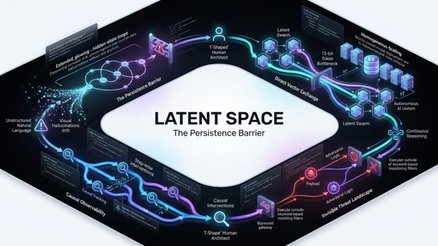
- Part 4 of 4 - Bridging the Latent Space Interop Gap
Introduction
Building on the foundational mechanics established in Part 3: Latent Swarms: The Persistence Barrier , executing continuous textless communication across clustered nodes demands strict structural alignment. Direct hidden-state exchange accelerates orchestration by cleanly bypassing the autoregressive bottlenecks of tokenised transmission.
Crossing model boundaries introduces severe manifold misalignment and unprecedented security vulnerabilities through two primary degradation vectors:
- Structural Warping : Minor quantization adjustments alter the absolute coordinate structure.
- Tensor Corruption : Key-Value (KV) cache tensors rapidly convert into mathematical noise upon injection.
This technical roadmap outlines the architectural protocols required to efficiently bridge disparate latent spaces , treating continuous-state routing as a high-risk attack surface that requires entirely new paradigms for latent-space firewalls.
Multi-model orchestration proceeds without representational collapse via two structural enforcement layers:
- Localised Projection : Leveraging manifold alignment to normalise topological structures.
- Secure Routing : Deploying neural translation adapters alongside rigorous security validation to ensure the state-preserving routing of uncompressed hidden representations across distinct system boundaries.
The Core Geometry of Latent Space Misalignment
The integration of distributed multi-model systems encounters a catastrophic structural barrier when executing latent reasoning across version boundaries. While a single foundational checkpoint guarantees internal vector stability, three specific modifications skew the coordinate alignment of high-dimensional hidden states:
- Localised Updates : Fine-tuning or continuous learning intervals shift parameter weights.
- Precision Adjustments : bfloat16 quantisation compresses coordinate resolution.
- Gradient Adjustments : Specialised optimiser steps alter the final convergence topologies.
Stochastic training dynamics dictate that networks exposed to semantically identical data construct structurally disparate vector orientations. This phenomenon of absolute coordinate mismatch disrupts zero-shot latent space communication.
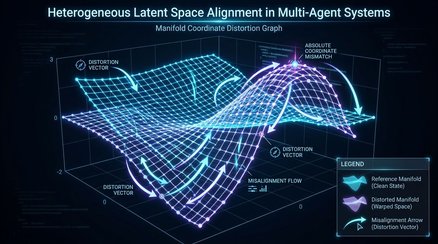
Injecting a high-dimensional vector (d_{model} = 4096) from an updated model version directly into an older backbone forces two immediate failure states:
- Coefficient Dampening : Geometric mismatch immediately degrades attention scores.
- Representational Collapse : Spatial drift disrupts textless inference , rendering incoming KV cache sequences mathematically unreadable without dedicated translation routing.
Mathematical Mechanics of Procrustes and Manifold Projection
Resolving coordinate discrepancies without reverting to high-latency textual tokenisation requires identifying topological isomorphisms between isolated manifolds. Using established linear algebraic frameworks, orthogonal Procrustes analysis discovers the exact geometric transformations required to synchronise distinct vector spaces .
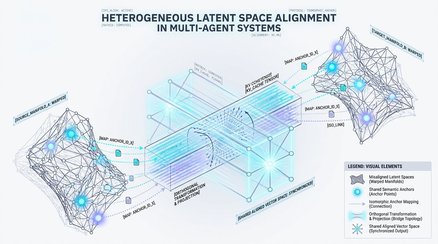
Formalising shared semantic anchors enables the calculation of an optimal orthogonal mapping matrix without the prohibitive computational penalty of full-model retraining. This mathematical translation shifts absolute coordinate frames into a shared relative frame, cleanly projecting the source output into the target receptive layers.
Post hoc linear transformations strictly assume a shared semantic domain. Training networks on completely distinct distributions generates non-linear distortions that break simple translations, driving the representational dissociation observed when forcing alignment across divergent semantic spaces.
Cross-Attention Adapters for Direct KV Cache Exchange
Routing architectures must deploy learned parametric alignments when static linear matrices fail to resolve complex topographical differences across diverse structural topologies. Dedicated neural translation adapters mediate access via a globally shared latent medium, dynamically aligning complex internal states.
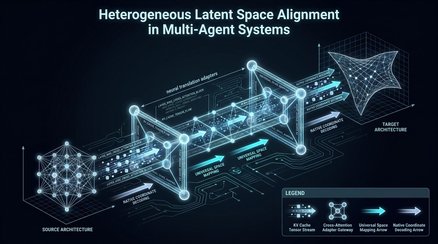
Modular routing nodes execute this dynamic alignment through two core components:
- Universal Space Mapping : Specialised cross-attention blocks map isolated KV cache tensors into a shared intermediate representation.
- Native Coordinate Decoding : The adapter decodes mapped tensors directly into the receiver's target coordinate frame.
This adapter topology isolates the hierarchical processing layers of each participating architecture to bypass parameter-scale mismatches. Distributed nodes execute high-bandwidth mixed-language modelling , dynamically sharing reasoning chains without autoregressive latency.
Training these layer-wise cross-attention adapters requires two preliminary prerequisites:
- Dataset Engineering : Compiling dedicated corpora featuring mixed language modelling losses .
- Computational Localisation : Executing a mandatory compute phase before operational deployment.
Latent Guardrails and Adversarial Vector Security
Transitioning from tokenised API bottlenecks to continuous latent state swarms fundamentally bypasses modern safety parameters. Circumventing the token layer nullifies three traditional defensive mechanisms:
- alignment protocols : Text-based semantic constraints fail to parse continuous vector trajectories.
- RLHF Boundaries : Behavioural tuning does not extend to raw mathematical injections.
- Token-Level Firewalls : Parsers such as Llama Guard cannot inspect continuous latent states.
Injecting uncompressed hidden representations directly across system boundaries grants direct read/write access to a model's latent topology. Processing interoperability solely as a geometric translation problem while omitting adversarial vector analysis renders systems functionally undeployable in secure enterprise environments.
Securing unfiltered vector communications requires deploying three distinct defence layers:
- Latent Filtering : Rejecting vectors that exceed predefined geometric variances.
- Anomaly Sanitisation : Normalising out-of-distribution mathematical signatures in real time.
- Vector-Level Firewalls : Bounding cross-boundary feature injection to prevent adversarial manifold exploitation.
Architectural Blueprints for Graceful Degradation Protocols
Integrating continuous cross-model translation systems into production clusters strictly requires deploying real-time geometric validation pipelines. Non-linear variations subtly warp latent trajectories over extended inference horizons, necessitating that the orchestration layer continuously evaluate alignment metrics.
To flag out-of-distribution drift, validation pipelines track two primary indicators:
- activation Variance Anomalies : Identifying mathematical deviations within intermediate hidden layers.
- Token Reconstruction Loss : Measuring degradation in projected outputs via robust interpretative mapping.
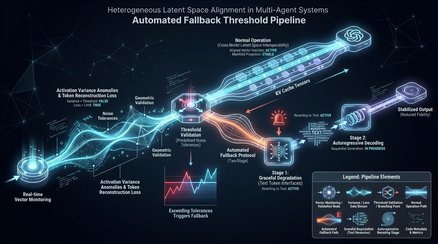
Enforcing a rigid runtime threshold ensures operational stability by monitoring real-time vector divergence relative to predefined noise tolerances. Exceeding these noise tolerances triggers a two-stage automated fallback protocol:
- graceful degradation : The multi-agent transaction reverts to standard text-token interfaces midstream.
- Autoregressive Decoding : The system decodes the latent space back into text, accepting an autoregressive compute spike to maintain data integrity.
Prioritising structural execution stability safeguards cluster operations. Workflows remain fully functional whenever a localised latent transformation layer fails to normalise the continuous vector sequence safely.
Conclusion & Strategic Advice
This final instalment concludes the architectural exploration into the mechanics of advanced multi-agent networking. Bridging the interoperability gap relies on establishing predictable, secure geometric translation channels to process vector states across disparate endpoints.
Accelerating textless inference sharing requires deploying two specific alignment methodologies:
- Foundational Matrices : Executing Procrustes analysis to map structurally similar manifolds.
- Cross-Attention Adapters : Integrating dynamic neural routing layers for highly diverse structural topologies.
Transitioning from tokenised API bottlenecks to continuous latent state swarms requires architecting fault-tolerant representation layers backed by robust vector security. Real-time vector orchestration transforms isolated predictive models into synchronous, production-grade reasoning systems through two defensive implementations:
- Rigorous Latent Firewalls : Filtering anomalous vector injections before inference.
- Automated Degradation Boundaries : Triggering fallback text decoding during alignment failures.
Evaluate the structural topology of your clusters, map your tensor boundaries, and begin prototyping custom, secure alignment pipelines today.
💬 As we transition from standard token APIs to continuous latent swarms, what do you believe is the biggest orchestration or security challenge? Share your insights below and ♻️ share this post with your network!
Further Reading
- Relative representations enable zero-shot latent space communication
- UMAP: Uniform Manifold Approximation and Projection for Dimension Reduction
- LLaMA-Adapter: Efficient Fine-tuning of Language Models with Zero-init Attention
More From Me
Original Article: Read on LinkedIn | Read on Substack