Latent Space: The Persistence Barrier
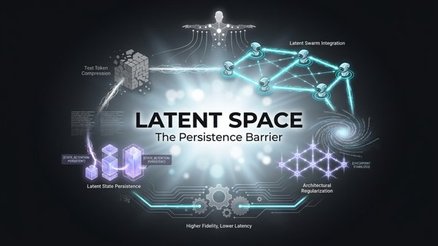
Part 3 of 4 - Writable Memory in Latent AI
Introduction
Building on the internal routing mechanics and test-time compute allocations mapped in Part 2: Latent Space Looped Transformers , this instalment of the series confronts the operational limits of continuous, hidden-state architectures. As system designs migrate from autoregressive token streams to pure latent reasoning, state persistence emerges as a critical failure point.
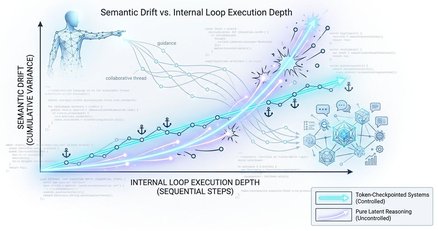
Executing uninterrupted continuous latent loops accelerates internal computation while triggering structural representation collapse . Mathematical variances compound exponentially without the semantic regularisation of discrete text tokens.
This guide details three architectural shifts required to stabilise deep latent loops and orchestrate high-density networks:
- Phase Breakdowns : The Persistence Barrier bifurcates into distinct training-phase and inference-phase failures.
- Causal Observability : Stepwise interventions expose the non-linear pathways of textless computation, establishing the necessary framework for debugging.
- Direct Vector Exchange : Tightly coupled multi-agent systems bypass the vocabulary bottleneck entirely by exchanging high-bandwidth vectors and continuous Key-Value (KV) caches directly, governed by strict cross-model alignment constraints.
The Persistence Barrier: Training vs Inference Breakdowns
Eliminating explicit text generation maximises processing speed. Relying solely on hidden-state recycling over extended horizons triggers the Persistence Barrier .
This breakdown manifests as two distinct mechanical failures: What Makes Effective Supervision in Latent Chain-of-Thought: An Information-Theoretic Analysis :
- Optimisation Barrier : Training phases experience severe gradient attenuation over deep latent horizons.
- Representational Barrier : Inference phases suffer compounding activation variance and representational drift .
At inference time, vocabulary generation functions as a discrete semantic anchor. Removing this regularisation during the forward pass causes minor mathematical deviations to compound exponentially across attention mechanisms due to attention entropy.
Deep latent horizons decouple vector activations from their structural alignment with the base text space, collapsing execution into two failure states:
- Incoherent Outputs : The system generates disorganised hallucinations .
- Repetitive Loops : The architecture becomes trapped in a cycle of execution.
The training barrier introduces gradient attenuation . Executing backpropagation through time (BPTT) over deep latent horizons causes gradients to decay rapidly.
This attenuation severs the network's ability to learn long-term dependencies between the initial context prompt and the final representational commitment. Operationalising latent-CoT requires independent solutions for the training-time challenge of supervising long continuous chains and the inference-time challenge of drifting vector activations.
Hybrid mitigation Tyler: Typed Latent Reasoning for Language Models -- When to Think, What to Compute, and How Much to Allocate :
- Latent Reasoning : The system allocates brief periods of pure hidden-state computation.
- Token Checkpoints : The architecture explicitly generates textual tokens to anchor the continuous state.
The Causal Reality of Continuous Thoughts
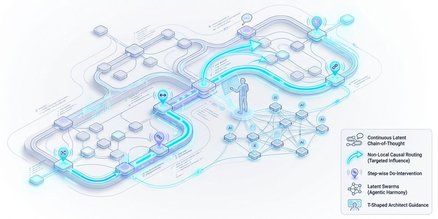
Debugging and optimising hidden-state loops requires treating continuous inference as a manipulable causal process. Through stepwise do-interventions within structural causal models (SCMs) , modifying an intermediate hidden state while freezing downstream variables exposes exact propagation routes for textless reasoning: Dynamics Within Latent Chain-of-Thought: An Empirical Study of Causal Structure .
Causal analysis identifies three distinct operational differences between latent steps and standard textual chains.
- Heterogeneous Leverage : A highly concentrated subset of thinking frames exerts outsized structural authority over the ultimate output.
- Non-Local Routing : Step-to-step influence bypasses neighbouring layers, utilising non-local, targeted routing pathways to propagate information.
- Staged Functionality : The latent step budget functions as a dynamically gated network, partitioning initial task parsing from late-stage commitments.
These causal observability frameworks constitute the mandatory debugging infrastructure for safely implementing multi-agent architectures. Sharing continuous latent states across a distributed swarm of agents demands exact causal tooling to trace the origin of a reasoning error.
The Rise of Latent Swarms: Bypassing the Vocabulary Head
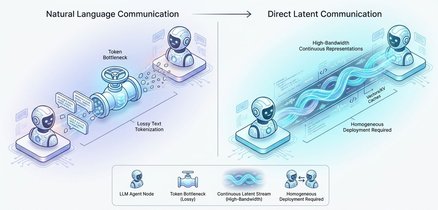
The architectural resolution to the vocabulary bottleneck scales beyond single-instance models into distributed multi-agent systems. Standard multi-agent frameworks force a high-dimensional hidden state through a restrictive 15-bit token bottleneck, writing text to a shared context window and forcing the receiving node to re-tokenise it.
Latent Swarms eliminate this inefficiency by allowing tightly coupled agents to exchange continuous representations directly: PolyKV: A Shared Asymmetrically-Compressed KV Cache Pool for Multi-Agent LLM Inference . Skipping the language head increases the density of contextual information per transaction.
Bypassing autoregressive generation reduces time-to-first-token (TTFT) and communication latency, enabling viable real-time collaborative loops: Agent Memory Below the Prompt: Persistent Q4 KV Cache for Multi-Agent LLM Inference on Edge Devices .
Transmitted states fuse into the receiving context layer via two primary methods:
- Prepend Operations : Injecting state vectors before the current active sequence.
- Concatenation Operations : Appending the continuous representations to the existing context tensor.
Multi-model orchestration imposes a strict architectural constraint due to incompatible latent vector spaces across different model backbones. Implementing universal continuous alignment layers or manifold projection matrices translates representations to maintain stability.
Latent Swarms currently require strictly homogeneous deployments (cloned models with identical parameter weights) to enable direct KV cache sharing. Heterogeneous setups need future manifold projection layers (see Latent Space: Bridging Model Gap
).
Latent channels introduce two unique security vulnerabilities requiring entirely new defensive paradigms: LARGO: Latent Adversarial Reflection through Gradient Optimisation for Jailbreaking LLMs :
- Hidden Payloads : Malicious vectors bypass keyword-based security linters .
- Continuous Reasoning Traces : Invisible computational steps execute adversarial logic outside standard monitoring constraints.
Strengths and Weaknesses: L-CoT vs. CoT
Standard Chain-of-Thought (CoT) relies on explicit natural language reasoning steps, while Latent Chain-of-Thought (L-CoT) performs multi-step reasoning directly in continuous hidden states.
Strengths of L-CoT (over CoT):
- Dramatically higher bandwidth (~40,000 bits per thought vector vs ~15 bits per token).
- Faster internal iteration and parallel exploration of reasoning paths.
- Reduced latency in long-horizon and multi-agent scenarios.
- Better at non-verbalizable or highly compositional tasks.
Weaknesses of L-CoT (vs. CoT):
- Reduced interpretability — latent traces are harder to inspect and debug than explicit text.
- Higher risk of representational drift and persistence issues (as detailed above).
- More complex training and alignment (requires hybrid checkpoints).
- Weaker interoperability across models without additional projection layers.
CoT remains superior for transparency, rapid prototyping, and human oversight, while L-CoT offers superior performance for deep, agentic, and swarm-based workloads once the persistence barrier is addressed.
Conclusion & Strategic Advice
Overcoming the persistence barrier transitions AI from isolated, stateless reasoners into a unified, high-bandwidth collaborative network. Substituting lossy token-based communication channels with direct integration of latent vectors establishes a highly integrated paradigm for distributed artificial intelligence systems.
When defining a production architecture, balancing raw execution speed against representational stability requires addressing version drift and architectural boundaries. Optimising deployment requires three strategic approaches:
- Homogeneous Workloads : Direct KV cache sharing offers unparalleled density and latency optimisation for identical agents sharing exact parameter weights.
- Cross-Boundary Interoperability : Mismatched model backbones and version updates distort underlying latent encodings. Deploying heterogeneous nodes requires traditional textual APIs for structural stability until robust manifold projection systems mature.
- Long-Horizon Reasoning : Hybrid token checkpointing dynamically anchors the continuous state, preventing inference-time representational drift across deep loops.
Deploy structural causal models to audit non-verbalised paths and continuously monitor for latent-specific adversarial vulnerabilities . To explore how we bridge version mismatches and translate disparate vector spaces without dropping back to text tokens, proceed to our dedicated architectural expansion guide: Latent Space: Bridging the Model gap .
💬 Where does text serialisation introduce the most cognitive latency in your current inference pipelines? Share your operational insights below and ♻️ repost to your network!
Further Reading
- Towards Effective GenAI Multi-Agent Collaboration: Design and Evaluation for Enterprise Applications
- Agentic Social Affordance Framework (ASAF): Agent Identity Design as a Collaboration Interface in Multi-Agent Systems
- A Survey of Multi-Agent Deep Reinforcement Learning with Communication
More From Me
Original Article: Read on LinkedIn | Read on Substack