Skunk Works: Reclaiming Joy
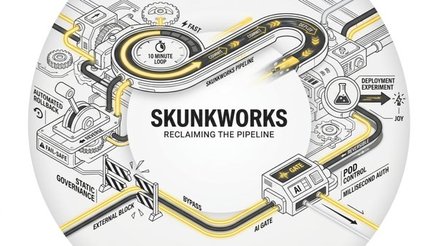
- Part 3 of 5 – Why Your CI/CD Pipeline Is a Bureaucratic Gatekeeper
Introduction
Building on the foundational concepts of structural team autonomy explored in Skunk Works: Non-Invasive Telemetry , this next evolution addresses an existential threat to modern engineering velocity:
- AI-Assisted Volume : Recent 2025 data from Microsoft demonstrates that engineers using AI tools complete 40.5% more pull requests .
- Structural Bottlenecks : At this unprecedented volume of autonomous code generation, the pipeline becomes a primary structural bottleneck.
- Future Collapse : A pipeline unable to process a rapid loop today will structurally collapse under the sheer volume of code generated by AI developer agents tomorrow.
Continuous Integration and Continuous Deployment ( CI/CD ) systems were engineered to return creative control to the builder, yet enterprise bureaucracy has co-opted them into automated change advisory boards . Because it's weighted down with manual approval hooks and compliance gates, the resulting pipeline operates from a default posture of fear.
By deconstructing the bureaucratic accumulation pattern, the pipeline is reclaimed through strict enforcement of the Ten-Minute Loop Rule :
- Risk Profile Shift : This heuristic targets a maximum duration from commit to a validated sandbox deployment .
- Failure Decoupling : Transitioning from manual governance to automated, instantaneous rollbacks decouples deployment from catastrophic failure.
- Reversible Experiments : Treating deployments as reversible scientific experiments eradicates the fear of releasing code, unlocks deterministic feedback loops, and restores operational velocity .
1. When the Pipeline Became a Prison
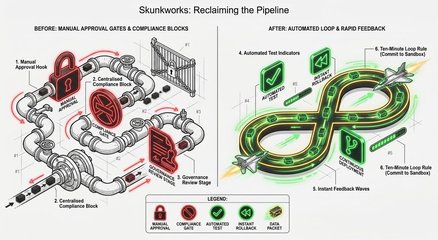
Continuous Integration originally provided immediate feedback on code changes, while Continuous Deployment enabled rapid shipping. Modern enterprises have systematically dismantled this architecture through three specific mechanisms:
- External Static Analysis : Streamlined loops degrade due to legacy static analysis gates operated by external teams that lack context.
- Non-Technical Governance : Manual approval hooks are strictly enforced by non-technical governance boards.
- Silo Elimination : Rapid delivery and operational velocity mandate the removal of these silos, as documented in DevOps Automation Pipeline Deployment with IaC .
The resulting pipeline serves as an automated change advisory board for the creative pipeline.
2. The Joy of the Fast Loop
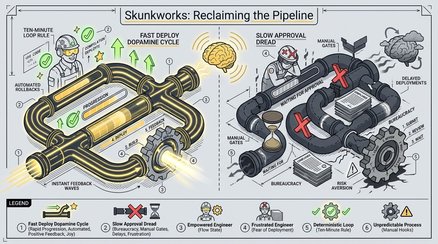
Observing a validated, deployed result within minutes initiates two defined psychological shifts:
- Informative Failure : When a system automatically rolls back, failure transforms from a catastrophic event into an informative metric.
- Rational Experimentation : Testing a hypothesis compresses from a multi-week governance ordeal into a ten-minute cycle, driving faster iteration.
Subjective engineering joy correlates strongly with rapid, deterministic feedback. Unpredictable pipelines become psychologically aversive, forcing teams to avoid deployments out of dread.
3. The Ten-Minute Loop Rule
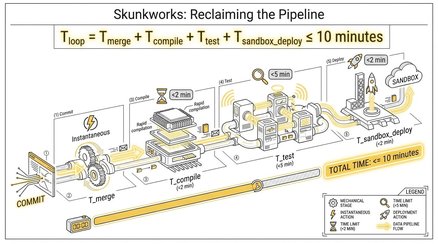
A Skunk Works CI/CD infrastructure enforces a non-negotiable limit on the internal development loop, defined as T_loop = T_merge + T_compile + T_test + T_sandbox_deploy <= 10 minutes . Achieving this threshold requires strict adherence to four operational boundaries:
- T_merge : Execution is instantaneous via trunk-based development .
- T_compile : Processing completes in under 2 minutes for incremental builds .
- T_test : Verification runs under 5 minutes for deterministic unit and integration tests .
- T_sandbox_deploy : Environment provisioning completes in under 2 minutes.
Elite teams target build-to-test cycles under 10 minutes Source: DevOps Training Institute, DORA and consistently achieve commit-to-production lead times measured in hours Source: DORA.dev .
(Caveat: This is an operational heuristic for decoupled microservices , as modern complexities like massive monorepo graph analysis or ML model weight distribution require bounded contexts. Furthermore, automated rollbacks demand robust health-check infrastructure; without proper canary deployments , they obscure system failures.)
4. What Slows Pipelines: The Bureaucratic Accumulation Pattern
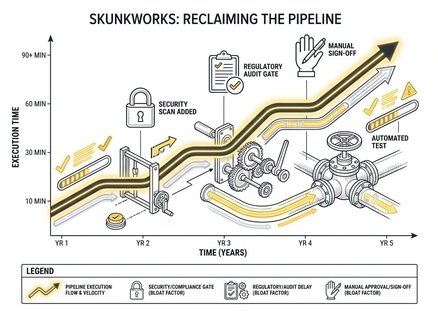
Enterprise pipelines suffer from bureaucratic accumulation , turning past governance decisions into ongoing execution delays. Individually justified events—such as a three-year-old security incident triggering a 12-minute vulnerability scan, or a regulatory audit appending a weekly manual sign-off—collectively transform a 10-minute loop into a 90-minute gauntlet.
From an infrastructure perspective, structural ownership mitigates this degradation by transferring pipeline control to the engineering pod via three specific mechanisms:
- The Binding Contract : The Ten-Minute Loop Rule dictates that adding a new gate requires removing an equivalent constraint.
- Modernised Security : Elite teams update security checks rather than removing them, replacing legacy external scans with intent-aware, AI -augmented inline validations.
- Algorithmic Gates : Utilising intent-aware authorisation for Zero Trust CI/CD and algorithmic, AI-driven autonomous decisions , multi-day manual governance boards are replaced with authorisation gates that run in milliseconds.
5. Automated Rollbacks and the Fear Eradication Principle
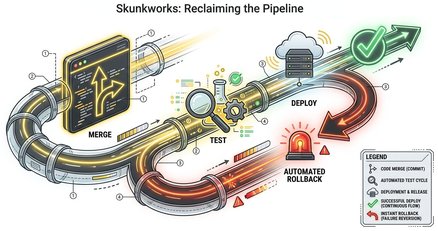
Manual approval gates are positioned as risk management, yet manual sign-offs by non-technical boards exclusively prevent deployments rather than preventing bad code. True risk mitigation relies on automated health gates and instantaneous rollbacks executing through a defined sequence:
- Threshold Monitoring : After deployment to a canary or sandbox, automated checks monitor error rates and latency .
- Instant Reversion : If thresholds are breached, the deployment reverts to the prior stable state within seconds.
This Fear Eradication Principle strictly applies to environments operating on decoupled data patterns. Automated rollbacks demand architectural discipline; stateful changes—such as database schema migrations —must be strictly decoupled from application deployment using expand/contract (parallel change) patterns, ensuring that reverting compute does not corrupt underlying data .
Respecting this stateful versus stateless separation, alongside deterministic test coverage, turns deployment into a reversible scientific experiment and restores operational velocity .
Conclusion & Strategic Advice
The combined execution of trunk-based development , deterministic testing, and decoupled automated rollbacks fundamentally alters the economics of software delivery. When selecting a pipeline strategy, evaluate operational constraints through two parameters:
- Compliance Postures : If the environment dictates strict external compliance over velocity, manual gates remain a procedural requirement.
- Velocity Postures : If rapid iteration and market responsiveness are prioritised, structural ownership and the Ten-Minute Loop Rule are non-negotiable.
What is the current median cycle time from commit to deployed sandbox in your environment, and what is the oldest gate in your pipeline that nobody can explain the origin of? Identifying these constraints is the first step toward reclaiming velocity.
For a deeper examination of the organisational resistance to this autonomy, and the resulting defensive managerial behaviour as AI accelerates code generation, proceed to Skunk Works: The Existential Panic .
💬 What is the oldest, most unexplained approval gate currently slowing down your pipeline? Share your experience in the comments and ♻️ repost this to spark a conversation with your engineering team!
Further Reading
- Intent-Aware Authorization for Zero Trust CI/CD
- AI-Augmented CI/CD Pipelines: From Code Commit to Production with Autonomous Decisions
- Ambush from All Sides: Understanding Security Threats in Open-Source Software CI/CD Pipelines
More From Me
Original Article: Read on LinkedIn | Read on Substack