Skunk Works: The Existential Panic
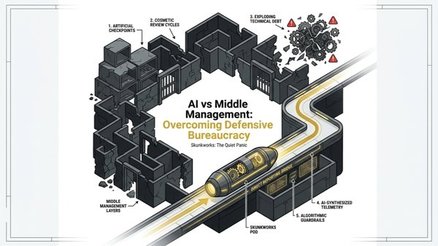
- Part 4 of 5 - Middle Management in the Era of AI
Introduction
Building on the foundational architectures established in Skunk Works: Reclaiming Joy , evaluating the structural friction caused by agentic systems colliding with legacy organisational design requires addressing three operational realities:
- Critical Vulnerabilities : The deployment of AI reveals the administrative coordination layer to be structurally obsolete.
- Pipeline Execution : Tasks traditionally defining middle management execute with near-zero latency through agentic pipelines .
- Bureaucratic Reactions : This automation triggers a self-preservation response where non-technical management tiers manufacture defensive bureaucracy and cosmetic checkpoints to justify headcount.
Transitioning from defensive bureaucracy to automated governance requires transferring accountability across three specific domains:
- Algorithmic Guardrails : Replacing human gatekeepers with verifiable programmatic constraints.
- Risk Systems : Implementing AI trust/risk management (TRiSM) to enforce system integrity.
- State Metrics : Utilising verifiable code-state metrics to evaluate output mathematically.
This guide explains how defensive posturing shows up, why non-technical authority can compromise technical output, and how direct-reporting models bypass bottlenecks to enable high-velocity, architecturally sound delivery.
1. The Quiet Panic
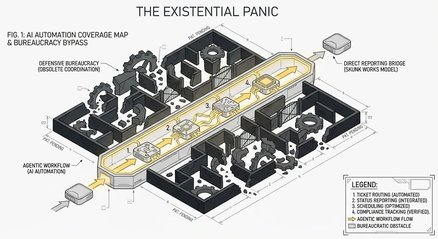
Administrative oversight functions primarily as coordination translation, managing operational bottlenecks across three distinct vectors:
- Progress Extraction : Polling engineering teams for daily operational updates and system status metrics.
- Executive Summaries : Compiling raw output data into high-level briefing formats for leadership.
- Dependency Routing : Managing cross-functional communication pathways and blocker resolutions.
Agentic AI consumes these tasks efficiently, driving enterprise restructuring across three specific data points:
- Hierarchical Flattening : Gartner projects that through 2026, 20% of organisations will deploy AI to flatten structures, eliminating more than half of administrative management positions Gartner, 2025 .
- Enterprise Acceleration : Technology giants, including Amazon, Google, Microsoft, and Dell, actively drive this "unbossing" trend ( Faisal Hoque, Forbes, 2025 ).
- Empirical Validation : Meta's flattening initiatives and Shopify's meeting purge shift the coordination burden to automated operational dashboards, replacing the human translation layer without overwhelming executive sponsors.
This structural automation forces a definitive institutional response across two fronts:
- Existential Threat : The administrative justification for maintaining a non-technical middle tier is evaporating rapidly.
- Predictable Reactions : Management layers construct artificial barriers and governance gates to ensure departmental survival.
2. The Self-Preservation Playbook
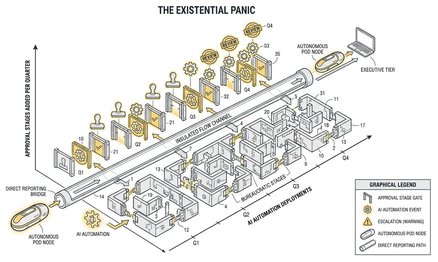
When an organisational class faces automation, it manufactures un-automatable work through three core forms of defensive bureaucracy:
- Artificial Checkpoints : Injecting mandatory human sign-offs into engineering pipelines for technically trivial modifications.
- Defensive Process Documentation : Generating elaborate frameworks that project rigour while directly consuming engineering bandwidth.
- Cosmetic Review Cycles : Mandating feedback sessions focused on proxies for quality, such as documentation formatting, Jira ticket hygiene, and adherence to arbitrary sprint ceremonies.
Justified as risk management, these gates are erected by individuals lacking the technical literacy to assess actual code quality, resulting in two severe operational failures:
- Technical Debt Accumulation : 67% of developers report that bureaucratic bottlenecks force structural shortcuts that increase technical debt ( Statsig Research ).
- Systemic Fragmentation : Fragmented oversight creates misaligned objectives and drives the proliferation of shadow IT ( APM Digest ).
3. How Non-Technical Authority Degrades Products
Granting veto authority over technical architecture to individuals who cannot evaluate code forces control through two superficial mechanisms:
- Cosmetic Requirements : Mandating visual adjustments and feature nomenclature to justify management involvement.
- Compliance Tick-Boxes : Enforcing arbitrary procedural checks completely disconnected from software integrity.
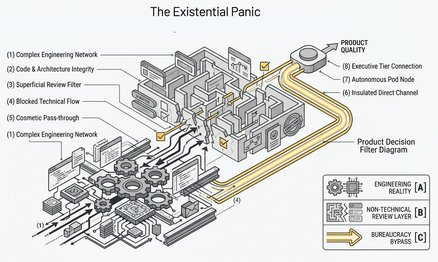
Unable to audit systemic integrity, non-technical authority degrades product stability through three cascading failures:
- Superficial Fixation : Management focuses exclusively on observable surface attributes, prioritising UI placement over backend stability.
- Architectural Subjugation : Core engineering imperatives, including dependency management and refactoring , are suppressed by abstract roadmaps and arbitrary deadlines.
- Systemic Fragility : Products engineered to satisfy cosmetic reviews become brittle, resulting in systems that are expensive to maintain and prone to catastrophic failure under load.
Prioritising self-preservation over cross-functional transparency consistently accelerates technical debt and degrades product health Deloitte Digital Transformation Research, 2025 .
4. The Structural Solution: Direct Reporting Chains
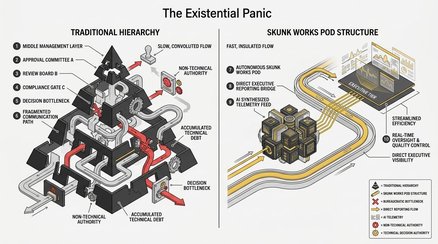
Applying Kelly Johnson's 1940s aerospace Skunk Works model to 2025 software engineering requires modernising the accountability mechanics to match the extreme velocity of modern environments:
- Evolutionary Necessity : In continuous-deployment software and AI ecosystems, legacy reporting structures fail to maintain pace with execution speed.
- Authority Consolidation : The programme manager must possess near-complete authority and report directly to the executive tier.
- Circuit Breaker Mechanics : Bypassing the defensive middle layer entirely ensures engineering decisions are evaluated strictly on technical merit.
Direct reporting functions sustainably only when governed by three automated mechanics:
- Telemetry Synthesis : Agentic AI must synthesise the pod's telemetry to prevent executives from being overwhelmed by raw operational data.
- Risk Mitigation : Voluminous agentic telemetry can hallucinate or obscure technical debt without programmatic parsing.
- Algorithmic Abstraction : An AI abstraction layer acts as an objective, non-political translator of the system's state, enforcing automated governance without human bureaucracy.
Deploying this architecture reduces political friction and eliminates jurisdictional authority from external management layers.
5. The AI Transition: Evolution, Not Extinction
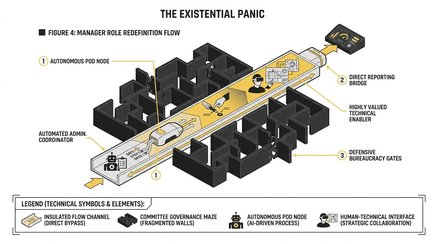
The middle manager role is bifurcating into two distinct operational trajectories:
- Aggressive Automation : Administrative coordinators will be replaced entirely by agentic pipelines .
- Technical Enablement : Professionals pivoting to evaluate architectural trade-offs and translate technical context for executives transition into critical operational assets.
The Skunk Works model explicitly eliminates non-technical authority over technical decisions to protect engineering integrity.
Conclusion & Strategic Advice
Navigating the AI era requires dismantling defensive bureaucracy and deploying agentic AI to amplify engineering velocity. Redesigning these structures requires strict adherence to engineering realities, without universally acceptable compromises.
Strategic Constraints for Restructuring must be evaluated against two operational realities:
- Technically Literate Executive Tier : Adopt the Skunk Works direct-reporting model immediately. Please replace human translation layers with automated governance and AI -synthesised telemetry to maintain rigorous accountability.
- Low Executive Technical Literacy : The Skunk Works model will fail under these conditions. Enterprises must restructure executive leadership or absorb the rampant accumulation of technical debt and degraded product quality as the inherent costs of preserving legacy structures.
Note: The direct-to-executive model requires an executive tier capable of evaluating technical nuances. Attempting to "upskill" a fundamentally non-technical management class to govern an autonomous AI pod invalidates the circuit-breaker thesis.
To explore the operational mechanics of these autonomous teams, continue to Skunk Works: The AI Misdirection.
Audit your engineering workflows today: Identify the exact percentage of approval gates evaluated by personnel who can genuinely assess the architectural integrity of the codebase.
Further Reading
- The New Developer Workflow: AI and the End of Boilerplate
- Unbossing the Enterprise: Agentic Workflows in 2025
- Breaking the Cycle of Technical Debt in AI Transformations
More From Me
Original Article: Read on LinkedIn | Read on Substack