Skunk Works: The AI Misdirection
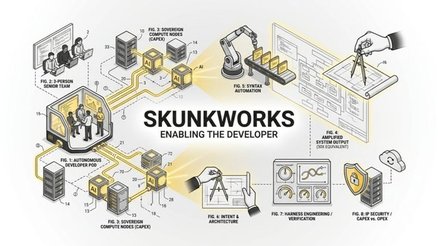
- Part 5 of 5 - Creative Liberation and the Rise of the Autonomous Pod
Introduction
Building on the structural analysis of defensive delivery pipelines in Skunk Works: The Existential Panic , the market operates under the misdirection that AI will replace software engineers. This technology eliminates the delivery and syntax-management bureaucracy around the builder, while keeping the core engineering role intact.
Evaluating this disruption requires an understanding of three specific operational shifts:
- Bureaucracy Dismantling: While enterprise alignment and dependencies require human judgment, AI tooling reduces Agile tracking and ticket coordination overhead.
- Architectural Separation: Isolating routine syntax generation from high-level systems architecture allows agentic AI and local sovereign compute to cut administrative friction.
- Strategic Reconfiguration: Small, high-density technical pods can redesign delivery pipelines into focused execution units.
The Misdirection
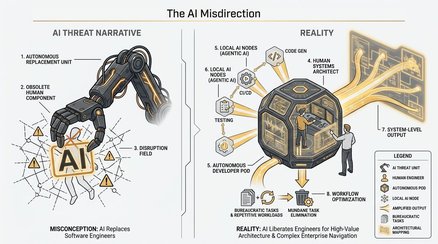
From a systems-design perspective, equating AI adoption with developer replacement conflates writing code with designing systems. Syntax is the lowest layer of the engineering decision stack.
Automated syntax generation removes friction across three specific engineering workflows:
- Repetitive Workloads: Autonomous tools reduce boilerplate creation, routine compliance scans, and repetitive dependency updates.
- Enterprise Navigation: Engineers reclaim operational bandwidth to process requirement gathering and evaluate architectural trade-offs.
- Architectural Mapping: Technical leads focus on designing resilient architectures and translating ambiguous business needs into reliable technical realities.
What Writing Code Actually Is
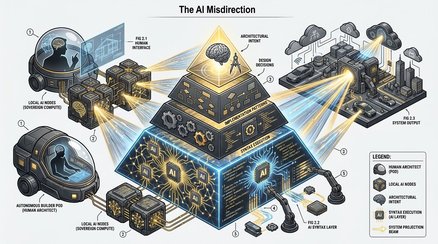
As Fred Brooks documented, the core difficulty of software development is the conception and management of complexity. The engineering decision hierarchy progresses sequentially from architectural intent to design decisions to implementation patterns and finally to syntax execution.
AI systems in 2026 process syntax and implementation efficiently but fail at generating architectural intent without strict human direction, creating three severe operational bottlenecks:
- Systemic Friction: Agentic pipelines execute non-deterministic operations that require rigorous external verification constraints.
- Cognitive Load: Debugging hallucinated agentic loops requires significant cognitive focus.
- Verification Overhead: Empirical research indicates that verification processes can temporarily increase task times by up to 19% for highly experienced engineers.
Architecting verification loops to constrain model outputs turns this cognitive overhead into practical leverage.
Creative Liberation: The Builder as Systems Architect
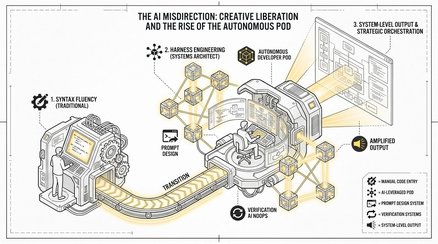
Removing mechanical constraints reallocates cognitive bandwidth to higher-order architecture. This requires shifting core engineering skills from syntax fluency to "harness engineering"—the capability to design prompts, systemic verification loops, and automated feedback structures that allow agents to operate reliably.
Evaluating output metrics reveals a distinct gap between upstream generation and downstream deployed code across two data points:
- Upstream Velocity: Engineers utilising these tools completed 40.5% more pull requests during high-usage periods (GitHub Copilot and Developer Productivity: An Observational Dose-Response Analysis).
- Downstream Delivery: Empirical data shows a narrower 20% improvement in shipped releases, which indicates that upstream volume without CI/CD maturity inherently causes pipeline blockages.
Modern agentic workflows autonomously perform testing and integrate with CI/CD for GitHub Copilot. The human architect manages the boundary where model output meets production infrastructure (Augment Code).
The Autonomous Pod in Practice
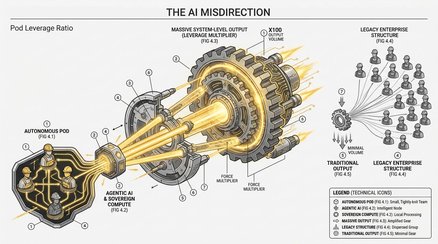
The autonomous Skunk Works pod achieves operational viability by integrating agentic AI with local sovereign compute. Processing open-weight models locally matches frontier cloud performance on narrow, highly contextualised synthesis tasks ( Towards AI ).
Deploying local infrastructure requires aggressive investment in high-bandwidth memory architectures, such as massive GPU arrays or Apple Silicon with 128GB+ unified memory.
Transitioning to this hardware model produces three immediate operational advantages:
- Cost Elimination : Upfront CAPEX removes cloud API dependencies for routine synthesis and eliminates massive per-token billing.
- Asset Protection : Sovereign compute hardware maintains absolute intellectual property security by isolating codebases from external networks.
- Role Consolidation : A pod of three senior engineers equipped with this hardware executes parallelised load testing and continuous security scans, taking on tasks previously required dedicated specialists.
The Competitive Survival Imperative
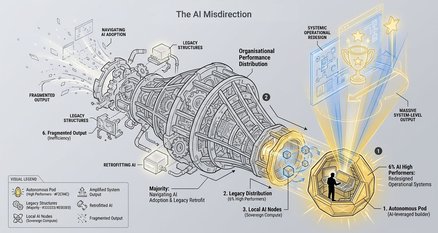
Only 6% of organisations are genuine AI high performers, based on their execution of systemic operational redesigns ( McKinsey State of AI 2025 ). The autonomous pod serves as the physical manifestation of this structural overhaul.
High-density engineering pods bypass bureaucratic velocity constraints through two core operational mechanics:
- Communication Compression : With a small team, we have frictionless internal information flow and minimal administrative overhead.
- Capacity Scaling : AI enables a small unit to generate the same output volume as large, legacy enterprise structures.
Conclusion & Strategic Advice
Selection Matrix: Deploy local hardware arrays for 80% of routine synthesis. Reserve frontier cloud API s strictly for the remaining 20% requiring complex architectural reasoning.
Strategic implementation requires acknowledging current market realities and infrastructural constraints. To meet true sovereign compute demands, you'll need to pivot from cloud OPEX to substantial upfront CAPEX in memory-rich hardware arrays.
Transitioning to the builder-as-architect model relies on three operational truths:
- Trajectory Mapping : The "builder as systems architect" model operates as a directional trajectory for future capabilities rather than a universal current state.
- Leverage Targets : The 3-to-30 leverage ratio is a directional guide for targeted headcount planning.
- Capital Allocation : Genuine sovereign compute requires aggressive capital allocation into memory-rich local hardware configurations.
Series Wrap-Up: This concludes our overarching thesis. The functional output of AI drives the definitive collapse of defensive delivery bureaucracy, forcing organisations to shift from managing builders to empowering autonomous architects.
To operationalise this model within your infrastructure, proceed to the next phase: Selecting Your Pod: The Talent Density Problem in AI-Leveraged Teams .
Call to Action: Evaluate your organisation today. Calculate your current ratio of technical executors to non-technical coordinators and determine the exact timeline required to invert it.
💬 Calculate your current ratio of technical executors to non-technical coordinators today—are you ready for the "autonomous pod" era? Drop your thoughts below and ♻️ share this post with your network!
Further Reading
- Building the Engineering Pod for Agentic Workflows
- Local LLMs and Sovereign Compute Strategies for 2026
- The Rise of Harness Engineering in Modern Software Development
More From Me
Original Article: Read on LinkedIn | Read on Substack