Optimizely One: Centralised Identity for Opti-ID
Introduction
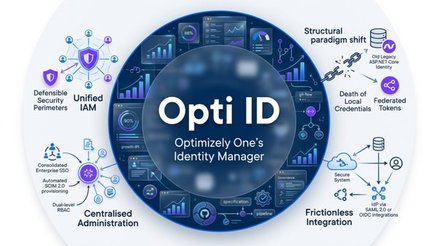
Single-product architectures are obsolete, superseded by dynamic, multi-product digital experience stacks. Operating content management systems, marketing platforms, and customer data engines in parallel surfaces a critical operational vulnerability: fragmented identity. Maintaining disparate authentication models across an enterprise ecosystem introduces administrative friction and drastically widens the security attack surface .
This guide provides a technical blueprint for implementing Opti ID, the centralised Identity and Access Management (IAM) plane unifying the Optimizely One ecosystem. By breaking down authentication silos, teams can architect a highly secure, federated identity model that scales with advanced enterprise demands.
Crucially, deployment environments dictate strict identity prerequisites. Self-hosted deployments can still use traditional authentication models; the CMS 13 release makes Opti ID a mandatory baseline for Digital Experience Platform (DXP) environments. Remaining on isolated legacy architecture blocks access to next-generation capabilities, including Optimizely Opal and Embedded DAM Optimizely CMS Developer Documentation .
Furthermore, a complete architectural blueprint must account for environment topology. This requires explicitly mapping Pre-Production and Production environments to dedicated Opti ID tenants, while establishing secure sandbox or simulator strategies for local developer authentication.
1. Why Centralised Identity Matters for a Multi-Product Platform
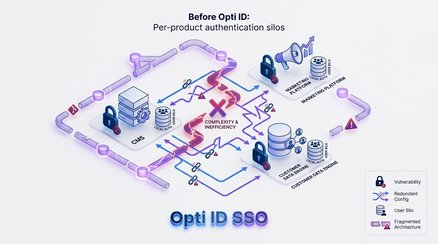
When systems operate distinct user directories, administrators are forced to configure redundant single sign-on (SSO) integrations and manually duplicate provisioning workflows across applications Optimizely CMS Developer Documentation . A single oversight during account de-provisioning creates a persistent security risk.
A unified IAM layer collapses this fragmented architecture to achieve two primary outcomes:
- Defensible Security Perimeters : Establishing a single boundary across the entire digital workflow.
- Centralised Administration : Consolidating provisioning and de-provisioning commands to eliminate redundant account updates.
2. What Opti ID Is: SSO, RBAC, and Provisioning in One Layer
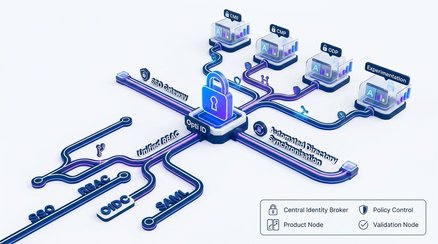
Opti ID operates as an enterprise-grade identity broker, Opti ID Login Gateway . It centralises access controls using three primary components:
- Central SSO Gateway : Routing authentication requests across the entire Optimizely One suite.
- Unified Role-Based Access Control (RBAC) : Standardising Role-Based Access Control (RBAC) permissions across all connected platforms.
- Automated Directory Synchronisation : Managing user lifecycles directly from the corporate directory.
Architects must distinguish between baseline provisioning and enterprise lifecycle management within this layer. While Opti ID supports Just-In-Time (JIT) provisioning via SAML / OIDC claims upon initial login, strict SCIM 2.0 (System for Cross-domain Identity Management) push provisioning is the prerequisite for enterprise implementations.
SCIM guarantees that user lifecycles are automatically synchronised with primary corporate directories like Microsoft Entra ID . This distinction becomes critical regarding session invalidation following abrupt user termination.
When a user is de-provisioned via SCIM, administrators must limit token expiration windows across two vectors:
- OIDC Token Lifetimes : Configuring short expiration limits minimises the latency window between directory revocation and the termination of active sessions.
- Cross-Application Perimeters : Ensuring the expiration policies apply equally to all connected applications (CMS, CMP, ODP).
3. CMS 13 Makes Opti ID Mandatory: What Changes
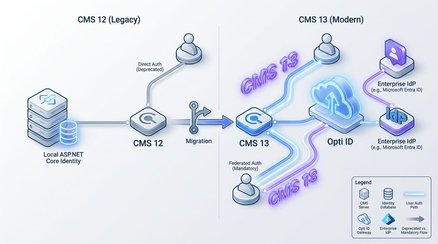
In previous iterations, engineering teams selected their own backend authentication models. With CMS 13, legacy local ASP.NET Core Identity databases are deprecated for editor and administrative operations in DXP environments; Configure Opti ID for CMS 13 .
Moving to CMS 13 requires teams to action two structural paradigm shifts:
- Credential Removal : Purging all local user databases and direct credential storage mechanisms.
- Token-Based Identity : Implementing the platform-mandated federated identity strategy exclusively.
4. Identity Provider Integration: Connecting Your Corporate IdP
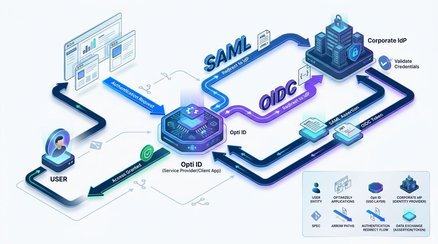
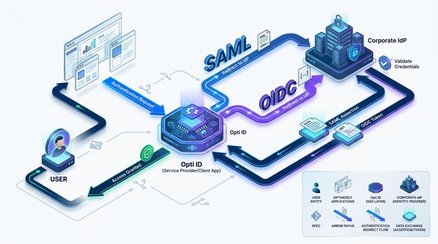
Opti ID secures system access by federating authentication back to the primary Identity Provider (IdP) through two supported integration architectures:
- SAML 2.0 Integration : Opti ID functions as the Service Provider . It parses assertions from the corporate IdP to map key claims (email, display name, and security groups) upon login; Configure Opti ID for CMS 13 .
- OIDC Integration : Registered as a secure client application, Opti ID executes a back-channel exchange. This mechanism validates session tokens directly against the corporate directory Optimizely CMS Developer Documentation .
5. Role-Based Access Control Across Optimizely One
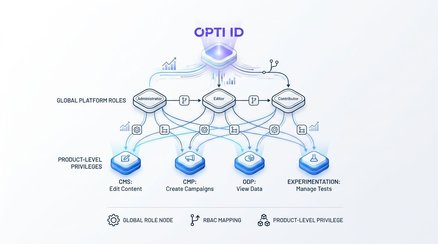
Opti ID manages granular privileges using a dual-level RBAC model Optimizely CMS Developer Documentation . Platform-level roles govern overarching capabilities and map directly to product-specific privileges.
Assigning a global "Editor" role initiates two simultaneous access grants in Opti ID Login Gateway :
- CMS Rights : Instantly providing editing permissions within the core content platform.
- Suite Privileges : Cascading equivalent contributor access across the integrated marketing and data platforms.
6. Migration: Moving Existing CMS User Accounts to Opti ID
Transitioning from local CMS databases requires manual mapping per the Optimizely CMS Developer Documentation . Following IdP federation, teams must audit legacy accounts to verify their alignment with global Opti ID definitions; Configure Opti ID for CMS 13 .
Programmatic migrations execute through two distinct endpoint targets:
- Standard SCIM 2.0 Endpoints : Utilising REST architecture to push formatted directory states directly into the Opti ID layer.
- Optimizely Graph API : Querying and updating bulk access parameters using the platform's native graph interface.
End-to-end validation with representative test accounts is mandatory before production cutover. Failing to test these endpoints results in immediate administrative lockouts upon deployment.
7. What Developers Need to Change in CMS 13
Codebases must systematically retire legacy configurations and replace custom middleware wrappers. The integration registers the official provider components using the EPiServer.OptimizelyIdentity package EPiServer.OptimizelyIdentity Package.
Because local ASP.NET Core Identity is removed, engineers require environment-aware logic to protect the production directory via two routing methods:
- Sandbox Routing : Pointing the application to a dedicated, non-production Opti ID tenant during local builds.
- Local Simulation : Running a standalone OIDC simulator to handle token requests offline.
Authorisation attributes and dependency injection must be mapped to environment configurations via appsettings.json . Instead of hardcoding conditional logic in Program.cs for every environment tier, developers should leverage . NET's native configuration provider hierarchy to automatically resolve the correct topology:
// Program.cs
// Environment-specific values (Sandbox vs Production) are resolved
// automatically via appsettings.{Environment}.json
builder.Services.AddOptimizelyIdentity(options =>
{
    options.ClientId = builder.Configuration["OptiID:ClientId"];
    options.ClientSecret = builder.Configuration["OptiID:ClientSecret"];
    options.Authority = builder.Configuration["OptiID:Authority"];
});
Please remove any custom authentication handlers that previously bypassed the core identity framework to enforce platform standardisation. Configure Opti ID for CMS 13 .
Conclusion & Strategic Advice
Unifying authentication through Opti ID is a structural necessity that transforms disparate SaaS tools into a coherent, enterprise-grade architecture. OIDC/SAML federation, granular dual-level RBAC, and unified auditing drastically lower operational overhead.
Implementing these combined protocols establishes a centralised, federated security perimeter that significantly reduces the multi-tenant attack surface. When architecting the CMS 13 upgrade, prioritise directory mapping accuracy, rigorous role standardisation, and strict token lifecycle management.
A resilient central identity layer is the foundation for secure, scalable digital experiences.
Further Reading
- Securing Multi-Tenant SaaS with Identity Federation
- OIDC vs SAML 2.0: Architecting Enterprise SSO
- Automating User Lifecycles with SCIM Provisioning
More From Me
Original Article: Read on LinkedIn | Read on Substack