Optimizely Graph: Migrating from Search & Navigation
Introduction
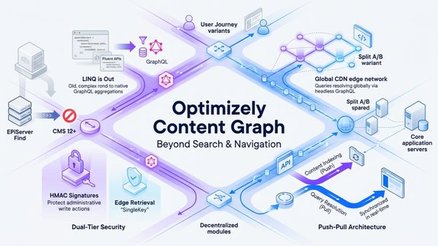
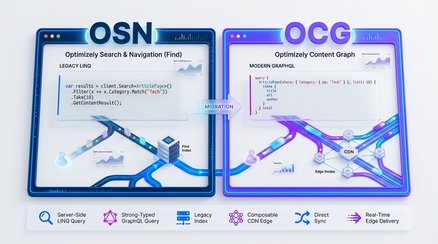
Optimizely Search & Navigation (EPiServer Find) operates on a managed Elasticsearch backend using a proprietary .NET LINQ -style API . While foundational for over a decade, its server-side execution model intrinsically routes all query workloads through the CMS application tier, generating substantial processing and memory overhead during high-traffic spikes. Platform investment has now entirely pivoted to Optimizely Content Graph, driving four core architectural shifts:
- Interface Decoupling : By migrating to Content Graph, monolithic and server-bound query logic transforms into a decoupled, CDN -backed GraphQL interface.
- Latency Reduction : This architecture drastically shifts computational loads away from core applications, leveraging global edge networks to resolve requests with minimal latency .
- Migration Scope : This guide outlines the architectural shift, including integrating required core packages, routing content lifecycle events to ingest pipelines, translating legacy access controls to the edge, and implementing dual-tier security for edge interactions.
- Ecosystem Modernisation : Upon execution, development environments will successfully dismantle legacy C# fluent APIs in favour of a modern, highly scalable graph ecosystem.
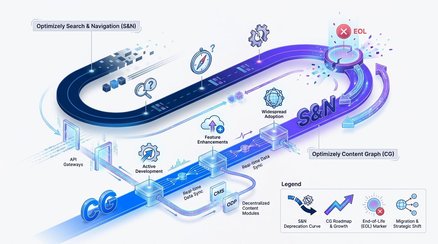
Why Search & Navigation Is a Dead End
Legacy Elasticsearch-driven patterns mandate that every search request traverse the MVC application pool. Relying on this approach introduces three primary operational bottlenecks:
- Scaling Limitations : This paradigm fundamentally prohibits edge caching and intrinsically ties query-load scaling to the primary application infrastructure.
- Platform Exclusivity : As digital experiences demand decentralised architectures, platform investment has focused exclusively on Content Graph.
- Hard Deadlines : With EPiServer Find officially entering its end-of-life cadence, teams are working to timelines verified via product-specific Release notes and Optimizely's official release notes .
- Version Constraints : Crucially, this structural leap is exclusive to modernised stacks. Environments operating on CMS 11 cannot adopt the Graph engine without first executing a full migration to CMS 12 (.NET 6+) or CMS 13.
Content Graph Architecture: How It Works
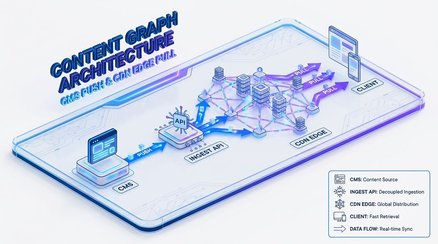
The underlying architecture enforces absolute segregation between indexing and retrieval. This push-pull dichotomy redefines operational load distribution according to the Optimizely Developer Documentation Portal through four distinct mechanics:
- The Push Mechanics : The integration monitors IContentEvents. Upon a lifecycle shift (publish, move, delete), the object serialises to JSON , securely dispatched through HMAC -secured HTTP requests into the ingest API.
- The Pull Mechanics : The system handles inbound traffic via GraphQL POST requests targeting cg.optimizely.com. This structural choice ensures high-throughput edge nodes geographically nearest to the user resolve the query, stripping latency and sparing application servers entirely.
- Edge Access Control : Legacy instances relied on .FilterForVisitor() to evaluate read permissions directly on the CMS server before yielding results. Content Graph shifts this paradigm by indexing CMS access rights alongside content payloads.
- Permissions Evaluation : Queries executed at the CDN edge evaluate authenticated versus anonymous content visibility by matching user authorisation headers against the indexed episerverRead permissions embedded natively within the graph schema.
NuGet Setup and Configuration
Integrate the foundational package securely from the Optimizely NuGet Package Feed: Optimizely.ContentGraph.Cms . Configuration resides natively in application settings, requiring the gateway mapping and cryptographic tokens to establish two critical runtime conditions:
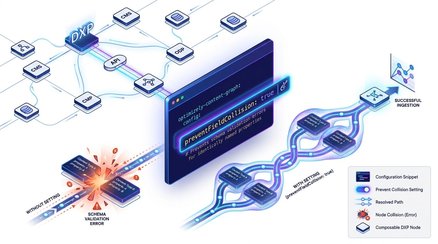
- Collision Prevention : One critical parameter demands immediate intervention: PreventFieldCollision: true .
- Validation Enforcement : Absent this boolean flag, identically named properties shared across diverging content models trigger schema validation exceptions during runtime generation, blocking subsequent synchronisation cycles.
Content Synchronisation: Wiring Publish Events to the Ingest Pipeline
Upon registration in the startup pipeline, the integration automatically hooks into the IContentEvents module. Publish, move, and delete actions seamlessly trigger HTTP dispatchers to the synchronisation endpoint without requiring manual listener boilerplate, but custom implementations require two specific interventions:
- Standard Mapping : While default CMS architectures map organically into the graph, complex custom scalar properties do not.
- Property Decoration : Custom property structs must be decorated with [GraphType(typeof(TargetGraphType))] attributes, ensuring the graph compiler correctly interprets and indexes non-standard value types.
Visual Suggestion : Event listener logic description
Writing GraphQL Queries Against Content Graph
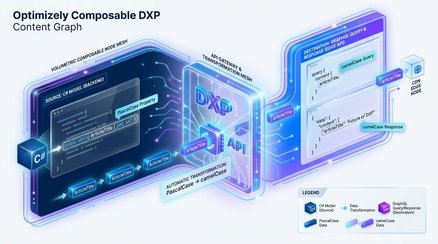
Executing requests against the edge relies on strong typing directly derived from the CMS schemas. Establishing raw or wrapped queries against the GraphQL interface dismantles legacy LINQ abstractions through three operational shifts:
- Schema Standards : The generated GraphQL syntax enforces headless schema standards by automatically converting native C# model properties from PascalCase (e.g., ArticleTitle ) to camelCase (e.g., articleTitle ).
- Aggregation Support : Search execution natively supports operations like faceted filtering and category counts via native GraphQL facet aggregations.
- Network Efficiency : Search payloads resolve vast structural aggregations within a solitary network trip.
Security: HMAC vs SingleKey Authentication
A bifurcated security posture successfully isolates operational execution paths into two distinct authentication models:
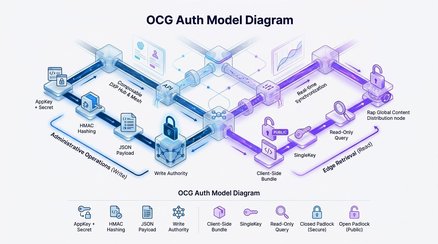
- Administrative Operations : The administrative push utilises an AppKey alongside a protected Secret, dynamically hashing JSON payloads and timestamps to generate HMAC signatures. This strict cryptographic handshake authenticates write authority.
- Edge Retrieval : Conversely, the query plane utilises the SingleKey .
- Vulnerability Analysis : During security sweeps, this read-only string is frequently flagged as an exposed vulnerability.
- Risk Mitigation Status : This is a false positive—it is intentionally public, inherently safe to embed in client-side bundles, and structurally devoid of any write or manipulative permissions.
Visual Suggestion : Auth model diagram
Migration Checklist and What to Watch Out For
Systematic integration avoids four predictable pitfalls:
- Schema Warm-Up : A new Graph environment remains a vacuum until initial processing. Initiate a full manual reindex via the administrator dashboard before running automated queries.
- LINQ Eradication : Legacy .Search<T>() invocations must be systematically removed. No automated compatibility shims are bridging Find to Content Graph SDKs.
- Access Control Migration : Standard .FilterForVisitor() security assertions do not run at the CDN level. Queries must be refactored to utilise the episerverRead field to ensure content visibility rules are strictly enforced for authenticated and anonymous users at the edge.
- Propagation Latency : Acknowledge eventual consistency . It takes roughly 30 seconds for local CMS changes to propagate globally across CDN networks. Do not construct transactional logic operating under zero-latency assumptions.
Conclusion & Strategic Advice
Migrating from EPiServer Find to Optimizely Content Graph fundamentally transforms the scaling model of digital platforms by offloading intensive computational logic onto distributed CDN environments. This marks a critical modernisation effort directly aligned with decoupled, headless computing methodologies, requiring three strategic actions:
- Security Model Deployment : Establishing dual-tier security models reduces vulnerability vectors, and using edge-proximate GraphQL requests significantly reduces user-facing search latency.
- Codebase Refactoring : Evaluate your existing search configurations, map your complex .Search<T>() routines, and execute the core synchronisation setups immediately.
- Extended Implementation : To extend this implementation with dynamic logic, continue this integration path in Optimizely Content Graph: Advanced GraphQL Patterns for Faceted Search and Autocomplete.
This isn't just an infrastructure upgrade; it's a fundamental shift in how digital platforms scale and distribute content. 💬 What is your team's biggest hurdle in migrating away from EPiServer Find? Drop your thoughts in the comments and ♻️ share this with your engineering network!
Further Reading
- Querying Content Graph : Optimizely Developer Docs: Querying Content Graph
- Performance Construction : Dev.to: Constructing Performant GraphQL Edge Architectures in CMS 12
- Data Flow Mechanics : Medium: Demystifying Optimizely Content Graph Synchronisation
More From Me
- Platform Upgrades : Upgrading Optimizely: CMS 11 to 13 Stepwise Guide
- Ecosystem Navigation : Navigating Optimizely: Product Suite Guide
- Content Operations : Understanding Optimizely: Content Marketing Platform (CMP)
- Headless Deployment : Unlocking the Power of Headless CMS with Optimizely
Original Article: Read on LinkedIn | Read on Substack