Mixture of Experts: The All-to-All Bottleneck
Introduction
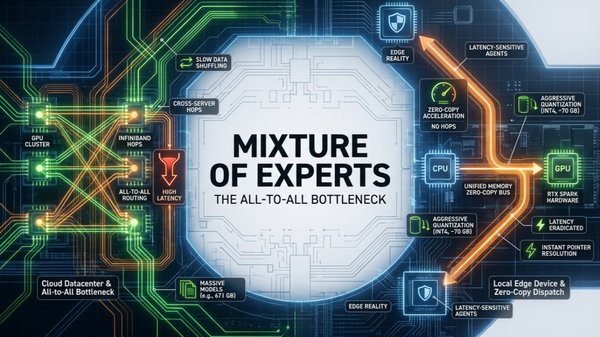
Mixture of Experts (MoE) architectures shift computational bottlenecks away from matrix multiplications directly into interconnect bandwidth limits. Resolving this distributed throughput penalty requires bypassing conventional cloud cluster topologies to establish hardware boundaries restricted to latency-optimised unified memory :
- Algorithmic Repositioning : Advanced routing heuristics decouple structural capacity from active computational overhead, triggering dense, cross-server all-to-all communication latency .
- Structural Bypass : Localised, zero-copy workstation infrastructures like the Surface RTX Spark Dev Box intercept and eliminate network-bound dispatch delays.
- Deployment Execution : This topology isolates highly efficient mid-scale sparse inference to a single local node, relegating massive 670B+ model configurations back to distributed cloud environments.
1. Frontier MoE Parameter Sparsity
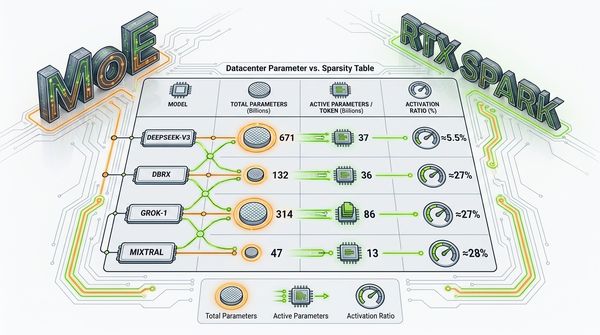
MoE structures substitute dense matrix multiplication for sparse parameter activation, enforcing rigid constraints on per-token mathematical operations. This dynamic scales total network capacity while restricting computational execution across four major industry frameworks:
- Architectural Scale : The DeepSeek-V3 framework coordinates a 671 billion parameter pool alongside a 5.5% activation ratio, managing tokens via a 256-expert layout equipped with Top-8 selection and a single shared expert; Emergent Mind: DeepSeek-V3: Open Sparse MoE Model .
- Mathematical Restriction : This routing topology limits the computational footprint to exactly 37 billion active parameters per token, establishing baseline efficiencies matching competing structures like DBRX (132 billion total / 36 billion active) and Grok-1 (314 billion total).
- Throughput Output : The Mixtral 8x22B layout implements an 8-expert configuration with Top-2 routing to activate 39 billion parameters from a 141 billion reserve Mixture of Experts explained .
2. The Physics of All-to-All Dispatch
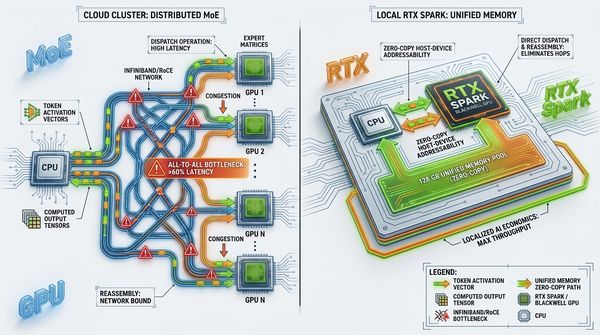
Executing distributed structures across cloud clusters dictates highly dense all-to-all communication collectives per inference layer; The Rise of Sparse Mixture-of-Experts: A Survey from Algorithmic Foundations to Decentralised Architectures and Vertical Domain Applications . Token transit physics mandate two distinct, bandwidth-heavy operational phases:
- Dispatch Operation : The infrastructure transmits token activation vectors across network fabric limits to isolate specific GPUs hosting targeted expert matrices.
- Reassembly Phase : Following localised Feed-Forward Network (FFN) calculations, the hardware returns computed output tensors across identical network channels to reconstruct sequence pipelines.
- Inference Throttling : This cross-server traffic permanently binds inference speeds to InfiniBand or RDMA over Converged Ethernet (RoCE) throughput limits, consuming up to 60% of total runtimes in unoptimised environments; Primers • Mixture of Experts .
3. Eliminating Network Hops via RTX Spark Unified Memory
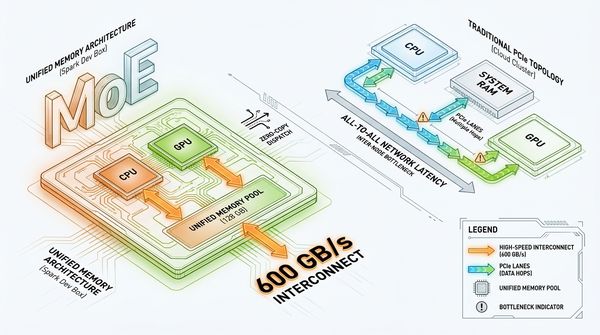
Neutralising datacenter interconnect delays requires migrating compute logic out of fragmented server racks into unified memory environments. The Surface RTX Spark Dev Box supplies a definitive physical bypass via its Blackwell architecture GPU containing 128 GB of unified memory:
- Host-Device Unification : High-bandwidth CPU-GPU interconnects instantiate a zero-copy memory hierarchy where orchestrators and GPU CUDA kernels share contiguous physical address space.
- Latency Eradication : Activation vectors strictly inhabit local boundaries, cutting out the server-to-server data shuffling essential to datacenter MoE frameworks Accelerating Edge Inference for Distributed MoE Models with Latency-Optimized Expert Placement .
- Throughput Tradeoffs : This architecture swaps ~8 TB/s HBM3e capabilities for a 600 GB/s unified memory pipeline, limiting maximum MoE parameter topologies to the 128 GB ceiling while resolving routing limits instantaneously (NVIDIA RTX Spark Architecture Documentation).
4. Architectural Implications for Edge Inference
Edge inference mandates strict structural recalculations due to insurmountable hardware capacity caps and rigid communication bandwidth ceilings; Accelerating Edge Inference for Distributed MoE Models with Latency-Optimized Expert Placement . Adapting MoE functionality to restricted environments demands three core operational shifts:
- Capacity Hard-Limits : Initialising 671 billion parameter architectures like DeepSeek-V3 fails mathematically on 128 GB machines, requiring a baseline 671 GB footprint even at FP8 precision.
- Token Dropping Penalties : Hardware overloads force excess tokens to bypass specific expert layers via residual connections , severely degrading mathematical output expressivity; Emergent Mind: DeepSeek-V3: Open Sparse MoE Model .
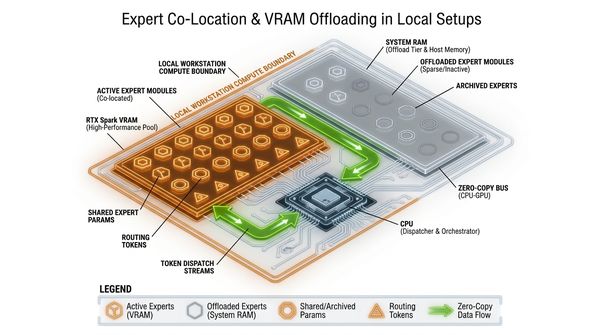
- Localised Offloading : Systems must restrict network scale to Mixtral 8x22B limits or implement dynamic parameter tiering, pulling high-frequency parameters into fast memory boundaries while managing background data fetches.
Conclusion & Strategic Advice
The mechanics of MoE scaling confirm interconnect bandwidth dictates inference throughput ceilings more heavily than raw parameter density. Migrating away from datacenter systems toward unified memory configurations neutralises the distributed all-to-all data penalty via two core structural adaptations:
- Hardware Transition : Integrating a 128 GB local memory pool trades massive HBM throughput for immediate, hop-free data access, bypassing cloud overhead entirely.
- Deployment Logic : Engineering units must isolate zero-copy host-device addressability alongside rigid FP8 quantisation logic to preserve local routing performance within designated physical thresholds.
- VRAM Adaptations : Edge adaptation strategies proceed to Part 2: Expert Co-Location & VRAM Offloading, which details methodologies for mapping expert routers into native memory trees without generating out-of-memory collapse states.
Decentralizing MoE workloads allows engineers to reclaim absolute inference speed. 💬 What do you believe is the biggest barrier to running frontier AI models entirely at the edge? Share your insights and ♻️ share this post with your network!
Further Reading
- ExpertFlow: Efficient Mixture-of-Experts Inference via Predictive Expert Caching and Token Scheduling
- RailS: Load Balancing for All-to-All Communication in Distributed Mixture-of-Experts Training
- Convergence Rates for Softmax Gating Mixture of Experts
More From Me
Original Article: Read on LinkedIn | Read on Substack