Latent Space: The Token Bottleneck
Part 1 of 4 - Bypassing Words in AI Reasoning
Introduction
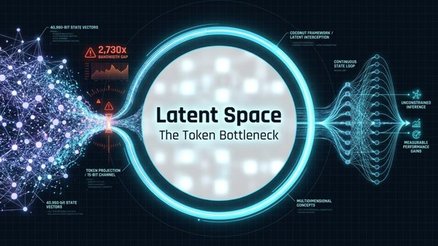
When we force a Large Language Model to reason out loud via traditional Chain-of-Thought (CoT), we are effectively forcing a massive, high-dimensional neural network to communicate with itself through the narrow straw of human language. While text-based reasoning works, it introduces a severe computational tax.
Latent Chain-of-Thought (Latent CoT) offers an alternative: executing intermediate reasoning entirely within the vector space, completely bypassing natural language token generation. Standard Transformer architectures, forcing hidden layers to project onto discrete language, create constraints during inference:
- Hidden-State Bandwidth : A single vector (d_{model} = 4096 using bfloat16 precision) carries roughly 65,536 bits of uncompressed, fluid information.
- Vocabulary Compression : Projecting the rich vector state onto a rigid 32,000-token vocabulary space forces aggressive compression to approximately 15 bits of discrete semantic data. We are throwing away massive amounts of representational nuance at every single token step.
- Expressive Limitations : This severe bottleneck dampens attention weights and imposes unnatural linguistic constraints on internal computation, restricting the model's native capacity to parallelise complex logic.
Recent research highlights a massive migration toward non-textual internal processing layers to resolve these bottlenecks, as detailed in A Survey on Latent Reasoning . To address these limitations, we must examine the foundational architecture that is pioneering this space: the Coconut framework.
The Coconut Architecture & Interception Mechanics
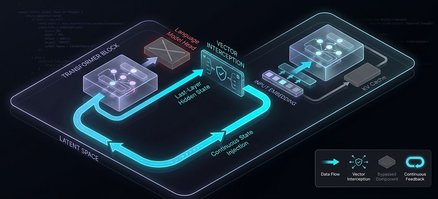
The Coconut framework routes the last-layer hidden state back into the model as the next input embedding, thereby sustaining reasoning entirely within latent space . Detailed in Training Large Language Models to Reason in a Continuous Latent Space , this paradigm structurally alters the runtime loop via three operational shifts:
- Vector Interception : The architecture intercepts the raw vector directly before projection, rather than routing hidden states through a linear language model head (LM\_Head) to write a discrete token to the Key-Value (KV) cache .
- Sequence Injection : The intercepted continuous thought is injected directly into the sequence dimension for the subsequent forward pass.
- Latency Elimination : Bypassing de-tokenisation eliminates autoregressive generation latency while preserving the full tensor-space dimensionality.
By operating entirely within the continuous layer space, the model preserves the rich fidelity of tensor activations, allowing the internal reasoning graph to mature and self-correct before crystallising logic into an output token.
The Curriculum Learning Protocol
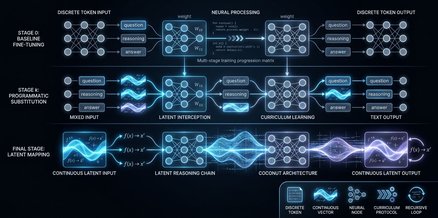
Latent spaces lack the mathematical boundaries of discrete tokens, leading to severe gradient instability and semantic drift during direct transitions from continuous input. Stabilising backpropagation requires the implementation of a rigid, three-stage curriculum learning protocol:
- Baseline Fine-Tuning : Training begins at Stage 0, with standard supervised fine-tuning performed on conventional text datasets.
- Programmatic Substitution : Stage k replaces the first k discrete text steps with continuous thought vectors, forcing the network to decode target answers while receiving non-linguistic inputs.
- Latent Mapping : The final training stage eliminates the text chain, mapping initial prompts directly to continuous latent thoughts.
The Coconut framework currently operates as an academic prototype restricted to synthetic planning tasks and closed mathematical environments. Operational stability across trillion-parameter models or massive pre-training token scales remains unverified.
Conclusion & Strategic Advice
Decoupling cognitive throughput from textual dependencies upgrades isolated reasoners into high-bandwidth systems. Transitioning away from the horizontal inflation of parameters towards test-time compute optimisations means understanding exactly how to allocate your computational budget. Selecting the correct reasoning layer demands evaluating infrastructure constraints against operational objectives via two deployment paths:
- Standard Discrete CoT : Executes optimal routing for highly auditable, interpretability-first pipelines where intermediate step visibility is legally or operationally required.
- Continuous Latent Loops : Supports high-frequency, closed-domain reasoning tasks prioritising absolute context preservation and ultra-low time-to-first-token (TTFT), assuming robust latent translation or architectural alignment.
The structural execution of these compute pipelines continues in ' Latent Space: Looped Transformers '
💬 Do you believe breaking AI free from human language structures is the key to unlocking the next era of intelligence? Share your thoughts below and ♻️ share this post with your network!
Further Reading
- A Formal Comparison Between Chain of Thought and Latent Thought
- Towards Reasoning Era: A Survey of Long Chain-of-Thought for Reasoning Large Language Models
- Chain-of-Thought Hub: A Continuous Effort to Measure Large Language Models' Reasoning Performance
More From Me
Original Article: Read on LinkedIn | Read on Substack