MoE VRAM Offloading: Architecture & Expert Co-Location Strategies

MoE VRAM Offloading: Architecture & Expert Co-Location Strategies
Introduction
Part 1: The Foundations of RTX Spark Unified Memory established the baseline hardware architecture. The immediate barrier in local AI orchestration is memory constraints.
Operating massive Mixture of Experts (MoE) topologies like DeepSeek-V3 or Llama 4 Maverick historically demanded sprawling, multi-node compute clusters. At 671 billion parameters, an uncompressed model commands an insurmountable 1.34 TB memory footprint.
The sparse routing inherent to MoE architectures presents a distinct optimisation vector. Token generation activates only a concentrated subset of roughly 37B active parameters per token.
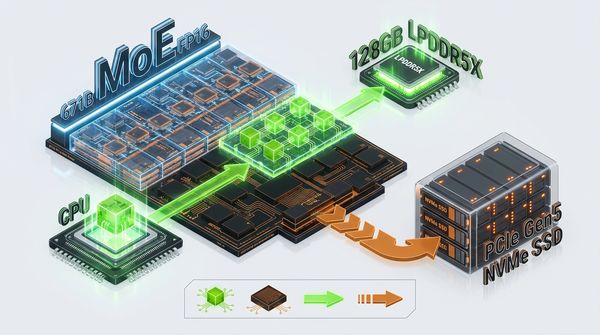
Bridging the gap between the 128 GB LPDDR5X DRAM bus and high-throughput PCIe Gen5 NVMe storage makes local management an achievable engineering reality. This architecture strictly serves high-capacity local batch processing or asynchronous agentic reasoning .
Executing this local inference pipeline requires three core orchestration mechanics:
- Memory Co-Location : Transitioning from uniform allocation to targeted 8-16 expert block co-location.
- Precision Scaling : Applying FP4/ FP8 mixed-precision quantisation to compress the footprint.
- Direct Memory Mapping : Executing zero-copy access via C# ILGPU to shift the bottleneck directly to the NVMe and Unified Memory boundary.
1. The Hero Image & Memory Bottleneck
Frontier MoE models route tokens through an intricate network of specialised layers. DeepSeek-V3 operates 256 routed experts and a single shared expert per layer.
Fitting its 671B parameters natively demands 1.34 TB, blocking desktop execution; Emergent Mind Topics — DeepSeek-V3 . Inference relies on exactly nine components per token (the top-8 routed experts plus one shared expert).
Capitalising on this sparsity allows the system to isolate a ~35–45 GB resident DRAM footprint. The active ~37B parameters remain pinned inside the 128 GB LPDDR5X unified pool.
Cold experts dynamically stream from PCIe Gen5 NVMe SSDs arXiv — Edge Inference for Distributed MoE . This physical reality transitions the system from being compute-bound to I/O latency-bound.
2. Co-Location Strategies for Local Hardware
The RTX Spark architecture eliminates the traditional boundary between "host RAM" and VRAM . The Grace CPU and Blackwell GPU communicate over a shared 128 GB LPDDR5X pool, pushing ~273 GB/s of DRAM bandwidth.
To prevent severe memory fragmentation , placement logic must adapt across three distinct strategies:
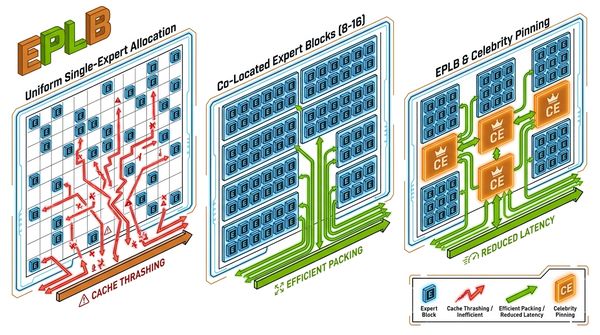
- Uniform Single-Expert Allocation : Assigning one expert per page triggers catastrophic cache thrashing and page-fault latency.
- Co-Located Expert Blocks : Grouping 8 to 16 experts per memory block maximises packing density and preserves spatial locality for unified bus throughput.
- EPLB & Celebrity Pinning : Tracking high-frequency "celebrity" experts keeps them permanently pinned in the DRAM pool, adapted from the Expert Parallelism Load Balancing (EPLB) protocol DeepSeek-V3 Technical Report (arXiv) .
EPLB mitigates 85% of cold-page NVMe fetch penalties. The architectural reality of the remaining 15% miss rate per routing step across DeepSeek-V3's 61 MoE layers guarantees blocking NVMe reads for almost every generated token.
Mitigating this constraint relies on introducing two concurrent execution paths:
- Speculative Pre-Fetching : Loading anticipated experts into memory before execution.
- Asynchronous Look-Ahead Routing : Masking I/O latency before the token payload reaches the GPU.
3. Quantisation & Memory Footprint Reduction
Serving dense models locally demands precise mixed-precision mathematics. Compressing weights to FP4 (0.5 bytes per parameter) reduces the total weight payload of a 671B model to roughly 335 GB.
Mid-tier models at the ~120B scale fit entirely within the 128 GB LPDDR5X capacity, occupying 60–80 GB. Larger 671B models require two distinct quantisation tiers:
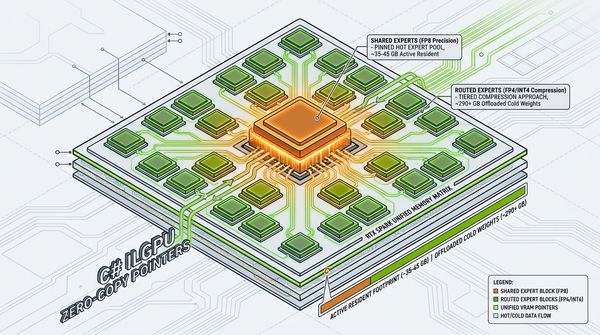
- Shared Expert Precision : Critical shared experts are maintained at FP8 precision.
- Routed Expert Compression : The highly numerous routed experts are aggressively compressed to FP4.
Under this protocol, the 37B active parameters and KV cache command an instant resident footprint of ~35–45 GB. The system offloads the remaining ~290+ GB of cold weights to the NVMe storage tier Friendli AI — MoE Models Comparison .
Relying on NVMe introduces a severe throughput bottleneck. The LPDDR5X unified memory operates at ~273 GB/s, while a top-tier PCIe Gen5 NVMe SSD caps at ~14 GB/s.
Reading a single 2 GB FP4 cold expert from disk mathematically requires ~140 milliseconds. When an inference step necessitates fetching multiple cold experts, generation latency spikes to hundreds of milliseconds per token, crashing output to single-digit Tokens Per Second (TPS).
4. Implementing Zero-Copy Offloading in C# (.NET 9 + ILGPU)
Leveraging the ~273 GB/s unified memory bandwidth without bottlenecking on standard managed framework abstractions requires direct memory mapping. C# combined with .NET 9 and ILGPU provides a direct bridge.
Zero-copy execution exclusively optimises the resident hot path . Establishing the context requires exact syntax to map operations directly into the hardware stream:
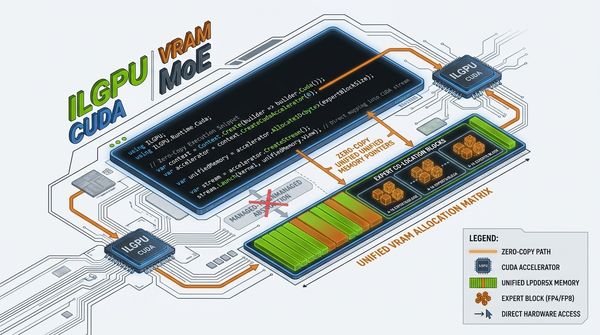
- Context Initialisation : Invoking context.CreateCudaAccelerator(0) acquires bare-metal unified memory pointers.
- Array Allocation : Calling Allocate1D<byte> allocates unified arrays for direct hardware access.
- Stream Mapping : Mapping the resulting ArrayView<T> directly into the CUDA stream ensures the CPU and GPU perform zero-copy kernel execution.
This raw mapping avoids the severe C# managed-to-unmanaged overhead on resident LPDDR5X memory. Pure interconnect throughput governs inference math once the experts page in from cold storage.
Conclusion & Strategic Advice
Combining these strategies fundamentally redefines the workstation limit for batch reasoning and agentic workflows. Enforcing 8-16 expert block co-location, hybrid FP8/FP4 quantisation, and zero-copy C# ILGPU execution transitions 671B parameter models from cloud-exclusive deployments into viable local pipelines.
To implement this architecture effectively, deploy three specific optimisations:
- I/O Mitigation : Implement EPLB + Celebrity Pinning to prevent 85% of fetch penalties.
- High Density Packing : Enforce Co-Located Expert Blocks (8-16) to eliminate memory fragmentation and cache thrashing.
- Resident Hot Path Mapping : Execute C# ILGPU Allocate1D<byte> to bypass managed-to-unmanaged abstraction overhead on LPDDR5X memory.
Working with coherent unified memory architectures like the RTX Spark requires moving beyond legacy mental models and focusing on strict capacity versus latency trade-offs. The next evolution of this setup lies in orchestrating these streams dynamically across complex tasks.
Part 3: Dynamic Load Balancing and Multi-Expert Reasoning explores how to integrate speculative pre-fetching to maintain this fragile balance under highly volatile, asynchronous token loads.
This unified memory architecture fundamentally redefines the workstation limit for asynchronous agentic workflows. 💬 Will optimised local inference eventually replace heavy cloud reliance for your engineering pipelines? Drop your thoughts below and ♻️ share this with your network!
Further Reading
- NVIDIA Unified Memory for CUDA Beginners
- ILGPU Official Documentation: Memory Buffers and Views
- Hugging Face: Mixture of Experts Explained
More From Me
Original Article: Read on LinkedIn | Read on Substack