Securing Optimizely Graph: Prevent Secret Leakage
Introduction
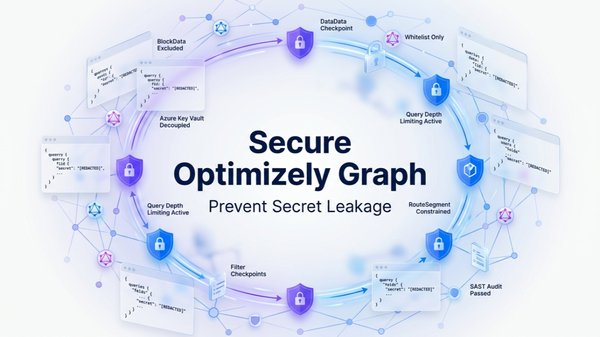
Automatic GraphQL schema generation accelerates modern deployment cycles but introduces severe operational and security risks when mapping administrative backend properties to public-facing APIs . Optimizely Content Graph simplifies scalable content delivery, yet its reliance on default assembly reflection exposes API credentials, internal structures, and complex relationship graphs through introspection .
The configurations and assembly scans detailed here apply specifically to Optimizely CMS 12+ ( .NET 8/10). In older CMS iterations or when utilising legacy search architectures like EPiServer Search & Navigation, entirely different initialisation paths apply.
This guide establishes a hardened, Zero-Trust architecture by structurally abandoning the default-inclusive "opt-out" indexing model. Implementing a secure, default-deny posture requires three core structural changes:
- Framework Shift : Abandon reactive blacklists and enforce a strict opt-in GraphQL schema configuration.
- Secret Isolation : Offload secrets to secure environment variables to decouple infrastructure from credential leakage.
- Threat Mitigation : Deploy automated defences against GraphQL-specific execution vulnerabilities to reduce index sizes by 75–80%.
1. The Hidden Risk in Automatic GraphQL Schema Generation
At system startup, the auto-discovery mechanism dynamically maps properties to expose the data structure:
- Key Concept : Default assembly reflection exposes backend properties to the public web during initialisation.
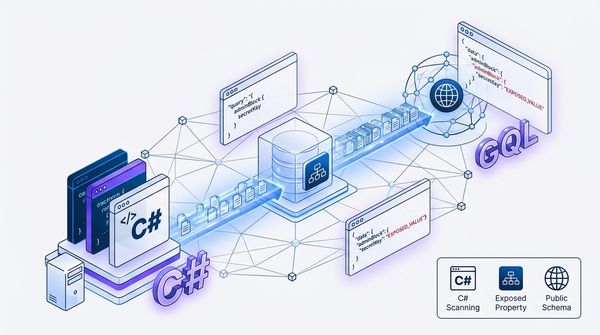
- Technical Detail : Optimizely Content Graph executes assembly reflection during the AddContentGraph service registration to discover C# classes, mapping public properties to a unified GraphQL endpoint Optimizely Content Graph Configuration .
- Action/Result : Embedding credentials like a MerchantKey directly inside a C# content block structure leaks property shapes via schema introspection, even when the database contains no instance data.
2. Introspection vs Instance Data Indexing
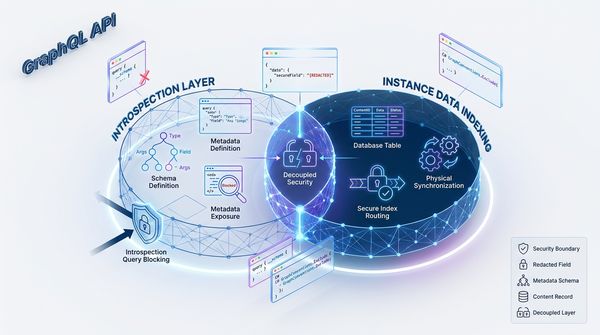
Securing the boundary requires treating the API surface as two distinct, independent layers:
- Key Concept : The API surface splits between a reconnaissance layer for structural metadata and an execution layer for physical data synchronisation.
- Technical Detail : The Introspection ( __type ) layer exposes schema designs to querying clients, while Instance Data Indexing governs the physical synchronisation of content records ( tblContent ) to the Graph cloud database.
- Action/Result : Applying targeted Conventions API configurations decouples these two layers, severing sensitive models from physical storage sync and introspection metadata to neutralise modern headless threats.
3. Implementing Zero-Trust: True Global Whitelisting
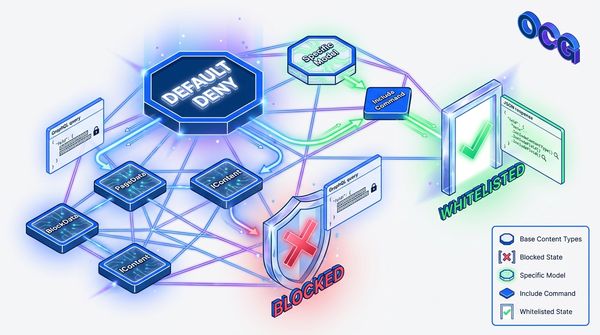
Modern DevSecOps mandates a default-deny architecture to eliminate the fragile "opt-out" blacklist reliance on ExcludeField and ExcludeContentType :
- Key Concept : Global exclusion of base abstractions blocks undocumented models from reaching the schema metadata.
- Technical Detail : Excluding base types like BlockData, PageData, or IContent via the Conventions API forces developers to explicitly invoke .IncludeContentType() and .IncludeField() to authorise public-facing schemas Optimizely Content Graph Advanced Features .
- Action/Result : Isolating connection strings and API keys from CMS properties and [appsettings.json](https://learn.microsoft.com/en-us/aspnet/core/fundamentals/configuration/) files into secure environment variables or Azure Key Vault dynamically loads credentials at runtime, physically blocking them from the GraphQL generation layer.
4. Volumetric Security & Index Efficiency
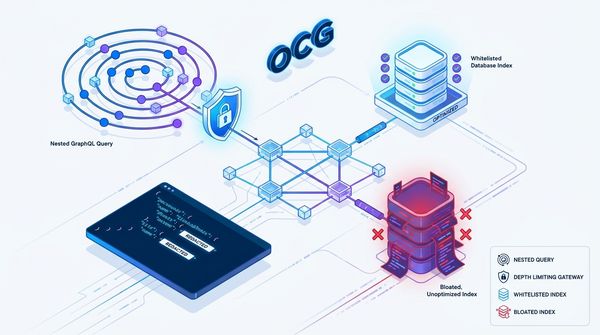
Execution phase security demands strict resource limits to prevent nested query Denial of Service (DoS) attacks and index bloat:
- Key Concept : GraphQL architectures require operational limits at the network edge to prevent resource exhaustion from complex relational queries.
- Technical Detail : Enforcing Query Depth Limiting and Query Complexity Analysis (Cost) at the API gateway or reverse proxy intercepts DoS attempts before they consume database RU (Request Unit) allocations.
- Action/Result : Defaulting to a global deny and explicitly whitelisting direct-query entities via the configureConventions callback in Program.cs prevents ContentArea structural fragments from generating index bloat, shrinking the total footprint by 75–80% and accelerating cloud synchronisation.
5. Query-Level Security & Routability Scoping
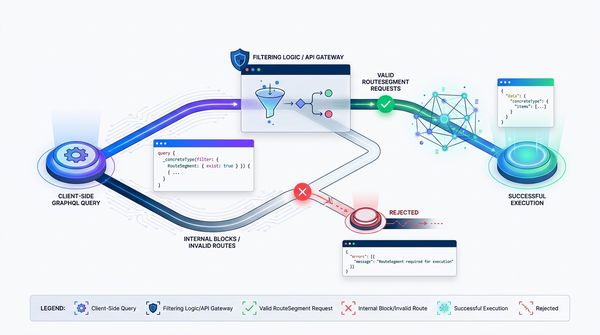
Client-side queries require strict routability constraints to prevent exposure of internal data containers and disconnected layout blocks:
- Key Concept : Frontend constraints ensure public searches reject items lacking valid URLs and neutralise cross-type schema scraping.
- Technical Detail : Executing searches with RouteSegment: { exist: true } suppresses asset folders, while passing the _concreteType or _typeName variables explicitly scopes the query to exact page models.
- Action/Result : These routing filters restrict execution to verified, public-facing endpoints and systematically hide backend structural fragments from the client schema.
6. Automated Security & CI/CD Audit Integration
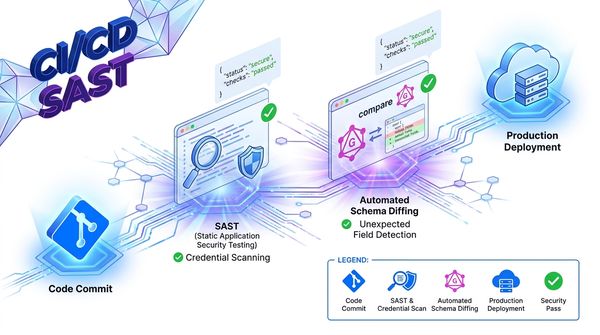
Modern deployment pipelines require replacing manual pre-flight checklists with three automated DevSecOps interventions:
- Key Concept : CI/CD pipelines must integrate schema auditing and code analysis to halt deployments containing unapproved mutations or hardcoded tokens.
- Technical Detail : Implementing Static Application Security Testing (SAST) detects credentials in C# models before compilation, while GraphQL schema diffing tools identify unexpected fields in the introspection endpoint.
- Action/Result : Deploying rate limiting at the gateway, enforcing RouteSegment checks on frontend queries, and abstracting credential retrieval through secure Vault APIs automatically neutralises nested query executions and source-control secret leaks.
Conclusion & Strategic Advice
Automated schema discovery accelerates system delivery, but deploying a default-inclusive graph introduces severe operational risk. Abandoning manual blacklists in favour of a strict "opt-in" Conventions API configuration establishes a Zero-Trust perimeter that blocks accidental credential leakage and optimises synchronisation performance.
Deploying a secure, enterprise-grade data orchestration layer relies on two architectural standards:
- Infrastructure Isolation : Coupling strict default-deny indexing with rigorous environment-variable secret management isolates sensitive logic from public-facing endpoints.
- Performance Optimisation : Operating the Content Graph as a heavily filtered delivery layer preserves high-speed execution and isolates sensitive infrastructure logic from the backend database.
💬 Is your headless architecture operating on true Zero-Trust, or are you still relying on risky default configurations? Drop your thoughts below and ♻️ share this post with your engineering network!
Further Reading
- GraphQL Security: Disabling Introspection (Apollo Server)
- OWASP GraphQL Security Cheat Sheet
- Secure Configuration in .NET via Azure Key Vault
More From Me
- Optimizely Graph: Migrating from Search & Navigation
- Architecting Zero-Trust Systems: A Guide to Web Cybersecurity
- Mastering Optimizely's Headless CMS: Unlocking Optimizely with Frontend Frameworks
- Securing Your Web Apps in 2025: Easy Lessons from IBM X-Force
- Modern Web Architecture: Scalability and Performance, Optimizely Can Help!
Original Article: Read on LinkedIn | Read on Substack