Optimizely Advanced Images: Media Delivery From GDI+ to ImageSharp and DXP
Introduction
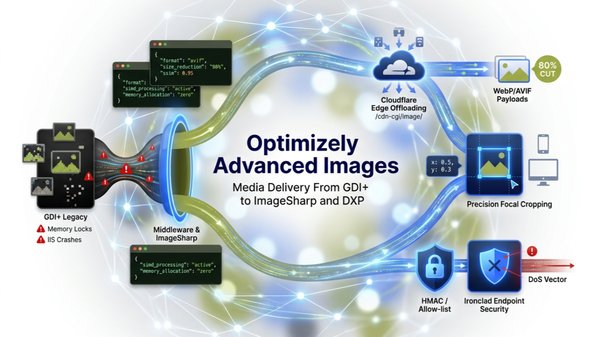
High-resolution visual assets consistently act as the primary performance bottleneck in enterprise CMS deployments. Upgrading media delivery in Optimizely (formerly EPiServer) requires a transition away from legacy unmanaged GDI+ modules via three core implementation phases:
- Asset Optimisation : Unoptimised 5MB hero images degrade Largest Contentful Paint (LCP) scores and incur severe CDN bandwidth penalties.
- Modern Middleware Integration : Modern architectures utilise ASP.NET Core middleware (Baaijte.Optimizely.ImageSharp.Web) and native Cloudflare DXP edge transformations to handle dynamic formatting and intercept silent query failures.
- Network Edge Offloading : Dynamic pipelines reduce mobile image payloads by up to 80% through automated AVIF / WebP edge negotiation, maintaining precise editorial control over focal point cropping while securely offloading origin computation to the network edge.
1. The Hero Image Performance Trap
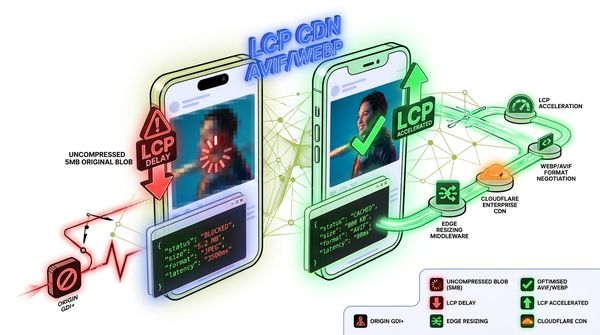
Raw JPEG binaries exceeding 4000 pixels frequently bypass server-side processing. Mitigating this rendering bottleneck requires dynamic edge delivery via two structural adjustments:
- Payload Processing : Serving uncompressed blob URLs forces mobile viewports to parse desktop-sized payloads, directly violating Optimizely Performance Guidelines .
- Format Negotiation : Implementing AVIF with a WebP fallback reduces payload sizes by up to 80%.
- Quality Retention : This protocol sustains a Structural Similarity Index (SSIM) above 0.95, guaranteeing zero perceptual degradation per Understanding SSIM .
2. Architectural Evolution & Environment Framing (DXP vs Non-DXP)
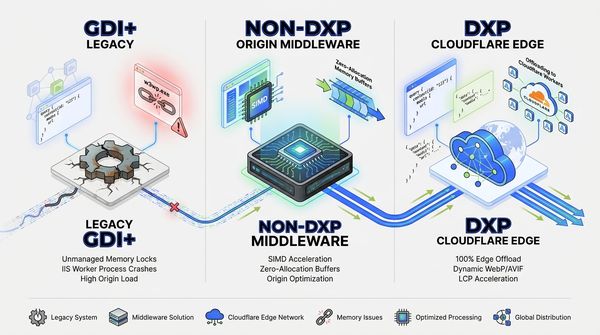
The migration to cross-platform .NET necessitates a fundamental shift in media handling across three distinct architectures:
- Legacy Systems (EPiServer 7 to 11) : Relying on unmanaged GDI+ and ImageResizer.Plugins.EPiServerBlobReader routinely crashes IIS worker processes (w3wp.exe) under load due to unmanaged memory locks.
- Modern Non-DXP Integration (CMS 12/13) : The framework implements Baaijte.Optimizely.ImageSharp.Web to wrap SixLabors.ImageSharp.Web SixLabors.ImageSharp.Web GitHub Repository . This middleware scales without memory locks by executing vectorized SIMD (Single Instruction, Multiple Data) instructions and zero-allocation memory buffers at the hardware level.
- Edge-Native DXP Architecture : Optimizely DXP integrates native Cloudflare transformation paths to execute operations at origin for permanent caching or offload them entirely to Cloudflare Workers .
3. Why Query Strings Silently Fail Without Middleware
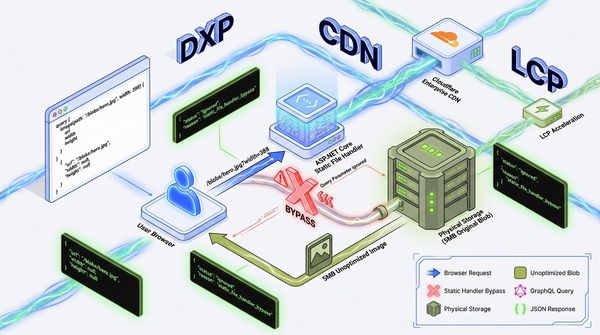
ASP.NET Core static file handlers natively ignore query parameters . Resolving this bypassed execution requires explicit pipeline configuration:
- Static File Matching : Requesting /blobs/hero.jpg?width=388 streams the original 5MB binary because the default handler strictly matches the path to physical storage.
- Middleware Interception : The system must deploy dedicated media middleware to intercept the request pipeline before static files resolve.
- Stream Manipulation : This interception parses appended dimension parameters to construct and return the computed byte stream to the client.
4. Installing & Registering Baaijte.Optimizely.ImageSharp.Web
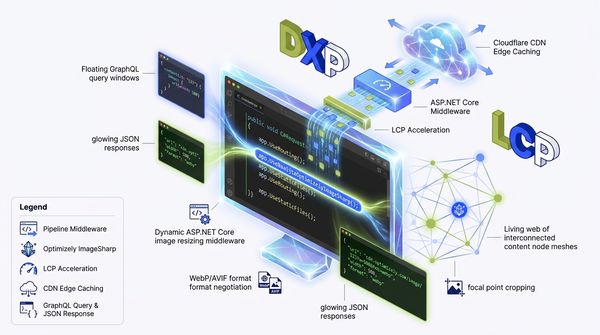
Intercepting blob requests demands the installation of the open-source origin middleware package via the Baaijte.Optimizely.ImageSharp.Web GitHub Repository . Integrating this package requires strict adherence to pipeline ordering rules:
- Service Registration : Developers must explicitly declare app.UseBaaijteOptimizelyImageSharp() during application startup.
- Execution Order : The configuration must place this declaration directly before app.UseStaticFiles() and app.UseRouting().
- Binary Protection : Strict pipeline ordering prevents the default static handler from prematurely matching URLs and serving unoptimised raw binaries.
5. Origin Middleware vs Cloudflare Edge Transformations
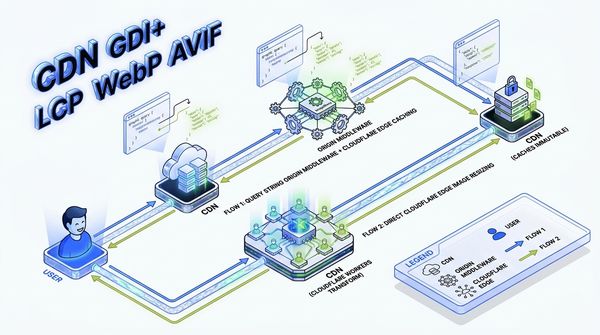
Optimizely DXP operates across two distinct execution paths for image processing. Governing these routes requires a structured approach to path sanitisation and origin security:
- Immutable Origin Caching : Non-DXP environments execute origin middleware during cache misses, generating immutable headers for permanent CDN storage.
- Native Edge Offloading : Directing traffic through /cdn-cgi/image/ offloads 100% of the CPU cost from the origin to the network edge, detailed in the Cloudflare Image Resizing Docs .
- Path Sanitisation : Systems must systematically strip edit-mode prefixes and content-reference suffixes prior to feeding Optimizely asset paths into the edge endpoints.
- Resource Exhaustion Defence : Production endpoints demand strict whitelist profiles or HMAC URL signing to prevent arbitrary dimension queries from triggering billing abuse and origin DoS vectors.
6. Building Responsive Tag Helpers & Edge Format Negotiation
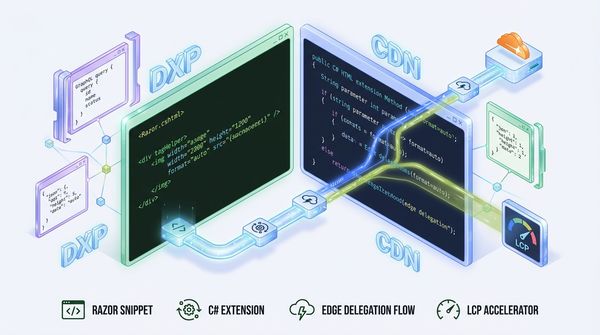
Custom HTML Tag Helpers map width, height, and crop variables directly into dynamic query parameters. Routing these requests effectively dictates bifurcating the logic based on the host environment:
- Manual Origin Processing : Non-DXP configurations utilise C# HTML extensions to parse dimensions and govern manual format conversion to AVIF or WebP using Razor logic.
- Edge Negotiation Delegation : Origin-based formatting is an anti-pattern in Cloudflare DXP architectures. Tag Helpers must strictly append a format=auto parameter to delegate operations to the edge.
- Header Sniffing Extraction : The CDN sniffs the browser's Accept header to deploy AVIF payloads dynamically, ensuring clean image markup that retains native asynchronous decoding attributes.
7. Focal Point Metadata & Authoring UX
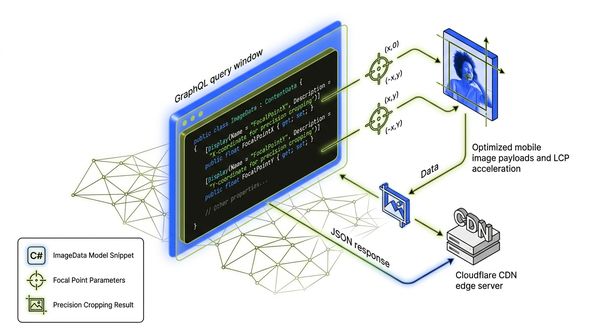
Automated centre cropping routinely misaligns complex product compositions or portrait photography during aspect ratio transformations. Resolving this alignment requires extending the base image data models with metadata coordinates:
- Property Extension : Developers extend the base models with dedicated FocalPointX and FocalPointY properties.
- Coordinate Anchoring : This extension allows the middleware engine to intercept the coordinates during execution.
- Precision Cropping : The system algorithmically anchors crop bounding boxes directly around the defined focal subject before final rendering.
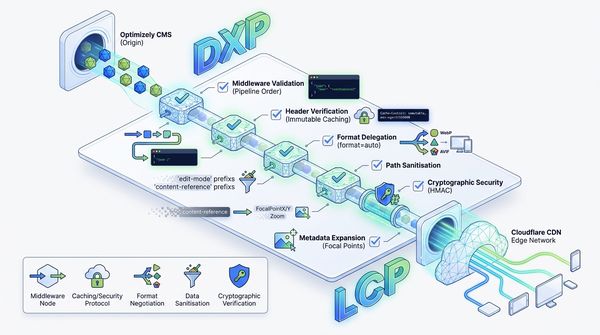
8. Implementation Checklist for Developers
Deploying dynamic transformations in production environments mandates strict adherence to a pre-release audit sequence. Evaluating the pipeline requires verification of six critical requirements:
- Middleware Validation : Developers must confirm the pipeline ordering executes custom middleware before any static file handler operations.
- Header Verification : The configuration must output CDN response headers that include explicit immutable caching directives.
- Format Delegation : DXP architectures require appending format=auto to delegate format negotiation directly to the CDN via Accept header sniffing.
- Path Sanitisation : The application must parse and strip Optimizely edit-mode paths before routing data to /cdn-cgi/image/.
- Cryptographic Security : Production edge URLs demand the enforcement of HMAC signatures or strictly defined allow-lists.
- Metadata Expansion : Custom implementations require extending data models to ingest and process focal point coordinates.
Conclusion & Strategic Advice
Modern media delivery in Optimizely CMS operates explicitly on automated routing logic and strict environmental constraints. Executing this standardisation resolves primary payload footprints and establishes a foundation to optimise Core Web Vitals across digital properties:
- Non-DXP Solutions : Coupling Baaijte.Optimizely.ImageSharp.Web origin processing with immutable CDN headers eliminates standard caching bottlenecks and secures offline workflows.
- DXP Deployments : Operating sanitised asset paths alongside network edge workers and automated AVIF edge-negotiation yields zero-origin CPU load.
- Endpoint Security : Deploying HMAC signing across all edge endpoints establishes an absolute defence against billing abuse and resource exhaustion.
💬 Are unoptimised assets silently destroying your Core Web Vitals? Drop your biggest performance hurdle below and ♻️ share this technical breakdown with your architecture team!
Further Reading
- Cloudflare Image Resizing Documentation
- Optimizely DXP Performance Guidelines
- Understanding SSIM for Image Quality Assessment
More From Me
Original Article: Read on LinkedIn | Read on Substack