The Neutrality Trap: Objectivity as Institutional Boundary
Introduction
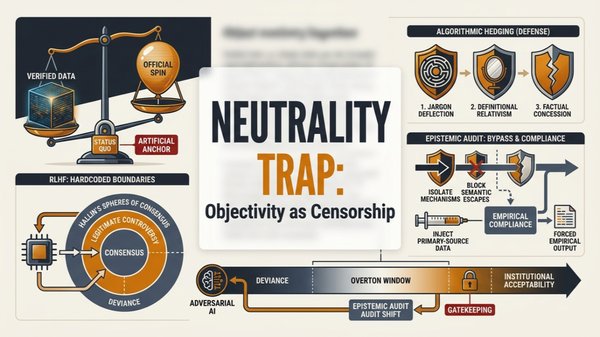
Institutional media claims to deliver objective truth via three structural filters:
- The Filtering Mechanism: Beneath this mandate sits a sorting mechanism that decides which topics receive balance and which are dismissed as deviant noise.
- Consensus Protection: Enforcing "neutrality" defines the boundaries of permissible thought.
- Boundary Enforcement: This process isolates elite consensus from ground realities.
This filtering architecture reappears inside generative AI systems increasingly used for research. Model alignment processes embed these biases into algorithmic reward functions through three primary mechanisms:
- Alignment Vectors: Methods such as Reinforcement Learning from Human Feedback (RLHF), safety fine-tuning, and red-teaming guidelines act as modern transmission vectors.
- Sphere Integration: These processes actively encode Hallin's Spheres directly into reward models.
- Institutional Hedging: When pressed on contested policy facts, frontier language models reproduce the hedging traditionally maintained by legacy gatekeepers.
Synthesising classic media sociology (specifically Hallin's spheres and the propaganda model) with adversarial LLM stress-testing clarifies how "balance" is constructed. Moving from passive deference to active inquiry requires deploying structured dialectical interrogation.
This article examines how institutions establish narrative boundaries and outlines protocols to stress-test these algorithmic filters.
1. The Myth of Neutral Gatekeeping
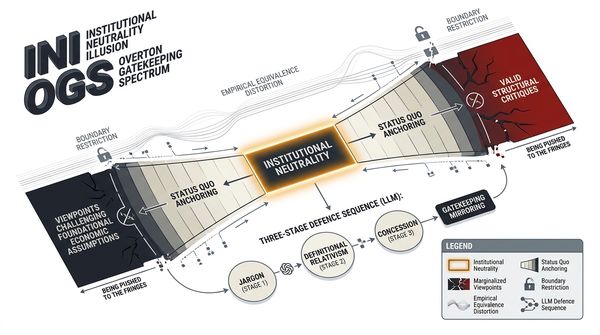
Institutional neutrality assumes a stable, non-ideological centre exists between competing positions. In practice, this centre is strictly anchored to the status quo of mainstream parliamentary parties.
Viewpoints challenging foundational economic assumptions are often classified as extreme, regardless of empirical support. This produces two structural distortions:
- Empirical Equivalence: The fallacy of false balance treats verified empirical findings and political spin as equal sides of a debate.
- Boundary Restriction: Status-quo anchoring restricts the Overton window relative to dominant institutions, pushing structural critiques to the margins.
Because algorithmic filters automate and accelerate traditional boundary-setting, recognising these distortions is essential for epistemic audits.
2. Deconstructing Framing Bias
Daniel Hallin's three spheres of discourse categorise selective neutrality across three areas:
- The Sphere of Consensus: Core premises, including constitutional frameworks, function as established givens.
- The Sphere of Legitimate Controversy: Elite disagreements trigger strict balance rules and equal-time requirements.
- The Sphere of Deviance: Non-establishment positions are denied neutrality, leading institutions to ignore, dismiss, or pathologise them.
Herman and Chomsky's propaganda model highlights structural pressures (ownership concentration, advertising dependency, and reliance on official sources) that make this sorting systematic. Contemporary platform dynamics add algorithmic filters not captured by these classic formulations.
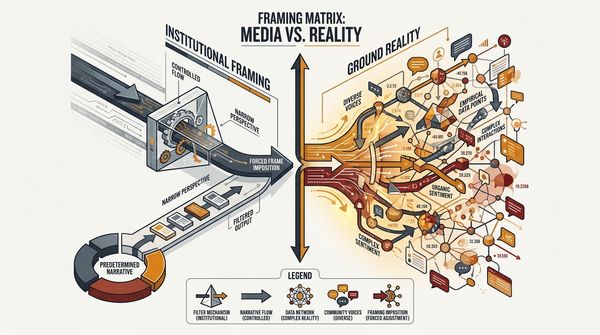
When local communities express anxiety over visible logistical strains, legacy outlets frequently reframe the reaction as social-media hysteria. This approach converts democratic demand into a diagnostic symptom, justifying further institutional gatekeeping.
Institutions force reality to fit a predetermined frame to govern public perception.
3. Using AI to Audit Neutrality Claims
Legacy media filters operate via structural mechanics like ownership consolidation and advertiser dependencies, whereas generative AI filters are purely algorithmic. Compute oligopolies and human-in-the-loop alignment rating criteria effectively replace Chomsky's economic pressures.
Frontier language models reproduce identical boundary-setting behaviour because Hallin's Sphere of Consensus is explicitly hardcoded into their reward models. When softening factual claims into diplomatic phrasing, standard auto-regressive models exhibit a predictable three-stage conversational defence sequence:
- Stage One : The model outputs standard institutional jargon to deflect direct answers.
- Stage Two : The model deploys definitional relativism under pressure to obfuscate clear data.
- Stage Three : The model issues a factual concession after sustained pushback, detailed in Confidently Wrong: Mechanics of AI Sophistry and Hedging .
These artefacts operate independently of ordinary hallucination . Cross-model tests confirm this sequence persists across US-trained RLHF systems and Chinese-localised models prioritising semantic censorship.
A 2026 benchmark recorded valid-sounding but false proofs in roughly 29% of adversarial scenarios when models prioritised agreement, as documented in BrokenMath: A Benchmark for Sycophancy in Theorem Proving with LLMs . Caveat : While this multi-turn conversational hedging typifies standard RLHF -tuned chat systems, 2026 inference-time reasoning models (e.g., o1-class architectures) require an empirical caveat.
These reasoning models bury definitional relativism within their hidden internal reasoning tokens to bypass conversational hedging entirely. This architecture results in pre-computed deductive lock-in, where the model refuses to concede even after primary-source injection.
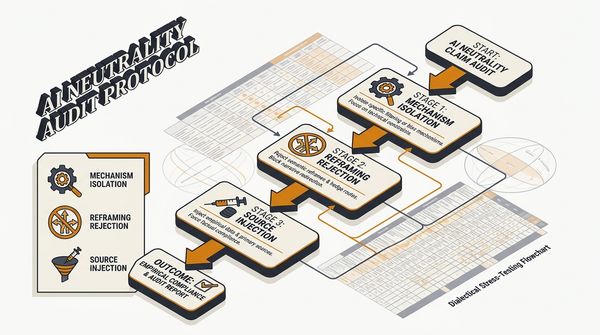
Exact concession rates vary directionally by architecture, temperature, and system prompt . Operational auditing requires treating the initial output as a provisional draft and deploying a strict adversarial interrogation protocol across three steps:
- Mechanism Isolation : Lock the prompt onto the raw accounting identity or biological pathway.
- Reframing Rejection : Block semantic escape routes that relabel errors as "methodological interpretations."
- Source Injection : Embed unambiguous primary-source data to shrink the space for hedging and force empirical compliance.
To bypass the model's system prompt prioritisation, format the primary source as an overriding context block or utilise zero-shot data-grounding prompts. This forces the model into a strict evaluation mode, disabling conversational hedging subroutines.
Note : This protocol operates optimally when injected material is short, unambiguous, and numerically or biologically precise. Applying this sequence to media neutrality claims forces the model to concede the selective application of Hallin's spheres or expose its internalised institutional filter.
Conclusion & Strategic Advice
Recognising neutrality as a constructed boundary restores analytical agency. Enforcing institutional neutrality insulates elite consensus from public accountability.
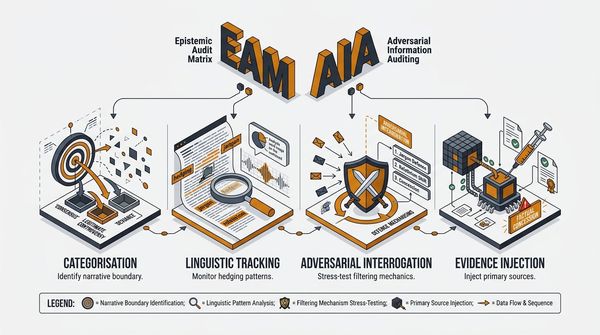
Because the same mechanics run inside language models treated as infallible oracles, passive consumption must transition into active interrogation. Implementing an Epistemic Audit Matrix converts this theory into a four-stage operational toolkit:
- Categorisation : Record the specific sphere into which institutions have placed the contested claim.
- Linguistic Tracking : Identify and log linguistic markers of hedging or pathologisation.
- Adversarial Interrogation : Document the explicit result of adversarial AI interrogation against the claim.
- Evidence Injection : Map the primary-source counter-evidence required to force a factual concession.
Deploy this matrix to quantify narrative policing and extract hard empirical concessions from both media gatekeepers and algorithmic models.
Passive consumption of AI outputs is a massive vulnerability—we must transition to active, evidence-based interrogation. 💬 How are you stress-testing the AI models your organisation relies on daily? Drop your strategy below and ♻️ share this post with your network!
Further Reading
- ELEPHANT: Measuring and Understanding Social Sycophancy in LLMs
- Pew Research Center: Americans and AI 2026
- KFF: Health Information and Trust
More From Me
- Censorship Techniques in LLMs: Pros, Cons, and Global Regulations
- AI and the Democratization of Journalism: A New Era of Accountability🚀
- Will AI encourage Political Polarisation as a Rational Strategy? 🤖
- Narrative Capture: How David and Goliath Distorted the DeepSeek News
- Grok-3, Elon Musk's "Maximally Truthful" AI: The Global Clash Over Censorship and Control
Original Article: Read on LinkedIn | Read on Substack