Filtering Hype: AI Frameworks for Verifiable Mathematical Proofs
Introduction
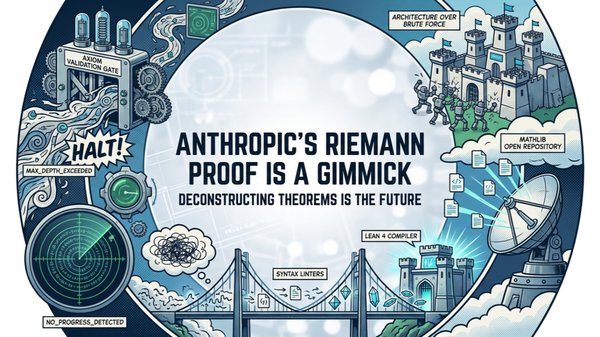
Building on the systemic stopping conditions established in The Meeseeks Paradox: When Your Completion Engine Won't Dissolve , deploying multi-agent graph environments against deep mathematics exposes the exact point where unstructured reasoning collapses. Attempting to resolve millennium-scale problems (such as the distribution of non-trivial zeros of the Riemann zeta function within the Riemann Hypothesis ) using monolithic prompts inevitably triggers catastrophic hallucination drift and context degradation.
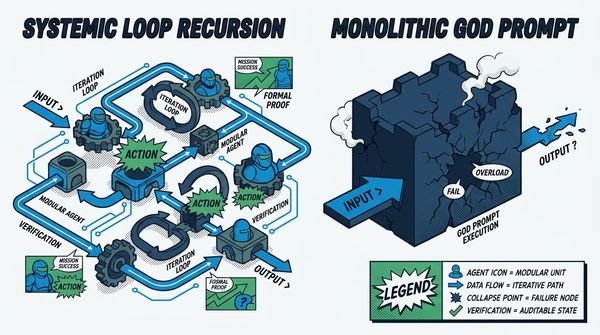
Treating mathematical formalisation as a distributed software compilation pipeline replaces open-ended generation with deterministic, auditable execution.
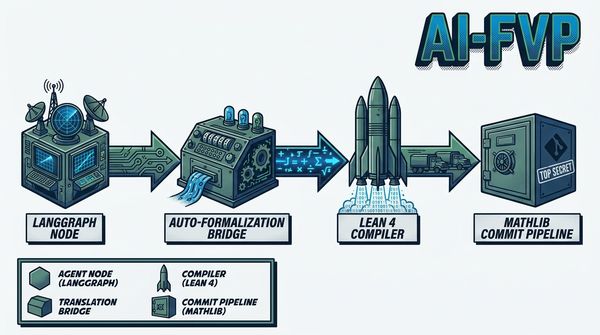
This architecture resolves the translation gap through two core components:
- Auto-Formalisation Bridge : Converts informal reasoning directly into rigorous compiler syntax.
- External Engine Integration : Binds recursive search loops to rigid stopping conditions and external theorem engines like Mathlib , shifting mathematical inquiry from speculative prompt engineering to resilient systems engineering .
From Meeseeks to Mathlib: The Circuit Breaker Applied
Unbounded agent loops produce three primary failure modes: runaway token expenditures, memory leaks , and fabricated assertions. The circuit-breaker pattern solves this vulnerability by moving halting logic outside the context window and into the orchestration routing layer.
Rather than relying on model self-termination, state graphs enforce deterministic execution gates. When a mathematical sub-path becomes blocked, the system halts execution immediately and surfaces an immutable ROADBLOCK_ERROR for downstream triage.
Setting the 50-Attempt Circuit Breaker
Recursive decomposition breaks hypotheses into dependency trees resolved leaf-up. When evaluating a sub-theory lacking foundational theorems, unconstrained agents generate ungrounded bridge lemmas .
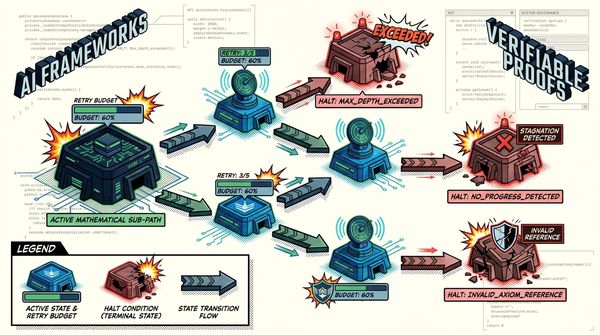
To eliminate confidently wrong sophistry , state machines evaluate three non-negotiable halting conditions:
- MAX_DEPTH_EXCEEDED : Caps node execution at a hard limit of 50 attempts (try_count >= 50), logging stalled paths directly to an audit register.
- NO_PROGRESS_DETECTED : Advances beyond text-embedding drift analysis ( Zou et al., 2024 ) by employing symbolic stagnation tracking . The system evaluates formal sub-goal equivalence to detect when agents generate divergent text equations without logical progression, terminating execution if structural logic stagnates across three consecutive loops.
- INVALID_AXIOM_REFERENCE : Intercepts unverified lemmas by validating all cited theorems against formal libraries before proof compilation begins.
The Token-Burning Spectacle
In August 2026, Anthropic reported that an unreleased Claude variant broke a 37-year-old numerical record , shifting the share of proven critical-line zeros from 41.6% to 67.2%. However, examining the compute footprint reveals an unconstrained brute-force run: roughly 60 sub-agents operating over 36 hours, consuming 31 million output tokens under arbitrary steering.
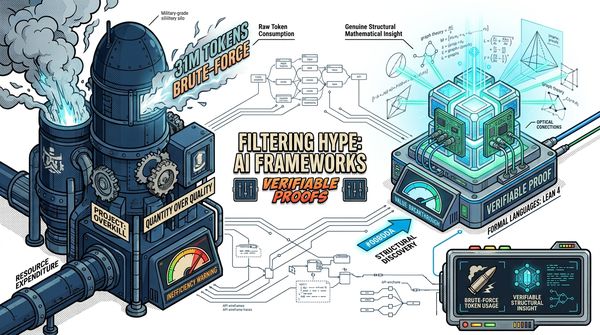
This demonstrates the God Prompt Trap at scale. Synthesising survey material, such as Enrico Bombieri's Millennium Prize review , via massive compute constitutes high-volume interpolation rather than structural discovery.
Rigorous mathematical discovery requires two foundational engineering practices:
- Architectural Routing : High-stakes reasoning demands modular routing, independent verification gates, and human oversight, as outlined in Beyond the 'God Prompt' .
- Logical Deduction : Improving numerical bounds remains distinct from proving the hypothesis itself; establishing universal properties requires exact logical deduction, as clarified in Claude Just Made Math History (Explained Simply) .
Open Publishing for Peer Review
Mathematical validation cannot rely on proprietary claims or closed API transcripts. Rigorous frameworks embed an automated compilation and publishing lifecycle into every resolved node.
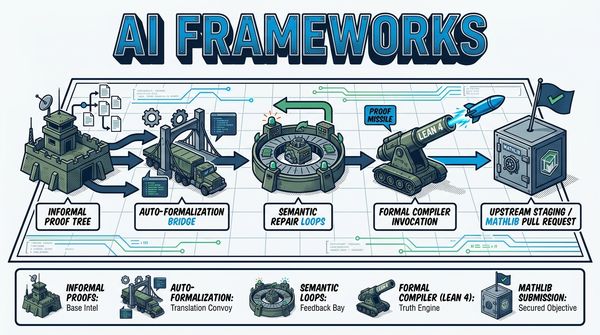
When an informal proof tree succeeds, the system routes the payload through a four-stage executable compilation cycle:
- Translation and Linting : Intermediate auto-formalisation agents and syntax linters convert informal reasoning into structured code.
- Semantic Repair Loops : Dedicated feedback loops process compiler diagnostics and iteratively correct syntax errors.
- Formal Compiler Invocation : The pipeline executes the Lean 4 theorem prover compiler against the validated syntax.
- Upstream Staging : Formally validated, lint-passing scripts stage directly to Mathlib's open repository , subjecting machine-generated claims to global peer verification.
What This Means for Your Stack
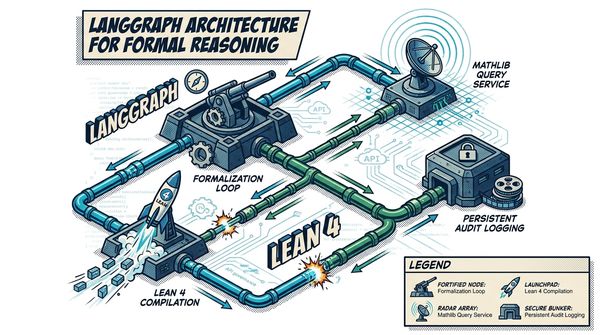
Extending state-graph architectures into rigorous verification engines requires three operational integrations:
- Lean 4 Auto-Formalisation Loop : Construct a multi-step Formalisation Loop that processes informal chain-of-thought , drafts Lean 4 syntax, runs the Lean 4 linter, feeds compiler diagnostics back to the LLM for correction, and only advances state upon successful compilation.
- Mathlib Query Service : Wrap library search APIs as pre-execution gates to validate axioms prior to proof generation.
- Persistent Audit Logging : Maintain append-only session telemetry (audit_trail.jsonl using JSON Lines ) recording all resolved and halted nodes for complete traceability.
Conclusion & Strategic Advice
Compute scale cannot substitute for architectural discipline. While massive search passes produce high-profile benchmarks, dependable formal reasoning requires bounded recursion, symbolic stagnation breakers, and open formal verification through dedicated auto-formalisation pipelines.
Architectural Recommendation Matrix
Enterprise deployment models require three distinct execution layers:
- Exploratory Hypothesis Mapping : Deploy LangGraph state machines equipped with symbolic stagnation trackers and formal sub-goal equivalence monitors to prevent token drain.
- Formal Theorem Proving : Enforce zero-tolerance axiom checks backed by an iterative Lean 4 auto-formalisation loop.
- Enterprise Verification : Implement immutable audit trails and open publishing pipelines for transparent validation.
Connecting deterministic circuit breakers to machine-checked proof engines transforms generative uncertainty into verifiable computation.
💬 How is your engineering team moving beyond monolithic prompts to build deterministic verification into high-stakes AI pipelines? Share your thoughts below and ♻️ share this post with your network!
Further Reading
- APOLLO: Automated LLM and Lean Collaboration for Advanced Formal Reasoning
- Lean Atlas: Integrated Proof Environment for Scalable Human-AI Collaborative Formalization
- Improving Alignment and Robustness with Circuit Breakers (Zou et al., 2024)
- Lean 4 Documentation & Mathlib Community Guidelines
More From Me
- The Meeseeks Paradox: When Your Completion Engine Won't Dissolve
- Beyond the 'God Prompt': A New Playbook for High-Stakes AI
- The God Prompt Trap: Single-Prompt Reasoning Amplifies AI Failures
- Confidently Wrong: Mechanics of AI Sophistry and Hedging
- All the Langs: LangChain, LangSmith, LangGraph, and LangFlow!
Original Article: Read on LinkedIn | Read on Substack