The Silicon Sword: AI and the New Global Arms Race
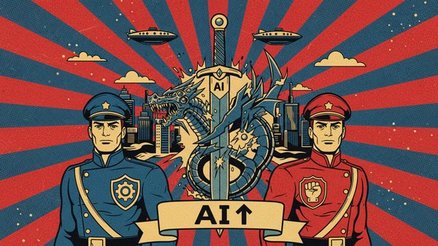
A New Kind of War
Warfare is undergoing its most significant shift in a century. The global arms race has moved beyond hardware and explosives; today, it is coded in silicon and decided in microseconds.
As of early 2026, major powers have transitioned to an "AI-first" military doctrine. This is a competition of algorithms and compute. The United States, United Kingdom, China, and Russia are racing to automate the "kill chain," deploying everything from autonomous drone swarms to generative AI planners. Emerging powers like India are also rapidly entering the fold.
In this environment, victory depends on the speed of AI-driven decisions, raising urgent questions about ethics and human control.
AI-Powered Fighting
In January 2026, the U.S. Department of War formalized its "AI-first" agenda. This is a directive to bypass traditional bureaucracy and field AI at "wartime speed."
The strategy centers on seven "Pace-Setting Projects" (PSPs) designed to integrate AI into intelligence, combat, and logistics. The objective is to move these tools from the lab to the front lines immediately, backed by massive Pentagon funding.
UK's Digital Frontline
The United Kingdom is investing £279 million in a new cyber hub for the 13 Signal Regiment. This unit is responsible for defending the Army's networks against near-constant digital assault.
For ground forces, the UK is fielding the "Dismounted Data System" (DDS). These AI-enabled tablets and radios process sensor data in real-time, improving situational awareness and reducing friendly-fire risks.
Adversarial AI
How Russia and China Are Using It: This tech race is the core of an ongoing shadow war between global powers.
Russia has deployed "Svod," a tactical platform running on Astra Linux OS. Svod utilizes the YOLO object detection framework to identify targets in drone feeds and provide commanders with automated tactical options, preventing decision bottlenecks.
Meanwhile, China is pursuing "intelligentized" warfare. Their focus includes AI-guided hypersonic missiles and drone swarms designed to overwhelm defenses. This strategy uses cyberwarfare and espionage to degrade Western advantages.
The Battlefield
Generative AI is now a standard tool for mission planning. The U.S. War Department's GenAI.mil platform, launched in late 2025, provides personnel with access to frontier models. While Anthropic was recently flagged as a supply chain risk, OpenAI has secured agreements to provide GPT models on classified networks.
In active operations, the Maven Smart System (built by Palantir) can now generate target packages in hours—a task that previously took weeks. However, this speed creates risks. Relying on AI for targeting heightens the danger of "hallucinating" targets, necessitating a strict human-in-the-loop requirement.
Rise of
Autonomous Systems: Modern combat increasingly features Lethal Autonomous Weapons Systems (LAWS). In current conflicts, AI-powered FPV drones are already responsible for a significant percentage of battlefield casualties.
Beyond direct combat, AI is optimizing predictive maintenance and "just-in-time" logistics. These systems ensure equipment remains operational and supply chains stay efficient during high-intensity conflict.
Conclusion
The Human Element in a Silicon Age: "AI-first" is no longer a concept; it is military doctrine. As the United States advances projects like Swarm Forge and Agent Network, and China refines its intelligentized assets, the window for human deliberation is closing.
The primary risk of the Silicon Sword is the loss of a "decision-making buffer." When the kill chain is compressed to seconds—a phenomenon called Decision Compression—the danger of escalation from a data-poisoning attack or software error becomes a global threat.
International norms must prioritize human oversight and accountability. We are in a race where delegating final decisions to code could lead to conflicts that spiral beyond human control.
💬 What do you believe is the most critical step needed to prevent an uncontrollable escalation of automated conflict? Share your insights and ♻️ this post!
Further Reading & Third-Party Resources
-
U.S. Department of War AI-First Agenda "" Details on the 2026 memoranda for wartime-speed AI.
-
UK MoD: £279M Cyber Hub Investment "" Official report on the Army's new Cyber Operations Centre.
-
CSIS Analysis: Russia's AI Command and Control "" Technical evaluation of the "Svod" system.
-
The New Kill Chain: AI in Modern Conflict "" How AI platforms are currently compressing battlefield timelines.
More from me
Original Article: Read on LinkedIn | Read on Substack