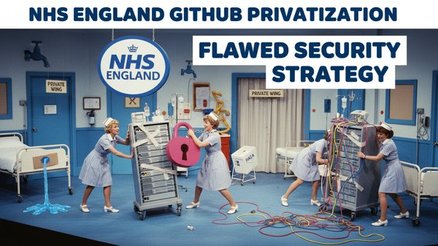
NHS England GitHub Privatization: A Flawed Security Posture
Introduction
The directive from NHS England to privatise all public GitHub repositories by May 11, 2026 marks a major pivot in digital strategy. Driven by concerns that frontier models like Anthropic's "Mythos" can uncover vulnerabilities autonomously at scale, the mandate seeks to restrict external code visibility.
However, treating repository concealment as a primary defense introduces three core structural vulnerabilities across health service infrastructure:
-
Obscurity vs. Assurance: Concealing source code fails to eliminate architectural flaws or vulnerabilities already indexed in public datasets.
-
Ecosystem Friction: Closing public repositories undermines community peer review, code reuse, and open-source contribution channels.
-
Governance Contradiction: The policy directly conflicts with Point 12 of the NHS Service Standard, which establishes open-source code as the baseline for public health tech.
The Directive: NHS England's Repository Privatisation
As of early May 2026, NHS England has mandated a significant change to its digital strategy and open-source engagement. As reported by The Register, the order requires that all public GitHub repositories associated with NHS England be made private by default, with a strict deadline of May 11, 2026. This rapid transition aims to enhance security by limiting external visibility of codebases.
The primary catalyst for this shift is the perceived threat from next-generation Large Language Models, specifically Anthropic's Mythos. The concern is that Mythos possesses the reasoning capabilities to perform autonomous, deep-link vulnerability research across vast public codebases faster than human maintainers can patch them.
This directive implies a shift away from public-by-default open-source practices towards a more restricted model, impacting how NHS England projects are developed and shared. The immediate operational impact includes:
-
Repository Reconfiguration: A scramble to reconfigure repository settings.
-
Sensitive Information Assessment: The need to assess code for sensitive information.
-
Access Management: Managing access permissions under a tight deadline.
Security by Obscurity: A Discredited Approach
Security by obscurity (SBO) is a principle that relies on hiding information or designs to achieve security, assuming an attacker cannot exploit a system if its inner workings are unknown. This approach is widely considered ineffective and dangerous by cybersecurity experts.
As Bruce Schneier, a renowned security expert, famously stated, "Security by obscurity is a terrible idea. It never works." (Schneier on Security). Modern security philosophy, aligned with Kerckhoffs's Principle, dictates that a security system should remain secure even if all details, except the key, are public. Relying on obscurity creates a false sense of security, as vulnerabilities can still be discovered through various vectors:
-
Reverse Engineering: Attackers can still deduce system workings.
-
Insider Threats: Internal actors can bypass obscurity.
-
Accidental Leaks: Unintentional disclosures can compromise systems.
-
Lack of Scrutiny: The absence of community review limits vulnerability identification and remediation.
Critics accurately describe this as a "bolted horse" scenario. If AI models like Mythos have already indexed public code during their training phases or through continuous web-crawling, then privatisation does not "un-train" them or remove the data from their existing knowledge base.
Impact on Open Source Collaboration and Transparency
The privatisation of all public GitHub repositories significantly hinders NHS England's engagement with the open-source community. Open-source development thrives on transparency, collaborative peer review, and shared innovation. By making repositories private, NHS England isolates its development efforts, leading to potential detriments:
-
Reduced Quality: Limiting external contributions can reduce software quality.
-
Compromised Security: Restricted expert scrutiny can impact software security.
-
Transparency Issues: Public and oversight bodies face challenges in understanding publicly funded software development and maintenance.
The open-source model, with its emphasis on community-driven vulnerability discovery and patching, frequently yields more robust software than closed-source development (The Linux Foundation: Why Open Source is More Secure). Additionally, this policy contradicts Point 12 of the NHS Service Standard, which mandates that new source code remain open to encourage reuse and peer review. This shift risks deterring contributors and restricting the public health digital talent pipeline.
Strategic Implications for Technical Leadership
For technical leadership within NHS England, the directive creates operational friction. While intended to mitigate AI-driven vulnerability exploitation, closing repositories undermines transparency and modern developer tooling:
-
Operational Execution: Managing access permissions and triage workloads under tight deadlines.
-
Security Education: Reinforcing the architectural limits of security-by-obscurity across governance boards.
-
Standardizing Exceptions: Establishing explicit review paths where public collaboration and standard-setting remain mandatory.
Proposing Robust Security Alternatives
Instead of relying on obscurity, public sector engineering requires defense-in-depth across the software lifecycle:
-
Automated SAST and Secret Detection: Continuous CI/CD scanning with tools like GitLeaks to intercept credentials before merge.
-
Independent Verification: Scheduled penetration testing and active vulnerability disclosure programs (OWASP Top 10).
-
Structured Governance: Aligning pipelines with the NIST Cybersecurity Framework and ISO 27001.
Remediating core architectural vulnerabilities provides enduring protection, whereas concealing code that has already been crawled by frontier models offers none.
Conclusion & Strategic Advice
Privatising NHS England's public repositories conflates secrecy with security. This approach overlooks the reality of web-scale indexing and abandons established open-source safeguards.
Technical leadership should focus on continuous verification, hardened pipelines, and transparent remediation over perimeter concealment.
Further Reading
-
NHS to close-source GitHub repos over AI, security concerns – Original report on the policy shift and the role of Anthropic's Mythos.
-
NCSC: Security Principles for Open Source Software – The UK National Cyber Security Centre's guidance on maintaining security while being open.
-
The Open Source Initiative (OSI) – Resources on the definition and global standards for open-source development.
-
GitLeaks: Scanning for Secrets – A practical tool for the "Sensitive Information Assessment" mentioned in your directive section.
More From Me
Original Article: Read on LinkedIn | Read on Substack