Optimizely Opal: Connecting to Core Enterprise Infrastructure
Introduction
In Part 4: Optimizely Opal — Implementation Blueprint & Strategic Roadmap , we mapped the conceptual data flow, sequence patterns, and JSON payloads between Optimizely Opal and the sovereign core. This final instalment details the explicit code and configuration parameters required to transition the deployment to a live environment.
The implementation relies on three distinct technical requirements to ensure marketing agility aligns with data sovereignty :
- Compliance Core Engineering : Writing the FastAPI service in Python to process internal validation logic.
- Middleware Orchestration : Configuring the visual webhook nodes in self-hosted n8n for secure routing.
- Tool Registration : Exposing the resulting custom integration within the Optimizely Content Marketing Platform (CMP).
Transitioning the Hub-and-Spoke model to production infrastructure mandates a strict definition of the network perimeter:
- Infrastructure Requirements : True data sovereignty requires self-hosted or strictly VPC -peered middleware.
- Architectural Anti-Patterns : Public multi-tenant orchestrators fundamentally compromise the integrity of the sovereign core.
1. The Sovereign Core: FastAPI & Python Agent
The central cognitive hub runs inside the private cloud. Deploying a stateless FastAPI service in Python processes compliance evaluation logic via a localised SLM or a stateful LangGraph chain.
Operating at the edge introduces two primary infrastructure trade-offs:
- Performance Overhead : Localised SLMs ensure absolute data privacy but introduce higher latency and constrained context windows compared to cloud-based models.
- Timeout Mitigation : Engineering the internal cluster to handle synchronous webhook timeouts helps maintain operational stability.
System reliability demands stringent data contracts defining inbound and outbound traffic via Pydantic models:
from typing import List
from pydantic import BaseModel

class ViolationDetail(BaseModel):
    rule_id: str
    description: str

class OutboundPayload(BaseModel):
    article_id: str
    draft_text: str
    target_region: str
    compliance_categories: List[str]

class InboundResponseData(BaseModel):
    overall_compliance_score: float
    approved: bool
    violations: List[ViolationDetail]
Authentication mechanisms secure requests from middleware orchestrators using API key dependencies. Adhering to zero-trust principles , the application forces a fatal error if environment credentials remain undefined:
import os
from fastapi import Depends, HTTPException
from fastapi.security import APIKeyHeader

API_KEY_NAME = "X-Sovereign-Auth-Token"
api_key_header = APIKeyHeader(name=API_KEY_NAME, auto_error=True)

async def verify_auth_token(api_key: str = Depends(api_key_header)):
    expected_token = os.getenv("SOVEREIGN_AUTH_TOKEN")

    if not expected_token:
        raise RuntimeError("Fatal: SOVEREIGN_AUTH_TOKEN environment variable is not set.")

    if api_key != expected_token:
        raise HTTPException(status_code=403, detail="Invalid Security Credentials")

    return api_key
The engine processes raw drafts against predefined regulatory parameters. The sovereign_compliance_hub.py logic identifies "guaranteed uptime" claims in the EU requiring mandatory SLA exemptions.
2. The Integration Fabric: Middleware Webhook Configurations
The integration fabric coordinates requests between the Optimizely Opal platform and the internal FastAPI server.
Maintaining absolute data sovereignty dictates three specific deployment parameters for the middleware layer:
- Self-Hosted Infrastructure : Deploying a self-hosted n8n instance inside the perimeter guarantees payload isolation.
- Routing Logic : A POST request triggers the webhook, which maps to the JSON payload to an HTTP Request node.
- Data Transmission : The node authenticates via headers, transmits data to the private FastAPI IP, and returns the audit directly to Optimizely Opal .
For Microsoft-centric ecosystems, alternative orchestration is viable through two primary requirements:
- Trigger Generation : Power Automate provides an HTTP trigger that creates a unique POST URL for the CMP.
- Tenant Isolation : This configuration operates strictly within a dedicated Azure tenant boundary to securely forward content to the internal core.
Routing sovereign compliance payloads through public multi-tenant iPaaS platforms such as Make or Zapier breaks the security perimeter. The architecture mandates self-hosted middleware or operations restricted to a dedicated Azure/ AWS tenant.
3. Custom Tool Registration in Optimizely One
Registering the webhook as a custom AI tool inside the Optimizely CMP Developer Console exposes the sovereign bridge to end users.
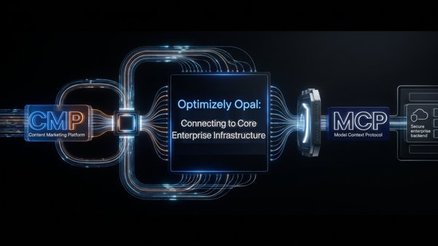
The enterprise architecture landscape is transitioning from bespoke OpenAPI webhook definitions to the Model Context Protocol (MCP) . MCP establishes a context-aware tool-calling standard that reduces the integration overhead of custom webhook bridging.
We build for current UI constraints using OpenAPI 3.0 integration and architect for MCP compatibility to ensure long-term system stability. The tool definition mandates two specific configuration elements:
- Tool Identity : A descriptive title defining the utility of the integration.
- Execution Parameters : Explicit instructions directing the engine to audit drafts against legal and trademark guidelines within an isolated environment.
The system relies on an OpenAPI 3.0 schema mapping to parse and transmit arguments systematically:
openapi: 3.0.0
info:
  title: Sovereign Auditor Bridge
  version: 1.0.0
paths:
  /v1/opal-bridge:
    post:
      summary: Securely audits draft content
      requestBody:
        required: true
        content:
          application/json:
            schema:
              type: object
              properties:
                agent_id: { type: string }
                payload:
                  type: object
                  properties:
                    draft_text: { type: string }
                    target_region: { type: string }
                    compliance_categories:
                      type: array
                      items: { type: string }
4. Execution & Verification
End-to-end testing within the Optimizely CMP editor canvas validates the deployment state.
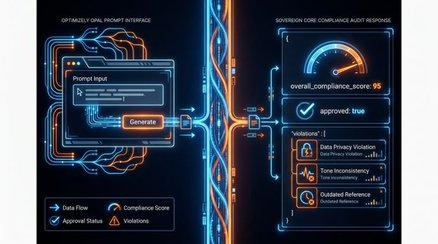
Triggering the Sovereign Compliance Auditor initiates a rigid, four-step operational sequence:
- Compilation : The platform aggregates the localised draft text and identifies designated trigger variables.
- Transmission : The system dispatches the API payload to the predefined webhook endpoint.
- Evaluation : The payload crosses the integration fabric into the FastAPI core to process internal policy rules.
- Resolution : The audit engine returns a structured JSON correction mapping that is directly applied to the writer in Optimizely.
Conclusion & Strategic Advice
This decoupled architecture bridges the gap between rapid content deployment and rigid data governance. Creative workflows process generative models safely by restricting sensitive data exposure of the strictly defined sovereign hub.
This Hub-and-Spoke deployment finalises the integration series and establishes a core architectural principle. Securely orchestrating modular cognitive agents across private and public boundaries creates true enterprise intelligence outside monolithic SaaS environments.
To scale your hybrid intelligence infrastructure, you must execute three technical priorities:
- Contract Optimisation : Refine your Pydantic data contracts to dynamically validate inbound traffic.
- Endpoint Evaluation : Audit existing integration points to guarantee absolute tenant isolation.
- Protocol Migration : Prepare your schemas for the transition to Model Context Protocol (MCP) standards.
💬 How is your enterprise balancing the demand for rapid AI adoption with the strict realities of data governance? Share your insights below and ♻️ share this architectural blueprint with your network!
Further Reading
More From Me
Original Article: Read on LinkedIn | Read on Substack