Optimizely Opal: Implementation Blueprint and Strategic Integration Roadmap
Introduction
Architecture without execution remains academic : Building on the foundational frameworks established in Part 3: The Hub-and-Spoke Architecture and AI Complexity Ladder , bridging intuitive edge interfaces with secure backend systems requires deliberate operational design.
Scaling generative workflows presents three fundamental conflicts between engineering and marketing operations:
- Data residency mandates : Engineering must comply with corporate requirements.
- Creative velocity : Marketing teams demand uninhibited content-generation throughput.
- Architectural separation : Resolving this tension demands explicit physical and logical decoupling.
Deploying a strict hub-and-spoke infrastructure introduces three distinct physical constraints:
- Latency budgets : Multi-layer API routing imposes measurable delays on synchronous requests.
- Single points of failure : Relying on dedicated routing tools requires active redundancy management.
- Hardware provisioning : Hosting localised cognitive cores requires ongoing infrastructure maintenance.
This guide provides a clear plan for integrating a front-end orchestration platform with a sovereign cognitive hub. Securely decoupling creative ideation from stateful logical processing requires four core mechanisms:
- Data lifecycles : Formalising strict operational boundaries for data transit.
- AI Security Gateways : Deploying semantic firewalls to evaluate and sanitise payloads.
- Polymorphic Payloads : Supporting flexible serialisation formats ( JSON , XML , or raw Markdown ) mapped to specific workflow use cases.
- Latency management : Executing asynchronous bridges to shield sensitive operations behind the corporate firewall.
1. The Implementation Sequence (Data Lifecycle)
Orchestrating this decoupled architecture begins directly within the Content Marketing Platform (CMP). Natural language prompts and rich-text drafts initiate the data lifecycle as the primary cognitive interface before triggering an external tool call Optimizely Opal: Architecting Hybrid Intelligence .
Traversing network boundaries securely requires a dedicated transport layer:
- Visual workflow webhooks : Routing engines like n8n manage transit to maintain a resilient hand-off; Power Automate to LangFlow: The AI Complexity Ladder Businesses Must Climb .
- Synchronous constraints : Generative Information Retrieval and LLM processing systematically breach standard HTTP timeout limits (typically 30–60 seconds).
- Asynchronous execution : The pipeline dictates a webhook handshake and polling architecture to accommodate latency budgets.
Before data enters the stateful execution framework behind the corporate firewall, the pipeline routes the payload through a dedicated AI Security Gateway. This semantic firewall executes three distinct validation checks:
- Independent sanitisation : The gateway scrubs the payload before it reaches the LangGraph compliance core; All the Langs: LangChain, LangSmith, LangGraph, and LangFlow!
- API isolation : External interfaces communicate with proprietary databases exclusively through explicit endpoints.
- Content and Format Validation : The gateway dynamically parses the payload based on its Content-Type headers (e.g., parsing structured JSON fields, enforcing XML schemas, or extracting Markdown metadata syntax blocks) while safeguarding against prompt injections and breaches of internal Data governance .
2. Defining the API Contract
Rather than mandating a single payload format, establishing the communication contract between cloud-based edge interfaces and the sovereign backend relies on a polymorphic payload model . The pipeline adapts to three distinct transport formats depending on the specific integration requirements of the creative ecosystem; Optimizely Opal: Architecting Hybrid Intelligence :
- Structured JSON Data : Best for stateless transactions and deep analytical payloads. The outbound JSON structures core identifiers (agent_id, timestamp) alongside crucial variables like article_id, brand_id, target_region, and an automated compliance_categories selection array.
- Semantic Enterprise XML : Best for deeply nested enterprise metadata and strict schema verification via XML Schema Definitions (XSD). This encapsulates legacy data models natively without losing relational hierarchy.
- Raw & Front-Matter Markdown : Best for rich creative drafts. By appending structural parameters within a YAML Front Matter header block (e.g., processing targets, regions) at the top of a standard Markdown file, editors pass raw text cleanly without causing string escape errors inside complex code envelopes.
Regardless of the outbound format, the inbound response routes structured insights back to the edge via three distinct variables, ensuring immediate validation regardless of whether it is serialised as XML tags or JSON properties:
- Compliance Baseline : Provides a deterministic baseline metric via an overall score.
- Immediate validation : Returns a boolean approved marker for conditional routing.
- Exhaustive violations bloc k: flags discrepancies, classifies the risk level (category and severity), isolates the non-compliant phrase (offending_text), and supplies a proactive suggested_revision string for direct editorial review; Optimizely Artificial Intelligence (Opal) .
3. The Tool Registration and Plumbing Recipe
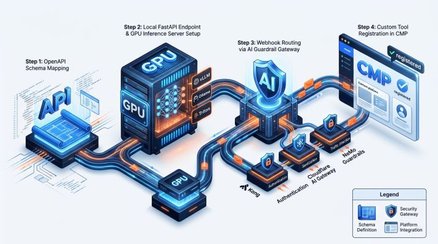
Deployment execution requires a strict four-step technical sequence. Initially, engineering maps the anticipated payload schemas to formalised OpenAPI configurations, utilising appropriate media-type definitions (application/json, application/xml, or text/markdown).
Engineering then constructs the localised reasoning graph and exposes it internally via a hardened FastAPI endpoint configured with custom multi-format request parsers:
- Generative Information Retrieval : Integrates semantic retrieval pipelines; Foundations of GenIR .
- Small Language Models (SLMs) : Parse sensitive workflows on-premises, Small but Significant: On the Promise of Small Language Models for Accessible AIED .
- Hardware provisioning : Requires dedicated GPU nodes and robust inference servers like vLLM , Ollama , or Triton Inference Server .
Next, the visual routing engine intercepts incoming HTTP Webhook triggers to operate exclusively as the transport orchestration layer. The engine passes the payload to a dedicated AI Security Gateway (such as Kong, Cloudflare AI Gateway, or NeMo Guardrails) to execute three critical checks: Power Automate to LangFlow: The AI Complexity Ladder Businesses Must Climb :
- Authentication : Validates origin request credentials.
- Payload Normalisation : Normalises incoming XML tags or Markdown blobs into standardised Python dictionaries or objects for the inner cognitive core.
- Traffic direction & Sanitisation : Scans the data for indirect prompt injections and routes the validated request to the cognitive core.
Finally, operators register the active webhook as a proprietary custom tool within the native CMP directory. This configuration unlocks direct, asynchronous invocation for end users.
4. The Three-Phase Strategic Roadmap
Execution relies on a three-phase integration schedule. Phase 1 (Weeks 1–4) targets a singular high-value workflow, such as automated content compliance using raw Markdown data streams, to establish the foundational asynchronous webhook bridge and launch a focused pilot Optimizely Opal: Architecting Hybrid Intelligence .
Phase 2 (Months 2–3) expands modular tooling across the wider Content management system to execute deep analytical queries into Customer data platform architectures. Integrating the sovereign core with a CDP introduces three fundamental operational shifts:
- Stateful processing : Converts the communication contract from stateless text evaluation to active Personally Identifiable Information (PII) handling.
- Payload encryption : Requires an entirely new, highly encrypted compliance schema that can mask PII markers within JSON or XML nodes.
- Data governance : Mandates elevated, cross-departmental security protocols.
Phase 3 (Month 4+) initiates comprehensive optimisation of the system architecture. This final stage incorporates three advanced engineering capabilities:
- Observability layers : Ensures deterministic debugging and token tracking across all serialisation formats All the Langs: LangChain, LangSmith, LangGraph, and LangFlow!
- Dynamic model routing : Controls compute costs and mitigates system scale limits based on payload weight.
- Agentic swarms : Deploys independent processing networks via standardised interoperability protocols; Model Context Protocol: Universal Adapter for Agentic AI🌐 .
Conclusion & Strategic Advice
Combining intuitive front-end orchestration with a sovereign cognitive hub will shape the future of enterprise workflow automation. Selecting the correct routing architecture requires three precise component allocations:
- Data transport : Deploy visual workflows exclusively for rapid webhook bridging.
- Semantic security : Mandate dedicated AI Gateways to handle payload evaluation across JSON, XML, and Markdown formats.
- Infrastructure realities : Mitigate single points of failure through advanced GPU provisioning and strict latency management.
This four-part series makes one clear point: true organisational intelligence can't be a single cloud application. Achieving maximum operational velocity without compromising governance mandates requires three structural changes:
- Strict API boundaries : Isolate the sovereign execution core from edge interactions.
- Asynchronous workflows : Accommodate necessary delay without dropping connections.
- Polymorphic Contracts : Construct flexible data schemas to standardise communication without bottlenecking content delivery.
Prevent legacy integrations from stalling digital maturity by executing these architectural upgrades immediately. Audit current orchestration pathways, deploy the AI Gateway, and initiate Phase 1 of the implementation sequence today.
💬 Are legacy integrations stalling your digital maturity, or are you actively building decoupled, asynchronous AI workflows? Share your thoughts in the comments below and ♻️ share this blueprint with your enterprise architecture network!
Others in the Series:
- Optimizely Opal: Intelligent in Isolation Hits the Enterprise Wall
- Optimizely Opal: The Hub-and-Spoke Architecture
- Optimizely Opal: Why Isolated Intelligence Encounters the Enterprise Wall
Further Reading
- LangGraph Official Documentation: Stateful Multi-Actor Agents
- n8n Webhook Documentation & API Integrations
- Optimizely AI (Opal): Intelligent Content Curation
More From Me
Original Article: Read on LinkedIn | Read on Substack