Aether Pine: CLI Automation and Multi-Agent Systems
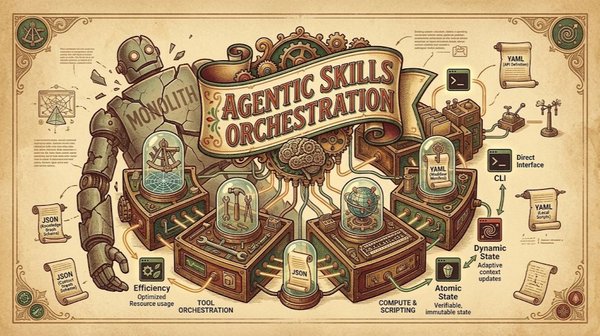
- Part 4 of 4 - Beaded Garlands
Introduction
👈 In Part 3, Aether Pine: The Author's Shield - Legal Protections for Gen AI , we detailed embedding C2PA Content Credentials and cryptographic Git ledgers to protect human authorship under GenAI IP laws. Now, we look at lightweight CLI automation and multi-agent orchestration.
Building on the orchestration mechanics established in the Aether Pine Companion Series , managing a multi-agent storytelling pipeline introduces immense control overhead. When designing generative ecosystems, early architectural decisions often default to massive, unified prompts or heavyweight graph-based state machines (such as LangGraph ) to process character arcs, world lore, and complex visual formatting.
These monolithic systems inevitably buckle under their own weight, precipitating three distinct failures:
- Context Bloat : Feeding entire project parameters into every model call inflates API token consumption.
- Vendor Lock-in : Deep integration with proprietary frameworks creates severe vendor lock-in risks.
- Asset Obfuscation : Tracking specific asset injections becomes functionally impossible during debugging.
This operational guide details the transition from opaque agentic swarms to a decoupled, framework-agnostic environment using CLI microservices and standard file configurations. By segmenting the pipeline into standalone Python utilities and wrapping them as Model Context Protocol (MCP) skills, developers achieve a reliable, cost-effective generation studio.
Segmenting this architecture guarantees three primary operational benefits:
- Zero Framework Dependency : Python utilities remain decoupled from external orchestration layers.
- Localised Debugging : Error states isolate to specific command-line module failures.
- Pipeline Integration : The flat structural design enables streamlined CI/CD integration.
The Monolithic Pitfall: Why Giant Swarms Collapse
Early-stage generative pipelines frequently assign a single manager agent to process characters, plot constraints, and rendering instructions simultaneously. In production environments, this "God Prompt" design creates a fragile workflow that degrades rapidly under execution pressure.
Feeding the complete project context into every model call drives massive API token inflation. Furthermore, resolving competing constraints within a single context window causes cascading output degradation. Fixing a specific character detail inevitably corrupts scene composition when a single prompt balances conflicting constraints.
Over-specifying a single prompt invites visual chaos and prompt drift due to two mechanical flaws:
- Contextual Overload : The model degrades when balancing narrative formatting against specific visual asset generation.
- Debugging Friction : The sheer difficulty of tracking where and when specific assets enter the pipeline makes it impossible to perform isolation testing.
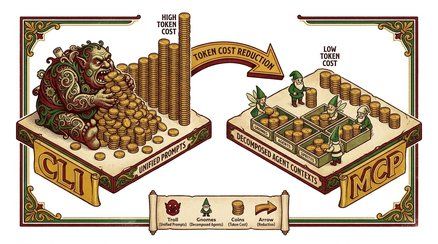
Decomposing Agents to CLI Commands
To address prompt fragility, these massive operations must be decomposed into isolated Command-Line Interface (CLI) commands. Segmenting execution provides layer-based autonomy, cutting input token costs by 60–80% because the model ingests only the exact parameters required for a specific step.
This architectural pivot yields immediate efficiency gains and limits the number of output tokens through highly constrained generation cycles. To manage state coordination overhead outside of graph frameworks, modules transfer context via structured, human-readable files such as YAML or JSON configurations.
Preventing data corruption during parallel tool invocation requires strict control mechanisms:
- File-locking Mechanisms : Enforcing isolation through libraries such as Python's filelock secures standard file states against race conditions .
- Sequential Execution : Strict execution sequencing ensures components pass validation before subsequent operations begin.
This decomposition cleanly mirrors professional visual compositing, separating a canvas into isolated depth planes. By establishing the structural scaffolding in one specialised step, subsequent AI models focus strictly on targeted styling without overarching constraints.
Orchestrating this layered logic necessitates explicit system commands:
- Character Logic : Running python -m src.cli.main character executes specific personality bounds.
- Narrative Plotting : Deploying python -m src.cli.main plot structures, story arcs.
- Validation Subroutines : Calling python -m src.cli.main lint runs independent quality checks.
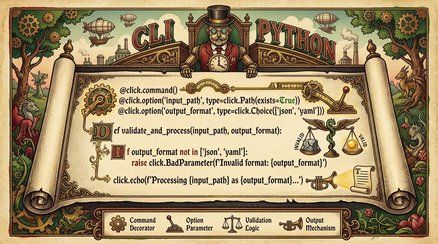
Boilerplate: CLI commands in the Studio
Implementing this decomposed framework requires a robust parameter-parsing architecture to ensure that independent modules pass context accurately and without regressions. Standard Python CLI frameworks like Click offer reliable validation, type checking, and structured exit-code reporting.
By isolating generative phases into standalone subcommands, developers achieve frictionless maintenance routines. Standardising this boilerplate allows you to dynamically lint output constraints and enforce styling rules deterministically .
Executing these utilities strictly outside the primary agent's context window—as implemented in the project's source story_gen_cli.py module—provides two core advantages:
- Isolation of Constraints : If an auditing rule changes, the main narrative compiler remains entirely untouched.
- Deterministic Execution : Hardcoded styling rules bypass generative ambiguity, securing output stability.
Converting CLI Utilities to MCP Tool Skills
The final operational step involves transforming these local microservices into dynamic capabilities using the Model Context Protocol Official Website . MCP operates as a secure bridge, exposing local utilities to high-level LLM orchestrators.
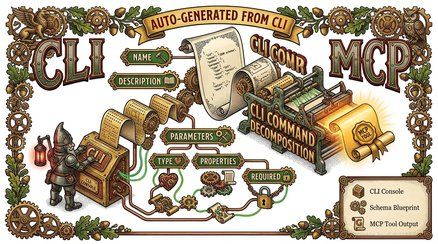
Mapping a decomposed Python script to an MCP Tool Schema converts the shell command into a native, callable agentic skill. Modern Python engineering recommends against manually maintaining this interface contract. Rather than hand-syncing JSON definitions with CLI parameters, modern implementations rely on introspection and reflection .
Teams implement dynamic schema generation through two primary mechanisms:
- Automated Generation : Tools like pydantic or dynamic Click parsing build the JSON schema directly from CLI decorators .
- Error Elimination : Auto-generating configuration schemas adheres to the DRY (Don't Repeat Yourself) principle, stripping out human transcription failures.
Transitioning from monolithic execution to MCP Inter-Process Communication (IPC) incurs a significant I/O penalty. Repeatedly provisioning distinct Python environments and reloading the context for fragmented tasks increases total execution time.
Engineers must acknowledge that massive token efficiency introduces operational speed costs, requiring specific mitigation strategies:
- Caching Implementations : Managing latency relies on internal orchestrator lazy-initialisation and caching mechanisms.
- State Retention : Optimising module invocation limits redundant context parsing.
Conclusion & Strategic Advice
As this 4-part series comes to a close, the operational mechanics highlight a clear necessity: rigid automation and opaque, framework-heavy swarms must yield to modular, deterministic architecture. Monolithic "God Prompts" fail at scale, succumbing to token bloat and creative drift.
Aggressively decomposing agent workflows into strictly typed CLI microservices and exposing them through auto-generated Model Context Protocol schemas eradicates over-specification. Break apart massive multi-agent swarms into singular Python scripts, establish safe file-based state transfers, and treat AI models as highly specialised tools.
While the future holds promises of real-time, node-based prompt mutations powered by local processors, today's solution requires executing three strict layered-autonomy principles:
- Command Isolation : Execute functions through discrete scripts rather than within overarching context windows.
- Structured Transfers : Enforce deterministic system states via hardcoded JSON or YAML file drops.
- Component Control : Retain absolute governance over individual narrative elements without framework dependency.
💬 Are you still relying on rigid, monolithic prompt structures, or have you started decomposing your agent workflows into specialised tools? Drop your insights in the comments below and ♻️ share this with your engineering network!
Further Reading
- Model Context Protocol Documentation
- Click: Python Composability and CLI Frameworks
- ComfyUI: Node-based Visual Generation Architecture
More From Me
Original Article: Read on LinkedIn | Read on Substack