Aether Pine: The Author's Shield - Legal Protections for Gen AI
- Part 3 of 4 - The Soft Wilds
Introduction
👈 In Part 2, Closed-Loop VLM Feedback for Visual Consistency, we established closed-loop Vision-Language Model (VLM) feedback loops to eliminate character mutation and style drift in generated art. Now, we focus on legal protection and computational provenance.
In my analysis of AI Laws & the No FAKES Act , I explored the major legal shift occurring in the intellectual property space. Today, I want to walk you through The Author's Shield —the practical workflow we built to ensure our content, such as The Soft Wilds: Strength of the Collective Stitch (Aether Pine Book 3) , is legally protected, verifiable, and ready for global distribution.
Previous phases of this publishing architecture detailed technical orchestration and visual consistency. The final operational requirement is defending the generated asset through structured legal compliance.
Establishing legal ownership of AI-assisted publications requires a systematic framework to secure the intellectual property behind the text. Constructing an "Author's Shield" protects digital assets against unauthorised synthetic replication through three specific integrations:
- Provenance Standardisation : Embedding C2PA Content Credentials into publishing workflows at the generation layer.
- Cryptographic Ledgering : Logging signed Git commits as mathematical proof of iteration and executive editorial control.
- Identity Fortification : Structuring personal brand metadata to trigger automated takedowns under the federal No FAKES Act.
1. The Legal Frontier of AI-Assisted Copyright
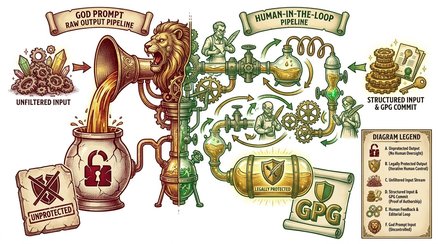
Securing protections for co-creative publishing requires strict documentation of human authorship. The US Copyright Office AI Registration Guidelines explicitly deny copyright protection for raw outputs generated from single-prompt instructions.
Operators must govern automated systems as specialised processing modules under strict, executive control to satisfy three primary registry requirements:
- Executive Control : Documenting human creative choices, including defining outlines, mapping narrative architectures, and executing editorial polish passes.
- Layout Coordination : Capturing verifiable human coordination and layout selection, as validated by the Kashtanova precedent ( Zarya of the Dawn ).
- Jurisdictional Standardisation : Resolving international inconsistencies by formatting compliance for the strictest global requirements, accounting for US active disclosure mandates and the automatic marking protections established by the UK Intellectual Property Office Copyright Guidance .
2. Integrating C2PA Content Credentials and Cryptographic Manifests
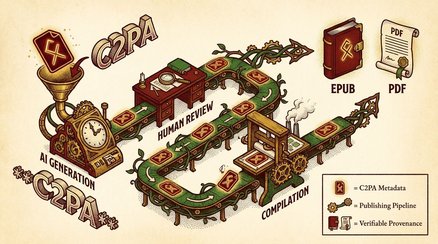
Establishing industry-standard digital provenance requires integrating the Coalition for Content Provenance and Authenticity (C2PA) framework. Standard version control lacks the required security primitives for modern IP defence, mandating the injection of cryptographic metadata directly at the generation layer.
Embedding C2PA protocols into compilation pipelines establishes a secure, tamper-evident history via three functional mechanisms:
- Manifest Injection : Recording exact tool utilisation metrics, separating machine-generated outputs from human-authored elements into final EPUBs, PDFs, and cover images.
- Protocol Alignment : Synchronising output metadata with the standard protocols currently enforced by the US government, major tech platforms, and foundational AI model creators.
- Proactive Watermarking : Embedding cryptographic watermarking to ensure digital assets carry an auditable history across all distribution vectors.
3. GPG Key Signed Git Logs as Proof of Iteration and Editorial Oversight
Producing an immutable digital paper trail for authorship requires treating story directories, configurations, character profiles, and narrative layouts as a version-controlled codebase. Signing each commit with a GPG key generates a cryptographically secure, timestamped ledger of every modification and layout decision.
During an audit by a platform or copyright office, operators export the signed Git log via a standard terminal execution:
git log --pretty=format:"%h [%G?] %GK - %an, %ar, %ae : %s" -n 20This cryptographic logging provides verifiable proof of iteration and editorial oversight, governed by two strict limitations:
- State Verification : A GPG signature mathematically proves that a specific private key signed a specific file state at a specific time, without inherently disproving machine generation of the underlying text.
- Human Diff Tracking : Repository logs must capture granular human diffs —line edits and structural revisions—instead of bulk, unedited script uploads.
4. Defending Personal Voice and Likeness Under the No FAKES Act
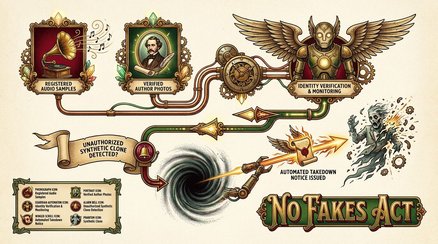
Unauthorised voice cloning and deepfakes require dedicated defensive protocols. Scheduled for 2026, the US Senate No FAKES Act Bill S.4875 introduces a federal property right to protect the voice and visual likeness of actual human individuals against unauthorised digital replicas.
The empirical scope of this legislation separates standard copyright law from personal identity defence through two distinct legal boundaries:
- Scope Exclusion : The legislation explicitly excludes generated fictional characters or world-building elements, limiting its coverage to the actual human creator.
- Identity Enforcement : The act establishes the legal framework for immediate, enforceable takedowns of synthetic clones of an author's identity used in audiobooks or promotional materials.
Conclusion & Strategic Advice
The operational value of "The Author's Shield" relies on integrating modern provenance standards directly with cryptographic version control. Layering the tamper-evident security of C2PA Content Credentials alongside the mathematical certainty of GPG-signed Git logs produces an auditable IP defence pipeline.
Operators can align their deployment pipelines with two specific operational profiles:
- Rapid Prototyping : Implementing basic version control and baseline C2PA watermarking establishes transparent tracking for generated assets.
- Flagship Brand Building : Enforcing strict GPG commit signing on all human diffs and embedding comprehensive Content Credentials into all final distributions guarantees maximum copyright defensibility.
Building rigorous, legally sound pipelines ensures human oversight in automated publishing workflows. Implementing these structures ensures long-term creative sovereignty via two final directives:
- Computational Provenance : Pairing generative models with strict documentation prevents authorship disputes.
Part 4, CLI Automation and Multi-Agent Systems, details how to replace bloated monolithic prompts with modular Model Context Protocol (MCP) tools and focused CLI micro-agents.
💬 How are you protecting human authorship and proving provenance in your generative workflows? Drop your thoughts below and ♻️ share this post with your network!
Further Reading
- A Practical Guide to GPG Signing Git Commits
- Understanding the US Copyright Office's AI Guidance
- Navigating the No FAKES Act: What Digital Creators Need to Know
- Coalition for Content Provenance and Authenticity (C2PA) Specifications
More From Me
Original Article: Read on LinkedIn | Read on Substack