AI Impacts: The Human Cost of AI Productivity
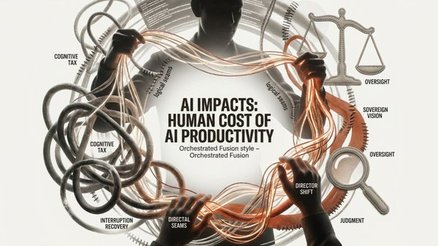
- Part 1 of 8: The Recap and Roadmap
Introduction
Generative productivity tools compress execution timelines while introducing silent cognitive residue and scaling context-switching friction. Building on mechanisms explored in How Context Switching Destroys Developers' Productivity, unmanaged synthetic output taxes mental stamina.
Rapid automation increases systemic strain, requiring mitigation via two primary frameworks:
- Cognitive Management Focus: The operational priority shifts from raw technological enablement to cognitive bandwidth management.
- Oversight Preservation: Stepping back from execution to reduce cognitive load risks missing subtle architectural flaws in automated decision-making pipelines.
Modern engineering cultures require three foundational architectural shifts:
- Systemic Friction Anticipation: Predicting points of cognitive fatigue across the execution pipeline to maintain output consistency.
- Resource Reallocation: Deploying engineering talent to govern and audit technical architectures rather than draft boilerplate.
- Deep Problem-Solving Architecture: Structuring workflows to protect deep focus during complex technical design.
Individual cognitive thresholds for context switching remain variable, depending on domain expertise and workflow design.
1. Introduction to the Series
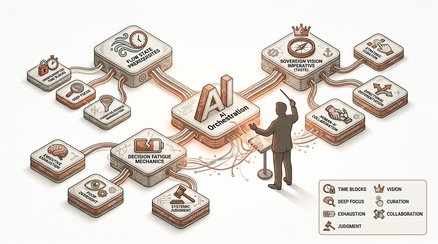
The productivity conversation frequently overlooks cognitive sustainability. Scaling automated tools without addressing human limits results in developer burnout and degraded review quality.
2. The Historical Foundations
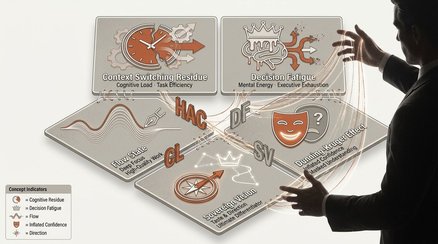
Auditing modern productivity requires evaluating five foundational cognitive mechanics:
- Context Switching Residue: Research by the American Psychological Association (APA) reveals that task switching can consume up to 40% of productive time due to persistent mental fragmentation.
- Decision Fatigue Mechanics: Continuous orchestration draws upon limited mental energy, depleting executive function (NCBI).
- Flow State Prerequisites: Deep focus remains mandatory for complex engineering design. Research from the Claremont Graduate University establishes uninterrupted time blocks as strict prerequisites for deep work.
- The Dunning-Kruger Knowledge Trap: Professional confidence can be artificially inflated when relying heavily on fluent, synthetic templates (ScienceDirect). This risk scales when conversational fluency is mistaken for domain expertise.
- Sovereign Vision Imperative: Standard implementation becomes commoditized. Market value concentrates around taste, systemic judgment, and strategic curation.
3. Strategic Framework for AI Integration
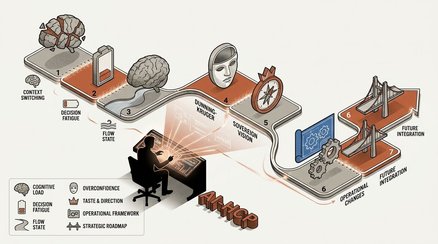
Addressing the workload paradox requires three structural adjustments:
- Cognitive Friction Mitigation: Accelerated generation demands more choices, requiring direct intervention to isolate decision points.
- Organisational Restructuring: Redesigning operating models to support multidisciplinary technical generalists.
- Competence Risk Management: Mitigating skill atrophy while balancing specialised depth against architectural oversight.
Conclusion & Strategic Advice
The interaction between synthetic tooling and human cognition demands intentional orchestration. Left unmanaged, rapid adoption compounds decision fatigue and degrades flow states.
Resource allocation requires evaluation through two priorities:
- Execution Prioritisation: Automating routine execution while protecting deep architectural design.
- Friction Isolation: Batching interactions to eliminate continuous context-switching interruptions.
Explore the next operational phase: AI Raises the Bar: The New Competitive Threshold, examining how elevated productivity baselines redefine market competition.
💬 Are your AI tools accelerating real problem-solving, or just creating more noise to manage? Share your experiences below and ♻️ share this post with your engineering network!
Further Reading
- Cognitive Biases in Software Engineering: A Systematic Mapping Study (IEEE Transactions on Software Engineering)
- The Future of AI-Driven Software Engineering (ACM Transactions on Software Engineering and Methodology)
- Software Engineering for Collective Cyber-Physical Ecosystems (ACM TOSEM)
More From Me
Original Article: Read on LinkedIn | Read on Substack