AI Impacts: The New Competitive Threshold
Page 2 of 8: AI Raises the Bar
Introduction
A foundational shift actively rewrites the economic and operational rules of knowledge work. Generative AI establishes a non-negotiable baseline for speed, throughput, and agentic autonomy past the era of "Wave 1: Human-in-the-loop Generation".
Scaling these models into multi-step, autonomous operations requires executing three strategic objectives:
- High-margin value execution: Organisations must scale models to run autonomous operations that deliver defensible returns.
- Competitive Threshold Recalibration : As execution speed multiplies and barriers to entry collapse, the standard shifts from output volume to systemic autonomy and grounded reasoning.
- Systems Engineering Focus : Decision-makers must recalibrate performance metrics and prioritise the rigorous systems engineering required to manage automated enterprise systems.
1. Introduction to the Elevated Benchmark
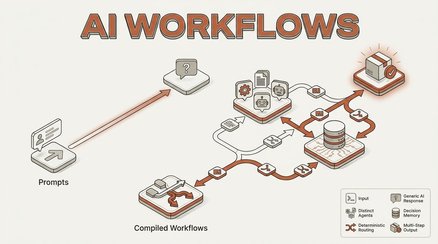
Artificial intelligence is a general-purpose technology, carrying macroeconomic gravity comparable to electricity or the internet. It establishes a high baseline for execution velocity across knowledge domains.
Capturing these structural benefits requires three architectural adaptations:
- Process Redesign: Integrating these capabilities requires tangible investments in systems architecture and workflow redesign.
- Deterministic Routing: The operational divide separates teams maintaining fragile prompt libraries from those deploying stateless decision memory and deterministic agent routing.
- Autonomous Standards: The baseline shifts from surface-level text generation to orchestrating reliable, autonomous systems.
2. The Productivity Evidence Is In
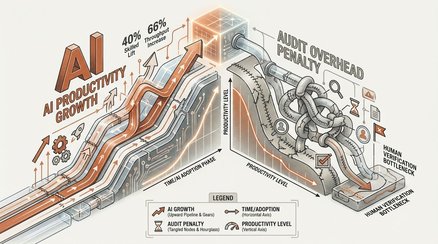
Empirical data confirms that generative tooling compresses traditional capability gaps. A controlled study demonstrated up to a 40% improvement in performance during simulated professional tasks (Harvard Business School Working Knowledge).
Aggregate benchmarks across business problem-solving reveal an average 66% boost in output volume (Stanford HAI AI Index Report). McKinsey estimates this acceleration represents $2.6 trillion to $4.4 trillion in annual economic potential (McKinsey Global Institute).
Validating the ROI of specification-driven architectures requires overcoming the "Audit Overhead Penalty":
- Review Mitigation: Linear scaling of model output triggers exponential scaling of human verification time, creating review bottlenecks.
- Grounded Reasoning: Teams must integrate structured retrieval and verification frameworks to mitigate this auditing burden.
- Orchestrated Throughput: Enterprise evaluations like OfficeQA Pro demonstrate that multi-agent pipelines improve reliability by reducing hallucination rates and eliminating manual audits.
3. Higher Bar, New Expectations
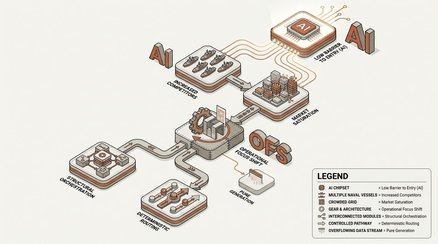
Faster execution alters expectations across business operations. Stakeholders expect rapid iterations, custom integration points, and high accuracy as default deliverables.
Maintaining an operational edge relies on two shifts:
- Market Saturation Response: Lower barriers to entry for routine copywriting increase competition, compressing the value of ungrounded generation.
- Deterministic Routing Shift: Prototype velocity forces teams to focus on system orchestration rather than manual text generation.
4. Workforce Implications
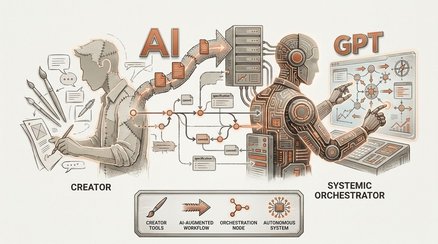
Workplace research indicates structural realignment in engineering and operations roles rather than aggregate employment decline (MIT Sloan Management Review). Routine clerical workflows transition to automation, elevating the role of architectural design.
Adapting engineering organizations requires three shifts:
- Systemic Orchestration: Individual contributors transition from manual coders to systemic orchestrators managing agentic workflows.
- Deterministic Oversight: Engineers govern autonomous execution paths and manage node boundaries rather than drafting intermediate artifacts.
- Business Alignment: Agent execution must conform to strict business logic and governance policies.
5. Practical Action for Leaders
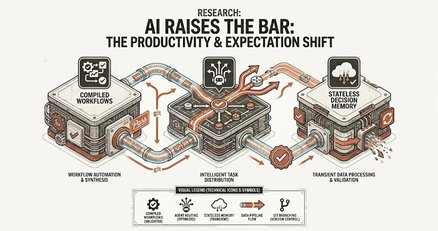
Managing this transition requires structured, specification-driven workflows.
Operationalising agentic architectures involves four core practices:
- Stateless Decision Memory: Design workflows where reasoning steps remain isolated, deterministic, and auditable.
- Compiled Workflows: Construct architectures where specialised agents handle distinct retrieval, synthesis, and verification nodes.
- Human-as-Router Paradigm: Focus engineering talent on defining system specifications and managing agent routing rules.
- Refined Evaluation Metrics: Evaluate systems based on error handling, latency, and grounded reasoning rather than raw token output.
Conclusion & Strategic Advice
The barrier to entry plummets, simultaneously driving the threshold for excellence to unprecedented heights. Selecting the right path requires treating generative models as integrated computational nodes within a broader multi-agent architecture .
Organisations must govern automation pilots through two primary strategic directives:
- Architectural Governance : Align automation pilots with structural systems engineering, prioritising use cases that augment governance over pure execution.
- Resilience Metrics : Evaluation metrics must shift from output quantity to the resilience of the underlying agentic systems.
Building on this operational foundation, we need to address the secondary effects of this technological acceleration in The Workload Paradox & Decision Fatigue.
💬 Are your AI initiatives trapped in the "prompting" phase, or are you actively building robust enterprise architectures? Drop your insights below and ♻️ share this post with your network to help them navigate the Wave 2 transition!
Further Reading
- Impact and Implications of Generative AI for Enterprise Architects in Agile Environments
- Stateless Decision Memory for Enterprise AI Agents
- OfficeQA Pro: An Enterprise Benchmark for End-to-End Grounded Reasoning
More From Me
- The AI Cost-Cutting Trap: Why "Same But Cheaper" is a $1 Trillion Fallacy
- The Hidden Perils of Cost-Cutting in AI: Safeguarding Expertise in a Knowledge Economy
- The Accountability Gap: Why Human Oversight Is a Business Imperative
- AI's Dual Shift: Escaping or Embracing the Chicago School of AI Efficiency
Original Article: Read on LinkedIn | Read on Substack